
What is AI search optimisation (AI SEO)? AI search optimisation is the practice of making your business visible inside AI-generated answers — not just Google search results. Tools like ChatGPT, Gemini, and Perplexity now answer questions directly, bypassing traditional links entirely. The two core disciplines are GEO (getting cited by AI platforms) and AEO (becoming the direct answer to a query).
Something has quietly changed about how Malaysians find information online — and most businesses have not noticed yet.
People are no longer just typing keywords into Google and clicking blue links. They are asking ChatGPT questions and reading the answer. They are seeing AI-generated summaries appear at the top of Google before any website is shown. They are using Perplexity and Gemini to research, compare, and decide who to hire.
This has created a new discipline every Malaysian business owner needs to understand: AI search optimisation.
How People Search in Malaysia Has Changed
Not long ago, ranking on the first page of Google was the primary goal of any digital marketing strategy. Get to page one, and the clicks followed. That logic still holds — but it is no longer the whole picture.
Google AI Overviews, the AI-generated summaries that now appear at the top of many search results, currently show up in roughly 20% of all Google searches globally. On queries involving comparisons, recommendations, or explanations — the kinds of searches Malaysian consumers make every day — that figure is significantly higher. According to Google’s own Search Central documentation, these summaries are designed to directly answer user queries, which means less need for users to click through to individual websites.
This is closely related to what Google first introduced as SGE, or Search Generative Experience. If you are not familiar with how that system works, our explainer on what SGE is and how it affects Malaysian search covers the mechanics in detail.
When an AI Overview appears, the search result beneath it loses an estimated 34% of its clicks, even if it holds the number one position. ChatGPT now processes over 800 million searches per week. These are no longer fringe tools — they are reshaping how Malaysian consumers find businesses and decide who to trust.
What GEO, AEO, and AI Search Optimisation Actually Mean
Three terms dominate this space, and they are often used interchangeably. Here is what each one means.
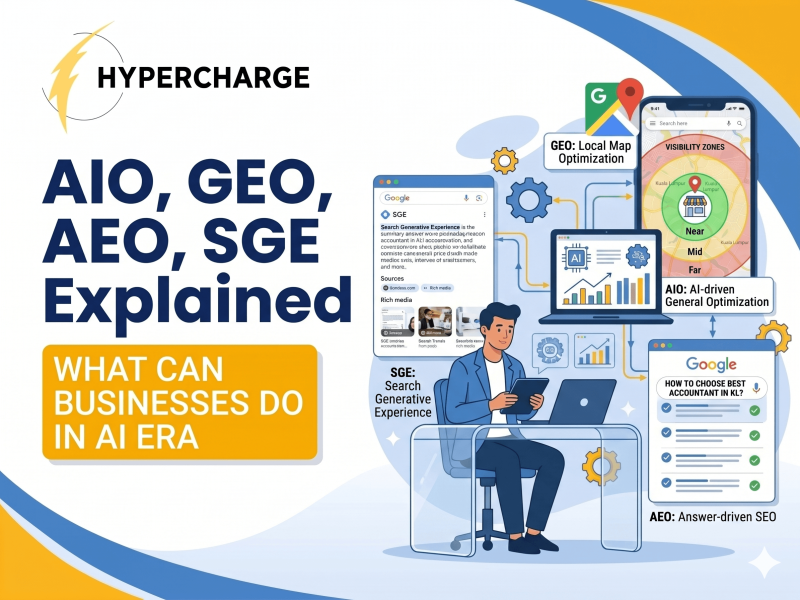
AI search optimisation is the umbrella term. It refers to the practice of making your business and its content visible, citable, and trusted by AI-powered search systems — not just traditional Google rankings.
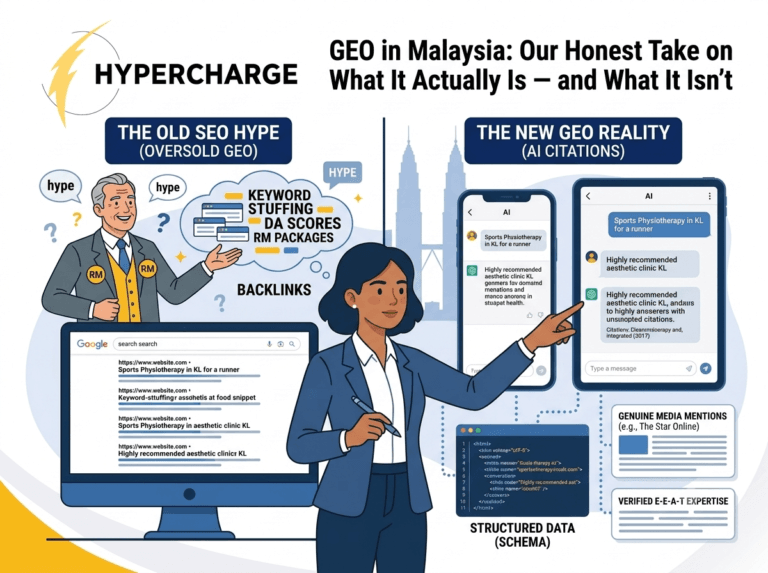
GEO, or Generative Engine Optimisation, is the specific discipline of optimising content so that platforms like ChatGPT, Google Gemini, and Perplexity cite or reference your business in their generated answers. The goal is not a ranking position — it is a citation inside a synthesised AI response. For a deeper look at how GEO connects with your Google Business Profile and local visibility, this guide on GEO and local search is worth reading alongside this article.
AEO, or Answer Engine Optimisation, focuses on structuring content so that AI systems — including Google’s featured snippets and AI Overviews, as well as voice assistants — select it as the direct answer to a user’s question. AEO is what makes a business the answer rather than just a search result.
Think of it this way: traditional SEO gets you found. GEO and AEO get you trusted enough to become the answer. These are not replacements for conventional SEO — they are the next layer built on top of it.
How AI Search Differs From Traditional Google Search
Traditional search engines rank pages. AI search engines synthesise answers.
When someone types a query into Google, they receive a list of relevant pages ranked by authority and relevance. The user clicks through to find what they need. When someone asks the same question to an AI search tool, the system reads multiple sources and produces a single coherent response — often without requiring a click at all.
This is the “zero-click” phenomenon, and it now accounts for more than 65% of desktop searches globally. The implications are significant: in the old model, appearing on page one guaranteed visibility. In the AI model, you either become a cited source or you are invisible to that user entirely.
This changes what “good content” means. AI systems do not reward keyword density or page length for its own sake. They reward content that is clear, structured, trustworthy, and directly answers the questions people are actually asking — using semantic understanding to evaluate whether a piece of content genuinely covers a topic, or just mentions the right words.
Why Malaysian SMEs Need to Care About This Now
Malaysia’s digital economy is expanding rapidly, with internet penetration exceeding 97% nationally. Urban Malaysians have adopted AI tools quickly, and according to projections from the Malaysian Digital Economy Corporation (MDEC), AI assistant usage among urban Malaysians is expected to rise by 45% by 2027.
More immediately: only 47% of businesses globally have any deliberate strategy for AI search visibility. That means more than half of your competitors are doing nothing about this yet. Research by Semrush found that visitors arriving through AI search convert at 4.4 times the rate of those from traditional organic search — meaning the traffic is smaller but significantly more qualified.
For businesses in high-trust industries — clinics, legal firms, financial advisers — the stakes are especially high. When a patient asks ChatGPT “what is the best dental clinic in Kuala Lumpur”, the AI draws on every available signal to decide whose name to surface. Businesses that have built deep, consistent content around their area of expertise hold a significant advantage. This is the same principle behind why topical authority outperforms keyword-by-keyword targeting in modern SEO — and it applies even more directly to AI search, where coverage and consistency are key signals of credibility.
What AI Search Optimisation Actually Involves
AI search optimisation is not a single tactic. It is a combination of content, technical, and authority-building strategies working together.
Content structure and clarity
AI systems favour content that is well-organised and answers questions directly. Lead with a clear answer in the opening paragraph, use descriptive headings, and include FAQ sections with genuine questions your customers ask. The goal is content that a machine can parse and extract just as easily as a human can read it.
Schema markup and structured data
Schema markup is code added to a website that tells search engines and AI systems exactly what the content is about. Pages with proper FAQPage, LocalBusiness, or Article schema show significantly higher visibility in AI-generated answers. It is one of the highest-impact improvements a Malaysian business can make, yet most local sites have none.
E-E-A-T signals
Google’s quality framework — Experience, Expertise, Authoritativeness, and Trustworthiness — applies equally to AI citation decisions. As outlined in Google’s quality evaluator guidelines, content attributed to named professionals with verifiable credentials is treated as significantly more trustworthy than anonymous content. For a practical breakdown of what this looks like, our guide on Google’s E-E-A-T framework covers the specific signals that matter most for Malaysian businesses.
Google Business Profile and local signals
For location-based businesses, the Google Business Profile remains a critical component of AI search visibility. When someone asks an AI tool for a service recommendation near them, profiles with complete, accurate, and regularly updated information consistently outperform incomplete ones. Reviews, business categories, and response rates all feed into how AI tools evaluate and surface local businesses.
Brand mentions and third-party authority
AI systems do not only read your website. They draw from review platforms, news mentions, community discussions, and professional directories. Businesses that appear consistently across trusted third-party sources give AI systems more material to draw from — and more reason to cite them.
How to Get Started
AI search optimisation can feel overwhelming when introduced all at once. The most effective starting point is simple: review your most important pages through the lens of a question.
Ask yourself: if a potential customer asked an AI assistant the core question my business answers, would my content be the clearest, most trustworthy response available?
If the honest answer is no, that is where to begin. Restructure one or two key pages with direct answers in the opening paragraph, add FAQ sections with real questions your clients ask, and ensure your Google Business Profile is complete and up to date.From there, a structured AI search optimisation strategy builds on these foundations — adding schema markup, deepening content clusters, and building the external trust signals that AI systems look for. The businesses that treat this as an ongoing discipline, starting now while competition is still low, are the ones most likely to hold strong positions as AI search continues to reshape how customers find businesses in Malaysia.
Frequently Asked Questions
No — but it builds on SEO. Traditional SEO focuses on ranking in Google’s search results. AI search optimisation (including GEO and AEO) focuses on being cited or referenced inside AI-generated answers from tools like ChatGPT, Gemini, and Perplexity. Strong SEO foundations make AI optimisation more effective, but the two require different content strategies.
Yes. In fact, smaller businesses often have an advantage because the competition for AI citations in local and niche categories is lower than in traditional search. A well-structured clinic or law firm website with clear content and strong local signals can appear in AI answers even without a massive SEO budget.
The simplest method is manual testing: search for the questions your customers typically ask across ChatGPT, Perplexity, and Google Gemini, and observe whether your business is mentioned. For more systematic tracking, Google Analytics 4 can capture AI referral traffic, and specialist platforms can monitor brand citation rates across AI engines.
Results vary depending on your current content quality and authority. Businesses that implement structural changes — schema markup, FAQ sections, improved content clarity — can begin seeing citation improvements within weeks. Building the deeper authority signals that drive consistent AI visibility typically takes three to six months of sustained effort.
No. Google still commands the vast majority of web traffic. As of late 2025, Google sends approximately 345 times more traffic to websites than ChatGPT, Gemini, and Perplexity combined. Traditional SEO remains essential. AI search optimisation is an additional layer on top of it, not a replacement.