
Every business owner in Malaysia with a website has received the message. Sometimes it arrives by email, sometimes through a LinkedIn connection request: “We noticed your website isn’t ranking on Google’s first page. We can fix that.” The pitch sounds identical whether it comes from a two-person outfit in Puchong or an established agency in KL Sentral — which is precisely the problem.
Choosing an SEO agency in Malaysia is harder than it looks, not because good agencies are rare, but because a bad one and a good one can sound exactly the same in a sales call. Both will promise rankings. Both will show you a dashboard. The difference only becomes visible six months and RM20,000 later.
This article breaks down what a competent SEO engagement should actually cover, the questions that separate serious agencies from retainer collectors, the warning signs that should end a conversation early, and what you can realistically expect to pay in the Malaysian market.
Why the Wrong Choice Costs More Than the Retainer
The most common outcome of a mismatched SEO engagement is not disaster — it is nothing. Twelve months of monthly reports showing keyword movements for terms nobody searches, traffic charts trending gently upward while enquiries stay flat, and a business owner who concludes that “SEO doesn’t work for us”.
The worse outcome is actual damage. Agencies that promise fast results have a strong incentive to use shortcuts — bulk-purchased backlinks, thin auto-generated pages, keyword-stuffed content — that can trigger Google penalties. Recovering from a manual action or an algorithmic devaluation takes far longer than doing things properly would have in the first place. Google’s own Search Central documentation on hiring an SEO warns explicitly against firms that guarantee rankings or claim a “special relationship” with Google — no such relationship exists.
There is also the quieter cost: opportunity. A year spent with the wrong agency is a year your competitors spent building the content, authority and local presence that you will now have to catch up on.
What a Complete SEO Scope Should Cover
A credible SEO proposal in Malaysia should address five areas. If one is missing, ask why — there may be a valid reason, but the agency should be able to articulate it.
Technical Foundations
Before any content is written, someone needs to confirm Google can actually crawl and index your site properly. That means site speed and Core Web Vitals, mobile usability, indexation health, structured data, and fixing broken links and redirect chains. For e-commerce and multi-language sites, this layer gets more complex — and more important.
Keyword Research and Content
This is where most of the long-term value sits. The agency should research what your customers actually search for — not what you assume they search for — and build content that matches that intent. In Malaysia, ask specifically whether they research Bahasa Malaysia and Mandarin keywords where relevant. A clinic in Kepong or a contractor serving Malay-majority suburbs leaves real traffic on the table with English-only research.
Local SEO
For any business with a physical location — clinics, law firms, restaurants, workshops — the Google map pack often matters more than the ordinary organic results. Local SEO covers your Google Business Profile, reviews strategy, local citations and location-specific pages. An agency pitching a brick-and-mortar business without mentioning local SEO has not thought about where your customers come from.
Authority Building
Backlinks remain a significant ranking factor, but the how matters enormously. Ask where links will come from. Placements on relevant, genuinely trafficked Malaysian and industry sites build authority; bulk packages of Web 2.0 links and private blog networks are the shortcut that gets sites penalised.
AI Search Visibility
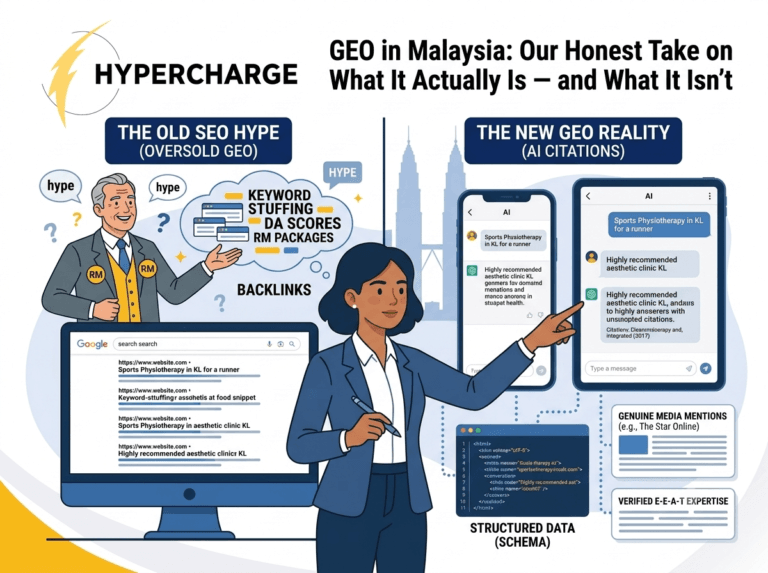
Search behaviour is shifting. Malaysians increasingly ask ChatGPT, Gemini and Perplexity the questions they once typed into Google, and AI Overviews now sit above traditional results. Forward-looking agencies track brand mentions in AI answers and structure content so it can be cited by these systems. This should not dominate a proposal — traditional search still drives the overwhelming majority of traffic — but an agency with no answer on AI search is behind the curve.
The Questions That Separate Serious Agencies From the Rest
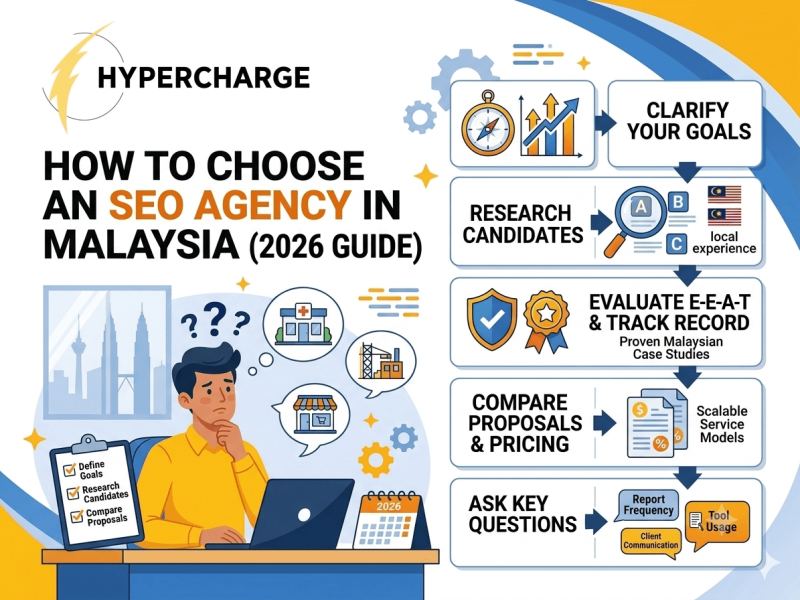
Once the scope looks complete, the vetting starts. Four questions do most of the work.
“Show me a case study from my industry — with numbers.” Anyone can claim results. A serious agency can show what it achieved for a comparable business: the starting point, the strategy, and outcomes measured in traffic, enquiries or revenue rather than vague “improved visibility”. Cross-check their reputation on third-party platforms like Clutch or Sortlist rather than relying on testimonials they curated themselves.
“What metrics will you report on, and how often?” The answer reveals the agency’s philosophy. Reporting built around keyword rankings alone measures activity, not outcomes. You want conversions, enquiries, and organic traffic to pages that matter — delivered monthly at minimum, ideally with a call to discuss what the numbers mean and what happens next.
“Who will actually work on my account?” The senior strategist in the sales meeting is not always the person doing the work. Ask whether content and link building are handled in-house or outsourced, and who your day-to-day contact will be. Neither answer is automatically wrong, but you should know before you sign.
“What do you need from me?” SEO is not fully hands-off. Good agencies will need you to approve content, supply subject-matter expertise, and sometimes give website access or development support. An agency that promises results with zero involvement from your side is usually planning to publish generic content you will never see.
Red Flags That Should End the Conversation
Some warning signs are reliable enough to act on immediately. Guaranteed number-one rankings — especially within 30 or 60 days — top the list, because no agency controls Google’s algorithm. Refusal to explain methods “because they’re proprietary” usually conceals tactics that would not survive scrutiny. Suspiciously cheap retainers — a few hundred ringgit a month — cannot fund real content and outreach; something is being faked or skipped.
Be equally wary of contracts with long lock-in periods and no performance checkpoints, reports you cannot understand and no one offers to explain, and agencies that never ask about your business goals before quoting a price. An SEO plan produced before anyone asks what a customer is worth to you is a template, not a strategy.
A guarantee is not always a dealbreaker, though. Some Malaysian agencies offer conditional guarantees — first-page rankings for a proportion of agreed keywords within 12 months, or fees refunded. The distinction is timeframe and specificity: a measured promise over a year is a confidence signal; a specific ranking in a month is fiction.
What SEO Actually Costs in Malaysia
SEO retainers in Malaysia typically range from around RM2,000 to over RM10,000 per month. Starter packages from established agencies generally sit between RM2,000 and RM2,500, mid-tier packages between RM3,000 and RM4,500, and enterprise or premium engagements from RM5,000 upward — with top-end agencies charging RM8,000 or more.
Price is driven by scope: industry competitiveness, keyword difficulty, website size, content volume, link building and whether you need local, national or multilingual targeting. A neighbourhood clinic targeting “klinik gigi Cheras” needs a very different budget from an e-commerce brand competing nationally.
The practical rule: match the retainer to the value of a customer. If a new client is worth RM5,000 to your firm, a RM3,000 monthly retainer that produces even two extra clients a month pays for itself. If a customer is worth RM50, the maths needs far more volume — and possibly a different marketing channel altogether.
Choosing With Confidence
The best SEO agency in Malaysia for your business is not the one with the most awards or the biggest client logos — it is the one whose scope covers what your business actually needs, whose case studies resemble your situation, and whose reporting you can read and challenge. That match matters more than any single credential.
Before you sign anything, sit with three shortlisted agencies, ask each the same four questions, and compare not just prices but the quality of the questions they ask you in return. The agencies that interrogate your business goals before quoting are the ones planning to be accountable to them. Take your time here — the cheapest month of SEO is the one you did not spend with the wrong partner. And if Hypercharge makes your shortlist, a free 30-minute consultation is the easiest way to put us through the same four questions.
FAQ
Meaningful movement typically takes three to six months, with compounding results from six to twelve months onward. Competitive industries and brand-new websites sit at the longer end. Any agency promising significant results in under 90 days is either targeting trivially easy keywords or overpromising.
Six- to twelve-month terms are common and not unreasonable, since SEO needs time to work. The red flag is a long lock-in with no performance checkpoints or exit clause. Some reputable agencies operate month-to-month — worth asking about if flexibility matters to you.
For most Malaysian SMEs, an agency is more cost-effective: a single experienced SEO hire can cost more than a mid-tier retainer, and SEO needs several skill sets — technical, content, outreach — rarely found in one person. In-house makes sense once SEO is central enough to justify a dedicated team.
Below roughly RM1,500 a month, be sceptical. Real SEO requires content production, technical work and outreach that cost money to deliver. Very cheap packages usually rely on automated reports, templated content or low-quality links — which at best do nothing and at worst attract penalties.
At minimum: organic traffic trends, conversions or enquiries attributed to organic search, keyword visibility for terms tied to your services, and a summary of work completed plus what is planned next. If a report only shows rankings, ask what business outcome those rankings produced.