
In Malaysia’s increasingly competitive search landscape, ranking is no longer just about inserting the right keywords into a page. Google wants to see whether your website demonstrates depth, structure, and authority around a topic.
That is where content silos come in.
A content silo is a deliberate way of organising your website so that related pages are grouped together by theme, intent, and business value. Done properly, silos make it easier for search engines to understand your expertise, and easier for users to move from research to enquiry.
For Malaysian SMEs, this matters even more in trust-sensitive industries such as private healthcare, legal services, finance, and professional consulting. If your site structure is messy, your expertise looks fragmented. If your expertise looks fragmented, your rankings and conversion rates usually suffer.
This is especially true for brands trying to build topical authority. A website that covers a topic comprehensively, and connects that content properly, has a much better chance of ranking than a site with isolated blog posts and weak internal linking.
In this guide, we’ll break down how content silos work, why they matter for Malaysian SEO, and how to structure them in a way that supports both search visibility and revenue generation.
What Are Content Silos in SEO?
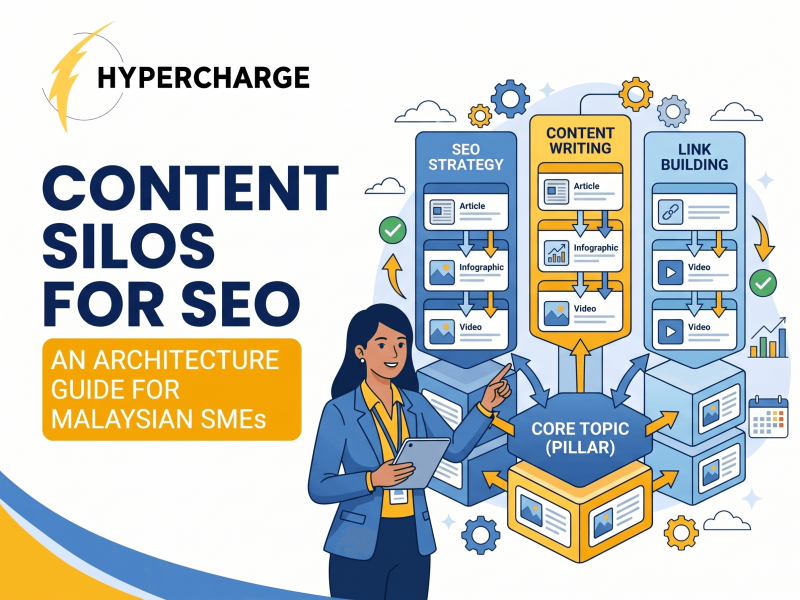
Content silos are a method of structuring website content into tightly related clusters. Each cluster focuses on one core topic, supported by subtopics that link back to a central pillar page and, where appropriate, to relevant service or conversion pages.
Think of it like a shopping mall directory.
If you walk into a mall and all the stores are randomly placed, it is frustrating and confusing. But if fashion stores are grouped together, food outlets are grouped together, and electronics are grouped together, navigation becomes intuitive. Search engines behave similarly. They want a website structure that is logical, predictable, and topically consistent.
A typical silo includes:
- a pillar page covering the main topic broadly
- several supporting pages addressing subtopics in depth
- internal links that reinforce the relationship between these pages
- clear pathways from informational content to commercial pages
For example, an SEO agency in Malaysia might build a silo like this:
- Pillar Page: SEO Guide for Malaysia
- Supporting Pages: keyword research, technical SEO, on-page SEO, local SEO, schema, internal linking
- Commercial Pages: SEO service, local SEO service, AI search optimisation service
This structure helps Google understand that the site is not just publishing random SEO articles. It is building genuine expertise around the subject.
Why Content Silos Matter for SEO in Malaysia
Malaysian businesses often operate in crowded SERPs where many companies offer similar services. In that environment, publishing more content is not enough. The content needs to be organised in a way that strengthens relevance and trust.
A siloed structure helps in several ways.
Stronger topical authority
When multiple pages on your site cover different angles of the same subject, and are internally linked in a meaningful way, search engines get a clearer signal that your site has depth. This supports rankings not only for the pillar page, but often for the entire topic cluster.
Better crawl efficiency
A well-structured site makes it easier for Googlebot to discover, crawl, and interpret content. This is particularly helpful for growing websites with service pages, blog content, category pages, and industry pages.
Improved user experience
Users should not need to guess what to read next. A silo helps guide visitors from general learning to more specific advice, then toward a service, consultation, or enquiry page.
Higher conversion potential
Good architecture is not just an SEO tactic. It is a commercial advantage. When users can move naturally from educational content to a relevant solution, lead generation improves.
For Malaysian SMEs, especially those targeting local search or trust-heavy services, this can directly influence revenue.
Why Silos Matter Even More for YMYL Websites
If you operate in a sector that affects a person’s finances, legal status, safety, or health, Google applies stricter standards. These are often referred to as YMYL topics: “Your Money or Your Life.”
Examples in Malaysia include:
- specialist clinics and private hospitals
- accounting and tax firms
- legal practices
- insurance and financial advisory brands
- property and compliance-focused services
In these sectors, website structure does more than improve rankings. It helps demonstrate credibility.
A healthcare clinic with scattered content on fertility, dermatology, and orthopaedics, all mixed into a generic blog feed, sends weak authority signals. But a clinic that groups its fertility-related content into one structured cluster sends a much stronger message: “We are credible on this subject.”
That aligns closely with Google’s E-E-A-T principles: Experience, Expertise, Authoritativeness, and Trustworthiness.
For Malaysian YMYL sites, strong silos can support E-E-A-T by making it easier to show:
- depth of subject expertise
- consistency of topic coverage
- author credentials
- supporting legal or medical references
- clear user journeys to trusted service pages
Physical vs Virtual Silos: Which Structure Should You Use?
There are two main ways to create a content silo.
| Silo Type | How It Works | Best Use Case |
| Physical silo | Uses URL structure to show hierarchy, such as domain.com/seo/technical-seo/ | Best for new sites or sites undergoing a planned rebuild |
| Virtual silo | Uses internal linking to establish topical relationships, regardless of URL path | Best for established WordPress sites that want to avoid large-scale URL changes |
Physical silo
A physical silo gives Google a very strong structural signal because the hierarchy is embedded in the URL itself. For example:
- /seo/
- /seo/on-page-seo/
- /seo/technical-seo/
- /seo/internal-linking/
This approach is clean, easy to scale, and helpful for both search engines and users. The downside is that changing to this structure later can require redirects, which introduces risk if not handled carefully.
Virtual silo
A virtual silo keeps existing URLs intact but uses a disciplined internal linking system to create topical groupings. This is often more practical for Malaysian SMEs already running live websites.
For example, even if your URLs are flat:
- /technical-seo-for-wordpress/
- /keyword-research-for-seo-a-malaysia-context/
- /onpage-seo-wordpress-malaysia/
you can still build a strong silo by linking them strategically to a pillar page like:
- /blog/seo-guide-for-malaysia/
For many businesses, virtual silos are the best first step because they improve structure without requiring a major migration.
The Revenue-First Role of Content Silos
Many articles about content silos stop at “help search engines understand your site better.” That is true, but incomplete.
A good silo should not just build rankings. It should help users move toward a business outcome.
That means your silo should be designed around:
- informational intent
- commercial investigation
- transactional intent
A common mistake is publishing top-of-funnel content with no meaningful bridge to bottom-of-funnel pages.
For example, someone searching for “how to choose a fertility clinic in Malaysia” is clearly researching a sensitive purchase decision. If they land on a useful educational page and the next internal links help them compare treatments, understand pricing, and then book a consultation, the content is doing its job.
If the page simply ends with unrelated blog suggestions, the opportunity is wasted.
A revenue-first silo connects:
- awareness content
- comparison and evaluation content
- service and conversion pages
That is where architecture starts influencing actual lead generation.
How Content Silos Support High-Intent SEO Traffic
Not all traffic is equally valuable.
A blog post that attracts broad educational traffic may help brand awareness, but it only becomes commercially meaningful when it contributes to a conversion journey.
A good silo lets you capture and nurture different types of searches:
Informational intent
Examples:
- what is RPGT in Malaysia
- IVF success rates Malaysia
- what is local SEO
These users are learning.
Commercial investigation
Examples:
- best conveyancing lawyer KL
- SEO agency Malaysia pricing
- IVF vs IUI cost Malaysia
These users are comparing options.
Transactional intent
Examples:
- hire SEO agency Malaysia
- book fertility consultation Kuala Lumpur
- tax advisory services for SMEs
These users are ready to take action.
Your site structure should help users flow from one stage to the next, instead of treating each page like an isolated asset.
Example: A Specialist Clinic Content Silo in Malaysia
Let’s say you run a fertility clinic in Kuala Lumpur.
A weak content strategy might produce disconnected articles such as:
- healthy foods for pregnancy
- IVF cost in Malaysia
- pregnancy supplements
- fertility doctor KL
There is content, but no structure.
A better silo would look like this:
Pillar page
Complete Guide to Fertility Treatments in Malaysia
Supporting pages
- IVF procedure in Malaysia
- IUI treatment costs and what to expect
- fertility testing before treatment
- fertility supplements and pre-conception health
- how to choose a fertility clinic in KL
Commercial pages
- fertility consultation booking page
- IVF treatment service page
- specialist doctor profile pages
Internal linking logic
- every supporting page links back to the pillar page
- the pillar page links out to all supporting pages
- relevant informational pages also link to appointment or consultation pages
- doctor profile pages reinforce E-E-A-T and trust
This creates a much clearer authority signal than random health blog posts, while also guiding users toward enquiry.
Example: A Legal Services Silo for a Malaysian Law Firm
Now take a law firm focused on conveyancing.
A strong silo might look like this:
Hub page
Conveyancing Law in Malaysia: Complete Guide for Property Buyers
Supporting pages
- RPGT explained
- stamp duty in Malaysia
- SPA process for first-time home buyers
- legal fees for property transfer
- strata title and land title differences
Conversion pages
- conveyancing legal services
- schedule a consultation
- office location pages for KL or JB
This structure helps Google understand the firm’s expertise in property law while creating a direct path from research queries to legal consultation.
It also prevents what many sites suffer from: content bleed. A page on RPGT should reinforce property-law authority, not send users into unrelated lifestyle or business content.
How to Build Trust Signals Inside Each Silo
For Malaysian YMYL industries, content structure alone is not enough. Each silo should also contain trust elements that strengthen credibility.
Include where relevant:
- author bylines with real credentials
- reviewer details for regulated topics
- references to Malaysian legislation, regulations, or official bodies
- last updated dates
- office location details
- contact and consultation pathways
- clear explanations of methodology, compliance, or editorial standards
For example:
- a legal article may reference the Housing Development Act
- a healthcare article may mention MOH-aligned terminology or specialist qualifications
- a finance page may reference BNM-related regulations where applicable
These details help both users and search engines trust the content.
Internal Linking: The Engine of a Silo
A silo is only as strong as its internal linking.
Publishing related pages is not enough. They need to be connected intentionally.
Best-practice linking pattern
- every spoke page should link back to the pillar
- the pillar should link to all major spoke pages
- related spoke pages can link sideways when the context is relevant
- informational pages should link to the best-fit service page when user intent is maturing
For example:
A page about “manual payroll mistakes” can link to:
- a broader payroll guide
- a comparison page on outsourced vs in-house payroll
- a payroll service page
That creates a clear progression instead of a dead-end article.
Use descriptive anchor text
Avoid vague anchors like:
- click here
- read more
- learn more
Use anchors that describe the destination topic, such as:
- internal linking strategy for SEO
- technical SEO checklist for WordPress
- local SEO services in Malaysia
This improves usability and strengthens topic association.
Avoid over-linking across unrelated silos
If every page links to everything else, your structure becomes muddy. Keep the majority of links within the topical cluster, and use cross-silo links only when there is a strong user reason.
Preventing Content Bleed
Content bleed happens when unrelated pages are excessively linked together, weakening your topical focus.
For example:
- a page about conveyancing links to a page about digital marketing trends
- a page about IVF costs links to a general lifestyle article
- a tax advisory page links to a generic company culture post
These links may seem harmless, but too many of them dilute the semantic clarity of your site.
A useful rule of thumb is this: most contextual links should stay within the parent topic cluster unless there is a clear benefit to the reader.
That does not mean silos must be isolated. It means cross-linking should be deliberate, not random.
URL Strategy for Malaysian SEO
Your URL structure should be clear, readable, and consistent with the topic hierarchy.
Good examples
- /seo/technical-seo-checklist-malaysia/
- /local-seo/google-business-profile-optimization/
- /healthcare/fertility-treatment-malaysia/
Weak examples
- /blog-post-32/
- /?p=456
- /category1/post-a/
A clean slug helps reinforce topical context and improves the chance that both users and search engines immediately understand the page.
English vs Bahasa Melayu URLs
For Malaysian SEO, the best choice depends on user intent.
- For B2B, professional services, and higher-value consulting, English URLs often make sense.
- For consumer-facing or government-related intent, Bahasa Melayu or bilingual architecture may perform better.
- For multilingual targeting, use separate language versions with proper hreflang implementation rather than mixing languages carelessly on one page.
Building Location-Based Silos for Multi-Area Businesses
If your business serves multiple cities or branches, you may also need location-based silos.
This is especially useful for:
- clinics
- legal firms
- service businesses
- consultants
- local SEO campaigns for multi-branch brands
Examples:
- /locations/kuala-lumpur/physiotherapy/
- /locations/penang/physiotherapy/
- /locations/johor-bahru/physiotherapy/
This helps you target location-specific intent without forcing one page to rank for every city.
It also improves local relevance for terms such as:
- physiotherapy KL
- dentist Penang
- lawyer JB
The important part is to avoid thin, duplicated city pages. Each location page should include genuine local relevance, such as branch details, service nuances, FAQs, testimonials, and area-specific trust signals.
Breadcrumbs, Taxonomy, and User Navigation
Breadcrumbs help users understand where they are in the site hierarchy, and they help search engines interpret structure.
For example:
Home > SEO > Technical SEO > Internal Linking Strategy
This reinforces relationships between pages and improves usability, especially for content-heavy websites.
Categories and taxonomies also matter. If your blog categories are too broad or inconsistent, your silo becomes weaker. Grouping content under clear themes makes it easier to maintain focus.
A strong taxonomy usually mirrors your business priorities, not just your publishing habits.
Why Content Silos Matter for AEO, GEO, and SGE
As AI-driven search evolves, site structure becomes even more important.
Search is shifting beyond blue links. Google’s AI experiences, answer engines, and LLM-powered discovery systems increasingly rely on content that is:
- well structured
- semantically clear
- topically deep
- easy to extract and connect
A siloed site is better positioned for this future because it helps machines understand the relationship between broad topics and supporting evidence.
If you want your brand to be cited or surfaced in AI-generated responses, your content cannot be scattered. It needs clear topical organisation.
This is particularly relevant for businesses investing in:
- AEO
- GEO
- SGE-focused content
- AI search optimisation
A pillar-and-cluster structure makes it easier for systems like Google Gemini or LLM-based search interfaces to interpret your authority on a subject.
Strengthening Silos with Schema Markup
Schema does not replace good architecture, but it strengthens it.
Within each silo, consider using the right structured data types where relevant:
- Article
- FAQPage
- LocalBusiness
- Service
- MedicalClinic
- LegalService
- Organization
- BreadcrumbList
For example, a fertility clinic silo may use:
- MedicalClinic schema on service/location pages
- FAQ schema on treatment explainers
- Breadcrumb schema across the hierarchy
This gives search engines more explicit clues about your business, services, and content relationships.
A 5-Phase Framework for Building Content Silos
Phase 1: Keyword mapping by business value and intent
Start with your revenue-driving topics. Identify the main commercial terms, then map supporting informational queries around them.
For example:
Core topic: SEO services Malaysia
Supporting queries:
- how SEO works
- SEO pricing in Malaysia
- how long SEO takes
- technical SEO checklist
- local SEO vs organic SEO
Your keyword map should reflect both topic depth and funnel stages.
Phase 2: Define your pillar pages
Each major business theme should have a central page. This is the page that broad, competitive terms are most likely to point toward.
A pillar page should:
- cover the topic comprehensively
- link to key supporting pages
- match the main commercial or strategic theme
- be substantial enough to deserve backlinks and internal prominence
Phase 3: Create or refine supporting content
Build supporting pages around subtopics, FAQs, comparisons, processes, and pain points. Each page should have a distinct purpose and not overlap heavily with the others.
This avoids cannibalisation while expanding topical coverage.
Phase 4: Deploy internal links strategically
Once the content exists, build the link architecture:
- spoke to pillar
- pillar to spoke
- spoke to relevant spoke
- informational to service page where intent fits
This is where many sites fall short. The content exists, but the relationships are never clearly established.
Phase 5: Measure and expand based on performance
Use Google Search Console and GA4 to evaluate:
- which pillar pages attract the most impressions
- which supporting pages gain clicks for long-tail terms
- which clusters assist conversions
- where users drop off before taking action
Then expand the best-performing silos with new supporting content.
Common Mistakes Malaysian SMEs Make with Content Silos
Publishing disconnected blog posts
Writing about many topics without a structured parent page usually produces weak topical signals.
Creating overlapping articles
If multiple pages target nearly the same intent, Google may struggle to know which one should rank.
Linking everything to everything
This creates noise instead of clarity.
Ignoring service-page connections
Informational content should support business outcomes, not exist in isolation.
Building location pages with thin content
For local SEO, every area page needs real value and differentiation.
Restructuring URLs too aggressively
If you already have rankings, a poorly executed physical silo migration can do more harm than good. In many cases, a virtual silo is the safer first move.
Final Thoughts: Structure Builds Authority, and Authority Builds Revenue
Content silos are not just an SEO framework. They are a way of turning your website into a clearer, more trustworthy, and more commercially effective asset.
For Malaysian SMEs, especially in competitive or regulated sectors, a strong silo structure helps search engines understand your expertise and helps users move through the buying journey with more confidence.
If your current website feels like a collection of pages rather than a system, that is usually the first sign that a silo strategy is needed.
The goal is simple:
- make your expertise obvious
- make navigation intuitive
- make internal links purposeful
- make commercial pathways natural
When you do that well, rankings improve. But more importantly, so does the quality of the traffic and the likelihood that traffic turns into enquiries.
FAQ About Content Silos for Malaysian Businesses
In many cases, search engines will start understanding the improved structure within a few weeks, especially if the pages are already indexed. More meaningful movement for competitive queries often takes several months, depending on your niche, site authority, and execution quality.
Yes. In fact, many Malaysian SMEs should begin with a virtual silo. This lets you improve internal linking and content relationships without changing URLs and risking existing rankings.
For newer websites, physical silos can work well because they create a clean foundation from the start. For established sites, virtual silos are often more practical and less risky.
Use the language your audience uses when searching with purchase intent. For many professional and B2B services, English works well. For broader local consumer demand, Bahasa Melayu or bilingual targeting may be the better route.
No. Even a site with 20 to 50 pages can benefit from better topical grouping and internal linking. In fact, smaller sites often see faster gains because structural improvements are easier to implement.