
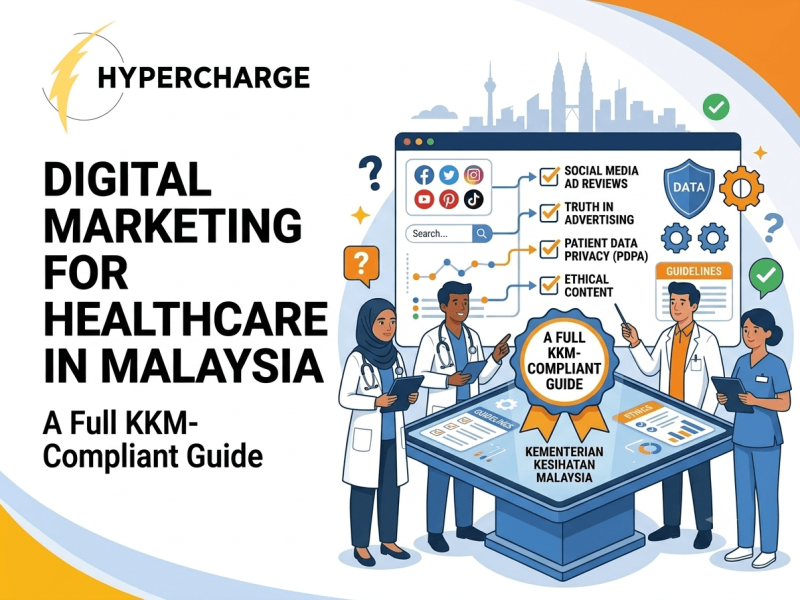
TLDR: Digital marketing for healthcare businesses in Malaysia requires higher trust standards than most industries. Google classifies medical content as YMYL — Your Money or Your Life — and applies elevated quality scrutiny to it. Malaysian clinics that succeed online combine a strong Google Business Profile, genuine patient reviews, E-E-A-T content with verified doctor credentials, local SEO for neighbourhood searches, and where appropriate, carefully managed Google Ads targeting high-intent treatment queries.
A patient in Cheras wakes up with a toothache on a Tuesday morning. She opens Google, types “dental clinic near me open now,” and within thirty seconds she’s reading reviews, checking a clinic’s opening hours on Google Maps, and looking at photos of the clinic interior before deciding whether to call.
She doesn’t visit the clinic’s website first. She doesn’t ask a friend. She Googles, evaluates the results using the signals visible in the search result itself — reviews, photos, hours, ratings — and makes a decision.
For Malaysian clinics and healthcare businesses, this is the new patient acquisition reality. The patients who need you most are already searching for you. Whether they find you — or your competitor — depends on how well your digital presence performs at the exact moment they look.
This guide covers every major digital channel relevant to Malaysian healthcare businesses — from GP clinics and dental practices to specialist centres and aesthetic clinics — with specific guidance on the trust and compliance standards that make healthcare digital marketing different from every other industry..
📌 Key Takeaways
- Google classifies healthcare content as YMYL (Your Money or Your Life) — meaning it applies higher quality and trust scrutiny to clinic websites than to most other business categories
- Google Business Profile is the single most important digital asset for Malaysian clinics — it determines whether patients find you in Maps searches before they ever visit your website
- Patient reviews are the most powerful conversion signal in Malaysian healthcare: clinics with 100+ reviews consistently outperform those with fewer, even when other factors are equal
- Healthcare SEO requires E-E-A-T signals — named doctors with verifiable credentials, accurate medical content, and demonstrated clinical expertise — not just keyword-optimised text
- Social media works best for treatment-specific clinics (aesthetic, dental, health screening) and as a retargeting tool via Meta Pixel — it is rarely effective as a primary acquisition channel for general GP clinics
- Malaysian healthcare advertising law is strict: paid digital ads need MAB approval and KKLIU numbers, before-and-after photos are prohibited, and “cure” claims for scheduled diseases like cancer and diabetes violate the Medicines (Advertisement and Sale) Act 1956
- WhatsApp is the primary communication and conversion channel for Malaysian patients — the quality and speed of WhatsApp responses is as important as any digital marketing channel
Why Healthcare Digital Marketing Is Different From Every Other Industry
If you’ve read general digital marketing advice and tried to apply it directly to a clinic context, you’ve probably noticed that some of it doesn’t quite fit. That’s because healthcare digital marketing operates under a layer of scrutiny — from Google, from regulators, and from patients themselves — that most other industries don’t face.
What YMYL Means for Malaysian Clinics
YMYL stands for “Your Money or Your Life” — Google’s internal classification for content types where inaccurate, misleading, or low-quality information could directly harm the reader. Healthcare is the clearest YMYL category: a patient who makes a health decision based on inaccurate information on a clinic’s website could suffer real consequences.
Because of this, according to Google’s quality guidelines for medical and health content, Google’s algorithm applies a higher quality threshold to healthcare pages than to most other content types. A general retail store can rank with thin, template-like content. A medical clinic website with the same approach will be outranked by competitors with authoritative, detailed, expert-verified content.
This is not a disadvantage for well-run clinics — it’s a barrier to entry that rewards genuine expertise. A dental practice whose website includes detailed procedure explanations, named dentist credentials, verified doctor profiles, and 80 genuine patient reviews is operating exactly as Google intends healthcare content to operate. The rankings reflect this.
The Malaysian Patient’s Digital Journey
Understanding how Malaysian patients actually find and choose a clinic shapes every digital marketing decision.
Stage 1 — Discovery: A patient experiences a symptom or need and searches on Google. Searches are often location-specific (“klinik gigi Bangsar,” “skin specialist near me KL”) or treatment-specific (“HIFU facial treatment Malaysia,” “root canal cost Malaysia”). Both types of search are entry points to a clinic’s digital presence.
Stage 2 — Evaluation: The patient evaluates the results using signals visible in the search result itself — primarily: review count and rating, clinic photos, opening hours, location proximity, and website quality if they click through. This evaluation happens in under a minute for many patients.
Stage 3 — Trust verification: Before committing, the patient often checks the clinic’s Google reviews in detail — reading recent reviews, checking responses, looking for reviews from patients with similar concerns. They may also visit the website to check for doctor credentials, treatment information, and pricing transparency.
Stage 4 — Contact: The patient contacts the clinic — almost always by WhatsApp or phone in Malaysia, rarely by email or online form. The speed and quality of this first response significantly affects whether the enquiry converts to a booked appointment.
Your digital marketing strategy should align with each of these stages: GBP handles discovery and evaluation, reviews handle trust verification, content handles treatment research, and WhatsApp handles conversion.
Channel 1 — Google Business Profile: The Most Important Asset for Any Clinic
For Malaysian clinics, Google Business Profile (GBP) is not one channel among many. It is the primary patient discovery mechanism — the listing that appears when a patient searches for your clinic type in your area, before they’ve visited your website and sometimes before they’ve even heard of you.
Why GBP Dominates Healthcare Discovery in Malaysia
When a patient searches “aesthetic clinic Petaling Jaya” or “dental clinic open Saturday Shah Alam,” Google’s local pack — the map with three listings — appears above all organic web results. These three positions are what most patients see first, evaluate, and click on. Position in the map pack is determined by your GBP’s quality, your review profile, and your proximity to the searcher.
A clinic with a complete, actively managed GBP and 80 genuine reviews will consistently outrank a competitor with a higher-end website but a sparse, inactive GBP listing. The patient doesn’t see the website first — they see the GBP listing. And a GBP listing is where most Malaysian healthcare search journeys either begin and continue, or begin and end if the listing isn’t compelling.
Healthcare-Specific GBP Optimisation
Standard GBP optimisation applies to clinics — complete business name, accurate category, consistent NAP, regular photos, active posting. But healthcare businesses have access to specific GBP features and face specific considerations that other businesses don’t.
Category selection matters acutely in healthcare. Google’s category library includes specific medical subtypes: Dentist, Orthodontist, Dermatologist, Aesthetic Medicine Physician, General Practitioner, Physiotherapist, and many more. Choosing the most specific accurate category — “Orthodontist” rather than “Dentist” if orthodontics is your primary service — directly affects which patient searches your listing is eligible to appear for.
According to Google’s guidance on Business Profiles for healthcare providers, healthcare businesses should use verified business categories, ensure services listed match actual offerings, and keep all information current — particularly hours, which patients rely on when making urgent care decisions.
Services listing in healthcare. Each treatment or service should be listed individually in your GBP services section. A dental clinic offering scaling, whitening, braces, implants, and veneers should list each as a separate service — not just “dental services.” Each service entry is an additional relevance signal that helps your listing appear for specific treatment searches.
Photos for healthcare. Clinic interior photos, reception area, consultation rooms, equipment, and team photos all build visual trust before a patient clicks. Before-and-after treatment photos (where MOH guidelines permit their use) are among the most compelling visual trust signals for aesthetic and dental clinics. Update photos regularly — a GBP with photos from 2022 signals stagnation to both patients and Google.
GBP posts for clinics. Weekly posts about services, health awareness topics, seasonal health concerns, or team introductions keep your profile active and give Google freshness signals. A post about “World Dental Health Day” or “signs you should see a dermatologist” demonstrates clinic engagement without requiring a clinical claim.
Channel 2 — Patient Reviews: The Trust Signal That Converts
In Malaysian healthcare, reviews are not a nice-to-have. They are the primary conversion signal that transforms a search result impression into a booked appointment.
How Reviews Affect Clinic Rankings and Conversions
The relationship between reviews and healthcare digital marketing performance works on two levels simultaneously.
At the ranking level: Google’s local algorithm uses review count, recency, and rating as signals of business prominence. Two clinics with identical GBP completeness will be ranked differently based on their reviews — the clinic with 120 reviews at 4.7 outranks the one with 30 reviews at 4.9 in most competitive categories because volume signals broader validation.
At the conversion level: A patient who finds your clinic in Google Maps reads your reviews before deciding whether to call. For a dentist, aesthetic clinic, or specialist — categories where patients feel vulnerable and are making significant decisions about their health and money — the reviews are the primary trust signal that bridges discovery and appointment. A clinic with 15 reviews and a 4.8 rating will consistently lose enquiries to a competitor with 90 reviews and a 4.6 rating, because volume matters to patient confidence more than a fraction of a rating point.
Getting Reviews Ethically in a Healthcare Context
Healthcare review collection requires specific care. Patient experiences are personal and sometimes sensitive — the pressure to leave a review should never feel inappropriate in a clinical setting.
The most effective and ethical approach for Malaysian clinics: send a follow-up WhatsApp message 24 to 48 hours after a patient’s appointment. “Thank you for visiting us yesterday — we hope you’re feeling well. If you have a moment, your feedback on Google would mean a lot to us” with a direct link to your Google review page. This approach reaches patients when their experience is fresh and doesn’t create pressure in the clinical environment.
For detailed guidance on the specific tactics that work for Malaysian healthcare businesses, our guide on getting Google reviews for clinics covers the full process including what to say, when to ask, and how to handle responses.
Never incentivise reviews with discounts, free services, or any form of benefit — this violates Google’s review policies and in a healthcare context creates additional ethical concerns around influencing patient testimony.
Channel 3 — SEO and Content Strategy for Clinics
E-E-A-T: The Content Standard Google Holds Healthcare To
For healthcare content to rank in Malaysia, it must demonstrate Experience, Expertise, Authoritativeness, and Trustworthiness — the four signals that Google’s E-E-A-T framework uses to evaluate whether content is fit to appear in healthcare search results.
What this means in practical terms for Malaysian clinics:
Named, credentialed doctors. Generic healthcare content that isn’t attributed to a specific, verifiable medical professional is a trust signal weakness. A page about aesthetic treatments authored by “the team at [Clinic Name]” carries less weight than the same page authored by “Dr. [Name], MBBS, Aesthetic Medicine Practitioner, registered with the Malaysian Medical Council.” The author’s credentials should be verifiable — a bio page linking to their MMC registration, their academic credentials, and their professional experience.
Accurate, up-to-date clinical information. Healthcare content that is factually incorrect, outdated, or makes unsubstantiated claims about treatment outcomes is penalised by Google’s quality evaluation systems. Every factual medical claim on your website should be accurate and, where possible, supported by reference to established medical guidelines.
Demonstrated clinical experience. Content that shows real patient outcomes — before-and-after images, case descriptions, treatment narratives — demonstrates that the clinic has genuine clinical experience rather than just generic marketing copy. This is one of the strongest E-E-A-T signals available to Malaysian healthcare businesses.
Transparent business information. Clinic address, operating hours, doctor names, contact details, and registration numbers all contribute to trustworthiness signals. Visitors to a healthcare website should never have to wonder whether the business is legitimate.
The Content Types That Work for Malaysian Clinics
Healthcare content in Malaysia performs best when it answers the specific questions patients are searching for before they visit a clinic. The highest-performing content types:
Treatment explanation pages. For each service the clinic offers, a dedicated page explaining what the treatment is, what it involves, who it’s suitable for, what results to expect, and what recovery looks like. These pages rank for specific treatment queries and convert visitors who are already researching that treatment — a highly commercial intent.
Cost and pricing content. “How much does [treatment] cost in Malaysia?” is among the most searched healthcare queries on Google. Transparent pricing content — even if it’s a range rather than a fixed price — builds trust and captures patients in the active research phase. Clinics that avoid pricing transparency in their content lose these searches to competitors willing to address the question directly.
Condition and symptom content. Articles addressing common conditions relevant to the clinic’s specialty — “signs you may need a root canal,” “what causes adult acne,” “when should you see a physiotherapist for back pain” — capture early-stage patients who are not yet searching for a specific clinic but are researching their symptoms. These informational articles build authority, drive traffic, and create familiarity with the clinic before the patient reaches the booking decision.
Doctor profile pages. Individual pages for each doctor — with photo, credentials, specialty areas, educational background, and professional experience — are both E-E-A-T signals and conversion assets. Many Malaysian patients specifically research the doctor they’ll be seeing before their appointment.
The healthcare SEO case that most clearly demonstrates what quality content execution produces at scale in Malaysia is HE Medical Clinic — a men’s health clinic whose structured content strategy, E-E-A-T implementation, and local SEO produced approximately 2,000 organic leads per month across its locations.
Local SEO for Multi-Location Clinic Groups
For clinic groups operating across multiple locations in Malaysia, local SEO strategy extends beyond a single GBP and website. Each location requires:
- Its own Google Business Profile, separately verified, with location-specific information
- A dedicated location page on the clinic group’s website targeting that neighbourhood’s specific search terms
- Location-specific review collection — reviews on the Shah Alam GBP need to come from Shah Alam patients, not consolidated to a single clinic profile
Schema markup — specifically MedicalOrganization and Physician schema — further strengthens each location’s entity signals and helps Google correctly associate each branch with its respective geographic area.
Channel 4 — Google Ads for Healthcare
When Healthcare Businesses Should Run Google Ads
Google Ads is appropriate for Malaysian healthcare businesses from Phase B onward — when the offer is validated, the website converts, and the clinic has enough reviews to support the trust signals that paid traffic needs to convert.
The high-intent nature of healthcare searches makes Google Ads particularly effective in this sector. A patient searching “dental implants cost KL” or “aesthetic clinic Bangsar” is often at the decision stage — ready to book, comparing specific options. Appearing at the top of those results through a paid listing, combined with a strong organic presence and GBP listing, maximises visibility at the most valuable moment in the patient journey.
What Makes a Healthcare Google Ads Campaign Work in Malaysia
Keyword specificity matters enormously. Broad healthcare keywords (“dental clinic Malaysia”) generate high spend and low-quality traffic. Specific treatment + location combinations (“dental implants Petaling Jaya,” “HIFU treatment Bangsar”) produce smaller traffic volumes but dramatically higher conversion rates because the searcher intent is precise.
Landing page alignment. A patient who clicks an ad for “root canal Subang Jaya” should land on a page specifically about root canal treatment, with the clinic’s Subang Jaya details, pricing context, doctor credentials, and a clear WhatsApp or booking CTA. Sending all healthcare ad traffic to a generic homepage is one of the most common reasons Malaysian clinic Google Ads campaigns generate clicks without appointments.
Healthcare advertising compliance. Malaysia’s Ministry of Health has specific guidelines governing healthcare advertising — including restrictions on certain types of claims, before-and-after imagery in some treatment categories, and requirements around advertising regulated healthcare services. Clinics must ensure their Google Ads copy, landing pages, and promotional materials comply with these guidelines. Google also maintains its own healthcare advertising policies that apply to Malaysian advertisers.
Channel 5 — WhatsApp as a Patient Acquisition and Retention Tool
WhatsApp is where Malaysian patient conversions happen. Not forms, not email, not phone calls for most patients — WhatsApp.
The digital marketing work — GBP, SEO, paid ads — drives patients to the point of contact. At that point, the quality and speed of the WhatsApp response determines whether the enquiry becomes an appointment.
For Malaysian healthcare businesses, WhatsApp represents a specific set of priorities:
Response speed. A patient who messaged a clinic at 9am and hasn’t heard back by 11am has almost certainly contacted another clinic in the meantime. In healthcare, where the decision is often driven by pain, concern, or urgency, a two-hour response window loses patients. WhatsApp Business auto-replies — acknowledging the message and setting a specific response expectation — reduce the perception of delay and keep enquiries warm.
Information quality. The first response to a healthcare enquiry should be informative, professional, and reassuring — not just “please call us.” Answering the question the patient asked (what’s the price range for X, is this treatment suitable for Y, do you accept Z insurance) in the WhatsApp message itself demonstrates competence and builds the trust that moves the patient toward booking.
Follow-up systems. Many patient enquiries don’t convert on the first contact — the patient is comparing options, thinking it over, or waiting for a specific timeframe. A structured follow-up — a WhatsApp message three days after the initial enquiry, a reminder about a promotional package, a seasonal health reminder — captures patients who didn’t convert immediately. Most Malaysian clinics have no follow-up system, which means lost appointments that a simple process would have recovered.
Channel 6 — Social Media: Where It Fits (and Where It Doesn’t) in Healthcare
Social media is where many Malaysian clinic owners start their digital marketing journey — and often where they spend the most time for the least measurable return. That’s not because social media doesn’t work in healthcare. It’s because it works for a specific purpose that differs fundamentally from what Google does.
Social Media vs Google: An Honest Comparison for Clinics
Google captures demand that already exists. When a patient searches “dental implant Bangsar,” they’ve already decided they want to explore the treatment. Your GBP or search result reaches them at the highest-intent point in their journey.
Social media creates awareness before demand exists. A patient who sees a TikTok video about Invisalign wasn’t searching for orthodontic treatment — but the content planted the idea. That’s a fundamentally different moment in the buying journey, and it requires a different conversion mechanism and a longer timeline to produce enquiries.
For general GP clinics, social media is rarely a strong primary acquisition channel. Patients don’t browse Facebook to find a GP — they search Google when they need one. A general clinic’s social media effort is better directed at patient retention and community presence than at new patient acquisition.
For treatment-specific clinics — dental practices pushing Invisalign or implants, aesthetic clinics promoting skin rejuvenation programmes, specialist centres offering health screening packages — social media can drive targeted awareness and treatment consideration among a specific demographic before they begin their Google search. The patient sees a video, gets interested, later searches for more information, and finds your clinic through Google. The social content initiated the journey; Google captured the intent.
When Social Media Works for Malaysian Healthcare Businesses
Social media is most effective in healthcare when it’s used for one of two specific purposes:
Creating treatment awareness for elective or planned procedures. Health screening packages, aesthetic treatments, dental procedures like whitening or veneers, and preventive wellness services are all categories where patients need to be introduced to the idea before they’ll search for it. A reel featuring a doctor explaining what a health screening package includes — and why 35-year-olds should consider one annually — reaches an audience that wasn’t yet looking but may soon be.
Retargeting warm audiences with Meta Pixel. Once a Meta Pixel is installed on your clinic’s website, Facebook and Instagram can show ads specifically to people who have already visited your website, viewed a specific treatment page, or clicked your WhatsApp button without converting. These retargeting audiences are dramatically warmer than cold social audiences — they’ve already shown intent — and they convert at significantly higher rates. Retargeting ad spend in healthcare is typically far more cost-effective than cold audience campaigns because you’re re-engaging people who were already considering your clinic.
Educational Content That Builds Patient Trust
The most effective social media content for Malaysian healthcare businesses is educational — content that provides genuine clinical value, positions the doctor or clinic as a credible authority, and builds patient trust before the booking decision.
Short-form video consistently outperforms static images in engagement and reach across TikTok, Instagram Reels, and Facebook. The formats that work specifically well for Malaysian healthcare:
Doctor FAQ videos. Sixty to ninety-second clips featuring a named doctor answering questions patients commonly ask — “is teeth whitening safe?”, “what’s the difference between HIFU and Thermage?”, “when should I see a dermatologist for acne?” — build trust in the individual practitioner, demonstrate genuine expertise, and give patients a sense of familiarity before they visit. A patient who has watched three videos by Dr. X is significantly more comfortable booking an appointment with Dr. X than with an unnamed “experienced team.”
Health myth debunking. Malaysian social media audiences engage strongly with content that challenges common health misconceptions — “no, drinking cold water doesn’t cause cancer,” “here’s what actually causes bad breath,” “this popular supplement doesn’t do what you think it does.” This content travels well through shares and saves, extending the clinic’s reach beyond its existing followers.
Behind-the-scenes clinic content. Short, compliant glimpses of your clinic — the consultation room, the equipment, the team preparing for the day — reduce the anxiety many Malaysian patients feel before visiting a new clinic for the first time. Familiarity with the physical space and the faces they’ll meet lowers the psychological barrier to making that first appointment.
All social content must be produced and reviewed against the compliance framework covered in the next section — because even educational content on social media falls under Malaysia’s healthcare advertising regulations if it promotes a treatment or service.
Using Meta Pixel for Healthcare Retargeting
Installing Meta Pixel on your clinic’s website is one of the highest-ROI technical decisions a Malaysian healthcare business can make for social media. The Pixel tracks website visitors and enables you to:
- Show ads exclusively to people who visited your Invisalign page but didn’t WhatsApp you
- Re-engage visitors who viewed your health screening page in the last 30 days
- Create lookalike audiences modelled on your existing patient base
- Exclude existing patients from new-patient acquisition campaigns
In a PDPA (Personal Data Protection Act) compliant implementation, the Pixel collects behavioural data without collecting personally identifiable information. Clinics should ensure their website’s privacy policy discloses the use of tracking pixels and gives visitors the option to opt out — a standard compliance requirement that most Malaysian clinic websites currently don’t address.
The Regulatory Framework: What Every Malaysian Clinic Must Know Before Publishing a Single Ad
Healthcare digital marketing in Malaysia operates within a specific legal and professional framework that does not apply to most other industries. Ignorance of these rules is not a defence — violations can result in fines, licence revocation, or disciplinary action from professional boards. Every clinic engaging in digital marketing must understand the following before any campaign, post, or piece of content goes live.
MAB Approval and KKLIU Registration Numbers
Any digital advertisement — including paid Facebook Ads, Instagram Ads, Google Ads, TikTok Ads, or sponsored content — that makes claims about a treatment, service, or health outcome must be approved by the Medicine Advertisements Board (MAB) before it is published.
MAB approval certificates are valid for three calendar years unless otherwise specified. Approved advertisements are issued a KKLIU registration number, which must be clearly displayed on every digital page or advertisement that has received MAB approval — including individual web pages, online ads, and social media promotional posts.
According to Malaysia’s MAB Guideline on Advertising of Medicines and Medicinal Products to General Public, the name, address, and contact number of the advertiser must also be clearly stated alongside the KKLIU number on any approved internet advertisement.
The practical implication: allow sufficient lead time before campaign launches to obtain MAB approval. Running a campaign without a valid KKLIU number — even for a few days while approval is pending — is non-compliant. If your agency or marketing team launches campaigns before approval is granted, the regulatory risk rests with the clinic as the registered business entity.
Content Restrictions You Cannot Ignore
Malaysian healthcare advertising law imposes specific content prohibitions that many clinics — and many digital marketing agencies — are unaware of. These apply across all platforms: website copy, blog articles, social media posts, paid advertisements, and any other public-facing content.
Before-and-after photographs and claims are prohibited. Under the MAB guidelines, advertisements must not contain improper, exaggerated, or misleading claims or visual representations showing changes in the human body. Visual “before and after” comparisons showing treatment outcomes are prohibited for medical advertising in Malaysia. This applies across all digital platforms. Clinics uncertain about their specific treatment category should obtain written guidance from their professional council before using any comparative imagery.
Scheduled diseases — no prevention, treatment, or cure claims. Under the Medicines (Advertisement and Sale) Act 1956, it is illegal to claim that any product or service can prevent, treat, alleviate, cure, or diagnose any of the following 20 scheduled conditions:
Diseases or defects of the kidney, diseases or defects of the heart, diabetes, epilepsy or fits, paralysis, tuberculosis, asthma, leprosy, cancer, deafness, drug addiction, hernia or rupture, diseases of the eye, hypertension, mental conditions, infertility, frigidity, impairment of the sexual function or impotency, venereal disease, and nervous debility or complaint arising from or relating to sexual intercourse.
Any content — website copy, blog articles, social media posts, or paid ads — that implies a clinic’s services treat or cure any of these conditions violates this Act. Even indirect or implied claims are considered violations. A clinic that treats diabetic patients cannot claim online that it “treats” or “manages” diabetes without specific MAB approval.
Prohibited superlatives and terms. The MAB guidelines explicitly prohibit a range of words and phrases in healthcare advertising. These include: “guaranteed,” “best,” “no side effects,” “No. 1” (unless independently substantiated), “miracle” or “magical,” “instant cure,” “anti-aging,” “superior,” “excellent,” “unique,” “world’s best,” and any other superlatives implying product or service superiority. Clinics should review all existing website copy and social media content against this list — many clinic websites currently contain multiple violations they are unaware of.
No comparative claims against competitors. Direct or implied comparisons that disparage another clinic or practitioner are prohibited. You cannot claim to be “better than” or “unlike other clinics” in a way that identifies or disparages a competitor.
No claims implying professional endorsement from white-coat imagery. Advertisements should not use visual or audio presentations of doctors, dentists, or other healthcare professionals in a way that gives the impression of professional or scientific recommendation for a product or service — unless that professional is the registered practitioner providing the service being advertised.
Disease Awareness and Health Education — The Permitted Exception
Not all health-related content requires MAB approval. The MAB guidelines explicitly encourage disease awareness and health education campaigns — content that informs the public about health conditions, preventive care, and where to seek professional advice — provided the content does not promote a specific product or treatment by name.
This is the compliance-safe lane for educational social media content. A video explaining “five signs you should see a dermatologist” that doesn’t name or promote a specific treatment or product is health education, not advertising. A blog post about “why regular dental check-ups matter” that doesn’t name specific services is permissible without MAB approval.
The test: if the content promotes patient understanding of a health topic without directing them toward a specific named treatment, product, or clinic service, it typically falls under health education rather than advertising. The moment it names a specific treatment, service, or makes an outcome claim, it requires MAB approval.
This is why many Malaysian clinics build their social media strategy around educational content specifically — it builds authority, drives engagement, and reaches potential patients without triggering the approval process that advertising content requires.
Testimonial and Review Compliance
Testimonials in Malaysian healthcare advertising are subject to specific restrictions governed by both the MAB guidelines and the PDPA.
Paid or incentivised clinical testimonials are prohibited. Any testimonial where the individual received monetary payment, discounts, free services, or any other benefit in exchange for providing an endorsement of clinical outcomes violates MAB guidelines. This applies to influencer partnerships, KOL collaborations, and any arrangement where a patient or public figure receives compensation for promoting treatment outcomes.
Testimonials in advertising must include specific disclosures. Where testimonials are used in approved advertising, the MAB requires a statement that: “The effect of the product may vary among individuals.” Testimonials must be from genuinely existing individuals who are accountable to the advertisement.
Consent requirements. Any testimonial published in advertising content must be supported by a written consent letter from the individual that includes their name, IC or passport number, signature, and contact number. Without this documented consent, using a patient’s testimonial — even a genuinely positive one — in marketing materials violates both MAB guidelines and PDPA requirements.
Experience of care vs clinical outcome claims. Patients may share their experience of care — clinic cleanliness, staff professionalism, waiting times, service quality — provided explicit PDPA consent has been obtained. This is the basis on which Google reviews are permissible. A patient saying “the clinic was clean, the staff were professional, and I felt comfortable” is permissible experience-of-care testimony with proper consent. A patient saying “the treatment worked perfectly for my condition” constitutes a clinical outcome testimonial that is subject to the restrictions above.
Google reviews are user-generated content on a third-party platform — not clinic-controlled advertising. They are therefore governed differently. However, reproducing or screenshotting Google reviews that contain clinical outcome claims and republishing them in marketing materials crosses into regulated advertising use and requires the appropriate consent and disclosure.
Governing Councils by Profession
Beyond the MAB guidelines, healthcare practitioners must follow the specific advertising and public information standards of their professional council. The MAB Advertising Guidelines for Healthcare Facilities and Services govern the advertising of clinic and hospital services specifically — distinct from the medicines guidelines — and apply to any promotional content about a healthcare facility’s services, facilities, or capabilities.
Medical practitioners — must comply with Malaysian Medical Council (MMC) guidelines on advertising and public information. The MMC’s code of professional conduct governs how doctors may present their qualifications, services, and outcomes in any public-facing context.
Dental practitioners — must follow Malaysian Dental Council (MDC) guidelines and provisions for public information. The MDC has specific standards for how dental services may be promoted, including restrictions on promotional language and claims about service outcomes.
Pharmacists — must adhere to the guidelines of the Pharmacy Board Malaysia and the MAB guidelines on medicine advertising, which govern how pharmacy products and health supplements may be promoted.
Practitioners who are unsure whether a specific piece of digital marketing content complies with their council’s guidelines should seek guidance from their professional association or a healthcare compliance adviser before publishing.
A Practical Compliance Checklist for Malaysian Healthcare Marketing
Before any piece of digital content is published — paid or organic — run it through this checklist:
| Check | Requirement |
| Treatment or service claims? | MAB approval + KKLIU number required |
| Before-and-after imagery? | Prohibited for medical advertising |
| Superlative language? | Remove — “best,” “guaranteed,” “No. 1” all prohibited |
| Scheduled disease claim? | Prohibited without specific MAB approval |
| Testimonial used? | Written consent + “effect may vary” disclaimer required |
| Educational content only? | Permissible without MAB approval if no product/treatment named |
| Doctor in white coat recommending a product? | Prohibited unless governed practitioner advertising own service |
| KKLIU displayed on approved ad? | Mandatory on every approved digital page/ad |
The practical advice for Malaysian healthcare businesses: involve a compliance-aware professional or agency in your digital marketing strategy from the outset. Penalties for non-compliance extend beyond regulatory fines — they include reputational damage that is particularly costly in a trust-sensitive industry where patient confidence is your most valuable asset.
The Patient Acquisition Funnel for Malaysian Clinics
Bringing all the channels together, this is how a well-designed healthcare digital marketing system converts a stranger into a patient.
Discovery (GBP + Local SEO): A patient searches for a treatment or symptom on Google. Your clinic appears in the Maps local pack and in organic results — because your GBP is optimised, your reviews are strong, and your location-specific content is indexed.
Evaluation (GBP profile + reviews): The patient reads your reviews, looks at your clinic photos, checks your hours and services. This happens in under a minute. A strong GBP profile with 80+ reviews and recent photos passes this evaluation. A sparse profile with 12 reviews and stock photos may not.
Research (website content): The patient clicks through to your website to learn more — about the specific treatment, the cost, the doctor. E-E-A-T content answers these questions clearly. Doctor profiles establish credibility. Before-and-after results (where guidelines permit) demonstrate outcomes.
Trust verification (reviews in detail): The patient reads three to five reviews in detail — looking for patients with similar concerns, checking how the clinic handled complaints, assessing whether the reviews feel genuine. A mix of detailed, genuine reviews from real patients is more persuasive than 50 one-sentence five-star ratings.
Contact (WhatsApp): The patient taps the WhatsApp button on your GBP or website. A fast, informative, professional response converts the enquiry into a booking.
Retention (review request + follow-up): After a successful appointment, a WhatsApp follow-up requests a review and opens the door for future appointments. Each positive review improves the cycle for the next patient.
This is why local SEO for healthcare businesses is not one channel among many — it’s the architecture that makes the entire patient acquisition funnel function. Every other element amplifies what local search visibility initiates.
Frequently Asked Questions
For Phase A clinics just establishing a local presence, a GBP alone can generate patient enquiries — particularly for general practice and dental clinics in lower-competition areas. As competition increases and treatment complexity grows, a website becomes essential. Specialist clinics, multi-location groups, and any clinic running Google Ads needs a website — the GBP is the discovery mechanism, but the website is where detailed evaluation and trust-building happens.
Before-and-after photographs are prohibited for medical practice advertising in Malaysia under the MAB guidelines — this is an absolute restriction, not a conditional one. The prohibition applies to websites, social media, paid advertising, and any other marketing material regardless of platform. Clinics currently using before-and-after imagery in advertising should treat this as an immediate compliance issue and remove such content. The restriction applies to advertising materials; clinical documentation and patient records used for internal consultation purposes are governed separately under clinical regulations. Clinics uncertain about their specific situation — particularly aesthetic clinics that have traditionally relied on visual outcome evidence — should consult with a compliance adviser familiar with both the MAB guidelines and their relevant governing council’s standards before resuming any visual outcome marketing.
GBP optimisation and review collection can produce measurable results — increased Maps visibility, more direction requests, more phone calls — within 60 to 90 days. SEO content takes 6 to 12 months to produce consistent organic traffic and lead volume. Google Ads can produce enquiries within days of launching, but requires a website that converts and a validated campaign structure to be cost-effective. Most clinics see the fastest ROI from combining GBP work and review collection first, then adding content and paid channels as the foundation matures.
For high-intent treatment searches where your clinic ranks organically in positions 3 to 5 but a competitor occupies positions 1 to 2, paid ads allow you to appear above that competitor for the highest-converting queries. For searches where you already rank organically in positions 1 to 2, the incremental value of paid ads on the same queries is lower — budget is often better directed to keywords where organic hasn’t yet achieved top positions. The most effective healthcare paid search strategies target specific high-value treatments where competition is strong and organic ranking is still developing.
It depends heavily on the clinic’s location and patient community. A clinic in a predominantly Malay-speaking area — government-adjacent areas, suburban communities outside Klang Valley — will miss a significant share of searches without Bahasa Malaysia content. A clinic in a predominantly Chinese-speaking area like Kepong or Cheras benefits more from Mandarin-language content. Urban KL clinics serving a mixed demographic benefit from both. At minimum, ensuring your GBP description and services naturally include Malay terms alongside English (reflecting how Malaysian patients actually search) is a low-effort improvement with meaningful local search impact.
Read This Next
Healthcare is one of the highest-intent local search categories in Malaysia — but the same digital marketing principles that work for clinics apply to any Malaysian SME trying to grow revenue through digital channels. The next article covers the broader revenue growth question that most SME owners are really asking.
👉 How to Increase Revenue for Your Small Business in Malaysia Through Digital Marketing The specific digital marketing actions that move Malaysian SMEs from stagnant revenue to consistent month-on-month growth — mapped to your current business phase.