
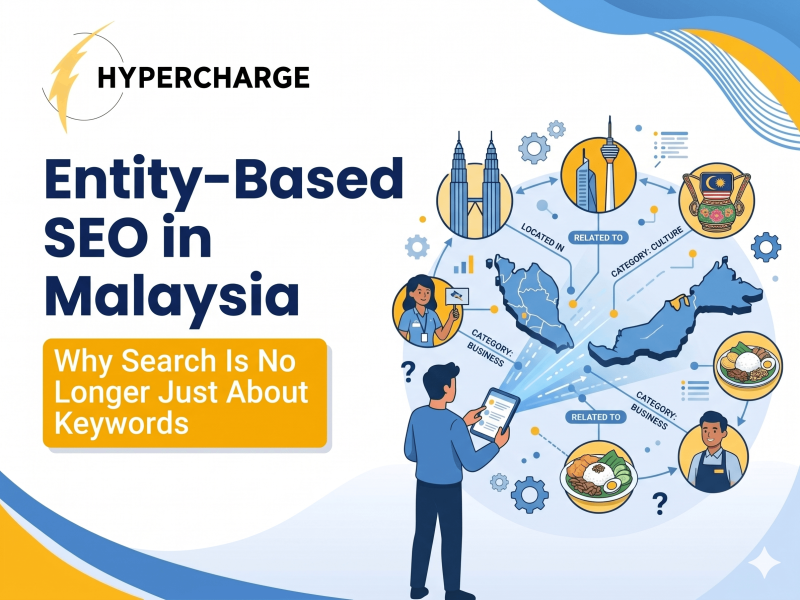
Entity-based SEO focuses on meaning, not just keywords. Instead of optimizing for phrases, you optimize for clearly defined things like your business, services, and locations. In Malaysia, this matters more because of mixed-language searches, strong local intent, and inconsistent business signals. If Google understands who you are, what you do, and where you operate, you can rank for more queries—even ones you didn’t target directly.
Search engines no longer rank pages simply because they contain the right keywords. They rank pages because they understand what the page is about, who the business is, what services it offers, where it operates, and how all of those things connect.
For Malaysian businesses, this matters even more than many overseas markets because local search here is often messy, multilingual, and heavily dependent on trust signals. A single business may be referred to in English, Bahasa Malaysia, Mandarin, or everyday rojak variations. Customers may search using brand names, service names, neighbourhood names, landmarks, or informal phrasing. Google has to interpret the meaning behind all of that.
That is why businesses that build strong entity signals often outperform competitors that are still obsessing over keyword repetition.
In this guide, we’ll break down what entity-based SEO is, how it works, why it matters in Malaysia, and how to actually use it to improve your rankings.
What Is Entity-Based SEO?
Entity-based SEO is an approach to search optimisation that focuses on things, not just words.
An entity is something that is unique, identifiable, and clearly defined. It can be a business, person, place, product, service, or concept.
For example:
- Hypercharge Digital is an entity
- Kuala Lumpur is an entity
- Google Business Profile is an entity
- Local SEO is an entity
- Dental clinic in Petaling Jaya can involve several connected entities: a healthcare provider, a city, a service type, and a commercial intent
Traditional SEO often starts with a phrase like “seo malaysia” or “local seo agency kl”. Entity-based SEO goes a step further. It asks:
- Who is the business behind this page?
- What services are clearly associated with that business?
- Which locations are relevant?
- Which other topics naturally connect to this subject?
- Does the website reinforce those relationships consistently?
In other words, keywords still matter, but they are no longer the whole story. They are signals. Entities are the underlying meaning.
Keywords vs Entities: What’s the Difference?
A keyword is the language a user types into Google.
An entity is the real-world thing or concept that Google tries to understand from that query.
For instance, someone may search:
- “best seo agency malaysia”
- “seo consultant kl”
- “how to rank on google maps”
- “why my website not showing on google”
These are different keyword phrases, but Google may connect them back to related entities such as:
- SEO agency
- Kuala Lumpur
- Google Business Profile
- Local SEO
- Website indexing
- Search visibility
That is why one well-structured page can rank for dozens or even hundreds of related searches without using every exact-match variation.
This is also why some pages rank for terms they never explicitly targeted. If Google understands the main entity, supporting entities, and user intent, it can match that page to a wider set of queries.
How Entity-Based SEO Works
Search engines try to build a clear understanding of the world. They do that by connecting entities and relationships.
So instead of reading a page as a pile of keywords, Google looks for clues like:
- the main subject of the page
- related terms and subtopics
- internal links to supporting pages
- structured data
- brand consistency across the website
- external mentions and citations
- author signals, reviews, and trust indicators
Think of it this way: a website is not just a collection of pages. Ideally, it should behave like a small knowledge hub.
If your homepage says you are an SEO agency in Malaysia, your service pages cover local SEO, technical SEO, and AI search optimisation, your blog explains related concepts in depth, and your About page clearly defines your team and expertise, Google can start connecting the dots.
That is entity-based SEO in action.
Why Entity-Based SEO Matters More in Malaysia
This is where the Malaysian angle becomes important.
Entity-based SEO is useful everywhere, but in Malaysia it becomes especially valuable because local search behaviour is less clean and less standardised than in many Western markets.
1. Malaysians search in mixed language patterns
A searcher may use:
- English
- Bahasa Malaysia
- Chinese terms
- hybrid phrasing
- city names mixed with service intent
- conversational or slang-heavy wording
For example:
- “klinik kulit pj”
- “best dentist subang jaya”
- “aircond service near cheras”
- “lawyer divorce klang”
- “seo agency malaysia”
These searches may describe the same kind of need, but the phrasing varies a lot. A pure keyword-stuffing approach breaks down quickly here. Entity-based SEO helps Google understand the underlying subject even when the words change.
2. Local trust signals matter heavily
Many businesses in Malaysia still compete in categories where customers care deeply about legitimacy before making contact. This is especially true in healthcare, legal, beauty, home services, and professional services.
So Google is not just matching text. It is also evaluating whether the business appears to be a real, trustworthy, well-defined entity.
That means signals such as:
- consistent business name
- address and phone number
- Google Business Profile
- reviews
- industry citations
- clear service pages
- branded mentions
- author expertise
- case studies
often carry stronger weight than businesses realise.
3. Businesses often target multiple cities and service areas
A lot of Malaysian companies want visibility in:
- Kuala Lumpur
- Selangor
- Petaling Jaya
- Subang Jaya
- Shah Alam
- Penang
- Johor Bahru
- other city clusters
This creates a challenge. You cannot just swap city names into duplicate pages and expect long-term results. Google needs to understand whether your business is a credible entity serving those locations.
Entity SEO helps here because it pushes you to build genuine location relevance, not just keyword variations.
4. AI search makes context more important
As Google evolves and AI-driven search becomes more prominent, search engines rely even more on context, relationships, and entity understanding.
That means the businesses most likely to benefit are the ones with:
- clear brand identity
- well-defined services
- strong topic coverage
- consistent terminology
- trustworthy external signals
For a Malaysian business, this can be the difference between being ignored and being cited.
Is Entity-Based SEO Different in Malaysia vs Overseas?
The principles are mostly the same. Google still wants clarity, consistency, and context no matter which country you operate in.
What changes is how those signals need to be built.
What stays the same everywhere
Whether you are in Malaysia, Singapore, Australia, the UK, or the US, entity-based SEO still relies on:
- clear topical focus
- strong internal linking
- structured site architecture
- schema where relevant
- brand consistency
- supporting off-page signals
- content depth and authority
What feels different in Malaysia
The difference is not that Malaysian SEO uses a different algorithm. The difference is that Malaysian search environments are more ambiguous in practice.
Here are the main ways that shows up.
Language and search phrasing are less standardised
In some overseas markets, search patterns are more consistent. In Malaysia, people mix languages, abbreviate locations, and use less formal phrasing. Google has to resolve more ambiguity.
Many local businesses have weak digital identity
A lot of SMEs still have incomplete websites, inconsistent citations, poor About pages, thin service pages, or half-optimised Google Business Profiles. So businesses with stronger entity clarity can gain a much bigger advantage.
Service areas are more clustered
Businesses often serve multiple areas close together, especially in the Klang Valley. That means location relevance needs to be built carefully, not spammed through repetitive pages.
Credibility matters in YMYL and local service categories
For healthcare, legal, finance, and professional services, strong entity signals matter even more because Google wants evidence that the business and its expertise are real.
So the core idea is this:
Entity-based SEO is not fundamentally different in Malaysia. It is simply more important to execute it properly because the local search environment contains more noise, more variation, and more weak competitors.
Examples of Entities for Malaysian Businesses
Let’s make this practical.
If you run a local SEO agency in Malaysia, your core entities may include:
- your brand name
- SEO
- local SEO
- Google Business Profile
- Kuala Lumpur
- Selangor
- AI search optimisation
- AEO
- GEO
- technical SEO
- case studies
- industries you serve
If you run a dental clinic, your entity ecosystem may include:
- your clinic brand
- dentist
- dental clinic
- braces
- Invisalign
- scaling and polishing
- emergency dentist
- city or suburb
- doctors or practitioners
- healthcare trust signals
If you run a law firm, your entity ecosystem may include:
- firm name
- practice areas
- divorce lawyer
- conveyancing lawyer
- corporate lawyer
- Kuala Lumpur or target locations
- legal services
- lawyer profiles
- credentials
- client trust signals
This is why a website should not just chase standalone keywords. It should clearly define the business and all the topics directly connected to it.
How to Build Entity-Based SEO Into Your Website
1. Define your core business entities
Start with the fundamentals.
Ask:
- Who are we?
- What do we do?
- Where do we operate?
- Who do we help?
- What topics do we want Google to associate with our brand?
For Hypercharge, that might look like:
- Hypercharge Digital
- SEO agency in Malaysia
- local SEO
- AI search optimisation
- technical SEO
- Google Business Profile optimisation
- SEO for healthcare and service businesses
If these are not obvious from the site structure, Google has more work to do.
2. Give each entity a clear “home” on the website
Each major entity should have a strong, dedicated page.
For example:
- homepage = brand entity
- service pages = service entities
- about page = business credibility entity
- location pages or industry pages = audience/location entities
- pillar pages = broad topical entities
- blog articles = supporting related entities
This is one reason pillar-and-cluster structures work so well. They help search engines understand which page is the main hub and which pages support it.
3. Build topic clusters around relationships, not just keywords
If your pillar page is about SEO in Malaysia, the supporting articles should cover the connected subtopics that help Google understand your topical depth.
That includes related entities such as:
- on-page SEO
- technical SEO
- local SEO
- off-page SEO
- internal linking
- schema
- Google Business Profile
- AI search
- E-E-A-T
- search intent
- topical authority
- entity SEO
This gives search engines a richer map of your expertise.
A page about entity-based SEO should not exist in isolation. It should link naturally to pages about semantic search, topical authority, internal linking, local SEO, and AI optimisation.
4. Use internal links to reinforce relationships
Internal linking is one of the clearest ways to show search engines how topics connect.
If you publish an article on entity-based SEO, it should probably link to:
- your SEO guide for Malaysia
- your topical authority article
- your local SEO service page
- your AI search optimisation service page
- technical SEO content
- semantic search or AEO/GEO content if relevant
Likewise, those related pages should link back where appropriate.
This does two things:
- improves crawlability and user flow
- reinforces entity relationships across the site
Done well, your internal links help Google understand not just what each page says, but how the entire website fits together.
5. Keep your brand signals consistent everywhere
Entity SEO is weakened when your business identity is inconsistent.
Your business name, service descriptions, contact details, About page messaging, and external citations should all align.
For Malaysian businesses, this is especially important across:
- website pages
- Google Business Profile
- local directories
- social profiles
- press mentions
- review platforms
- industry listings
If your business is called one thing on your website, another thing on your Google profile, and a shortened version elsewhere, you create unnecessary ambiguity.
Consistency helps search engines attach authority to the correct entity.
6. Use schema as support, not as a shortcut
Structured data helps search engines interpret the page more clearly, but it is not a substitute for strong content.
For local businesses, relevant schema may include:
- Organization
- LocalBusiness
- Service
- FAQ
- Article
- Breadcrumb
- Person
- Review
- MedicalBusiness, LegalService, or other specific types where appropriate
Schema can help disambiguate entities, but only when the page itself is already clear and useful.
Think of schema as reinforcement, not magic.
7. Strengthen trust signals around the entity
For local and service-based SEO, trust matters.
That means strengthening signals such as:
- real case studies
- author bios
- practitioner or team profiles
- awards or certifications
- reviews
- testimonials
- location information
- business history
- transparent contact details
This is particularly important for Malaysian businesses in high-trust industries such as healthcare, legal, finance, and property-related services.
If Google sees a well-defined business with credible supporting evidence, it becomes easier to treat that business as a reliable entity.
How Entity-Based SEO Supports AI Search
Entity-based SEO is not just good for traditional rankings. It also supports visibility in AI-driven discovery.
Large language models and AI-enhanced search experiences do not rely on keyword matching the same way old-school SEO once did. They work better when they can identify:
- who the brand is
- what the brand is known for
- which services and topics relate to it
- whether the information appears credible and consistent
That is why entity clarity overlaps strongly with:
- AEO
- GEO
- LLM visibility
- semantic SEO
- topical authority
If your site clearly defines your brand, your services, your expertise, and your topical relationships, you become easier for AI systems to interpret and potentially cite.
In other words, entity-based SEO is one of the bridges between traditional SEO and AI SEO.
Common Entity SEO Mistakes Malaysian Businesses Make
Treating entity SEO like keyword stuffing with new branding
Adding more related words into a page is not enough. Entity-based SEO is about clarity and relationships, not word count.
Publishing thin service pages
If your service pages barely explain what you do, who you help, where you operate, and how the service works, Google gets weak entity signals.
Creating duplicate city pages
Swapping “KL”, “PJ”, and “Shah Alam” into near-identical pages is not a real entity strategy. It often creates weak location relevance instead of strong authority.
Inconsistent business information
Different business names, old phone numbers, vague service descriptions, and mismatched branding across platforms make it harder for Google to trust the entity.
Ignoring the About page
A weak About page is a missed opportunity. It should help define the business, the team, experience, and expertise.
Forgetting that local SEO is also entity SEO
Your Google Business Profile, reviews, citations, and website content all work together. They should tell the same story about the same business.
How to Measure Whether Entity-Based SEO Is Working
You usually will not measure entity SEO through one exact keyword alone. Instead, you look for broader patterns.
Signs it is working include:
- more impressions across related keyword variations
- stronger rankings for semantically related searches
- better performance across topic clusters
- more visibility in local results and rich results
- improved internal linking and crawl paths
- higher branded search demand
- stronger relevance across service-plus-location combinations
- more appearances for long-tail informational queries
In Google Search Console, one strong sign is when a page begins ranking for a wider set of related searches beyond the exact term you originally targeted.
That usually means Google understands the topic more deeply.
What Entity-Based SEO Looks Like for Hypercharge
For Hypercharge, entity-based SEO should help establish a very clear search identity.
The site should consistently reinforce that Hypercharge is associated with:
- SEO in Malaysia
- local SEO
- Google Business Profile optimisation
- AI search optimisation
- technical SEO
- SEO for service businesses
- SEO for healthcare and local industries
- trusted, practical, Malaysia-specific SEO guidance
That means content should not just target keywords. It should build a connected ecosystem of meaning.
Your pillar page on SEO Guide for Malaysia should act as a central hub. Supporting articles like this one should deepen understanding around related entities and point back to the pillar. Service pages should anchor the commercial side. Case studies should validate trust. Industry pages should add relevance for target markets.
That is how topical authority becomes easier to defend.
Final Thoughts
Entity-based SEO is really a shift in mindset.
Instead of asking, “Which keyword should I add to this page?”, you start asking:
- What is this page truly about?
- Which entity does it support?
- Which related entities should be reinforced?
- How does this page connect to the rest of the site?
- Would Google clearly understand who we are, what we do, and why we are relevant?
For Malaysian businesses, that shift is especially valuable.
Our search landscape is multilingual, highly local, often inconsistent, and full of businesses with weak digital signals. That creates a real opportunity. The businesses that define themselves clearly, structure their websites properly, and build consistent trust signals can stand out faster.
So no, entity-based SEO is not a completely different game in Malaysia.
But because of how Malaysian users search, how local businesses present themselves online, and how Google handles ambiguity, it can be one of the biggest competitive advantages you have.
FAQ
An entity is a unique, identifiable thing or concept that search engines can understand, such as a business, person, location, product, or service.
Not completely. Keywords still matter, but they now work as part of a bigger system. Search engines use keywords to understand intent, then use entities and relationships to interpret meaning.
Because Malaysian searches often involve mixed languages, location modifiers, informal phrasing, and strong local trust factors. Entity SEO helps search engines understand the business more clearly despite that variation.
Schema helps support entity clarity, but it does not replace strong content, site structure, and brand consistency.
Yes. AI systems rely heavily on context, relationships, and entity understanding. Strong entity signals make a business easier to interpret and potentially easier to surface.