
Most Malaysian business owners who invest in SEO have no idea whether it is working. Not because they are not paying attention, but because their agency sends them a monthly report showing keyword rankings and organic traffic — and neither of those numbers tells them whether the investment is generating more business.
This guide is about fixing that. By the end of it, you will know exactly which numbers to track, how to calculate your SEO return in ringgit terms, and what questions to ask any agency that cannot show you the answers.
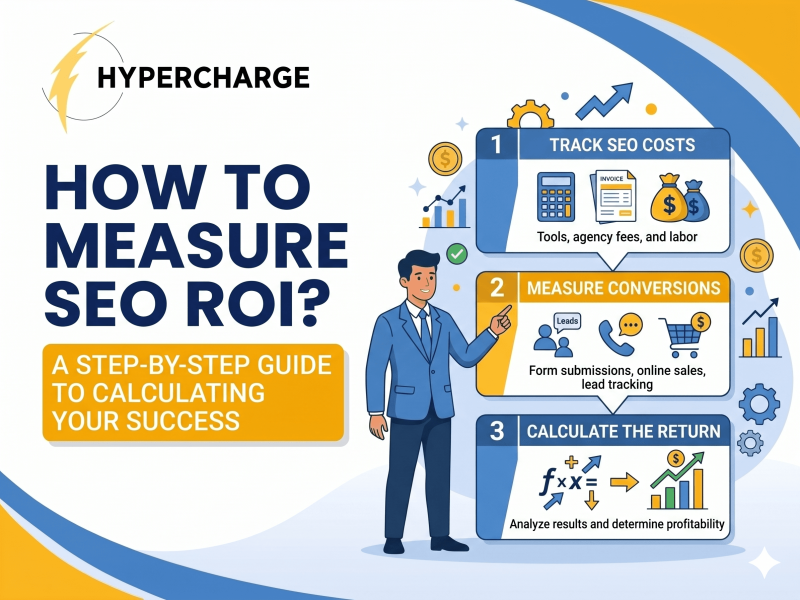
What is SEO ROI? SEO ROI (return on investment) measures the revenue your business generates from organic search relative to what you spend on SEO. The formula is: (Revenue from SEO – SEO Cost) ÷ SEO Cost × 100. For example, a business spending RM2,500 per month on SEO and generating RM9,000 in revenue from organic leads has an SEO ROI of 260 percent.
What Is SEO ROI — And Why Most Malaysian Businesses Measure It Wrong
Ask most Malaysian business owners how their SEO is performing and they will tell you two things: their website is ranking for certain keywords, and organic traffic has increased. Both may be true. Neither tells you whether the SEO investment is profitable.
Rankings are an input, not an outcome. Traffic is a volume metric, not a business metric. A dental clinic ranking number one for “dentist Petaling Jaya” but converting none of those visitors into booked appointments has not achieved anything commercially meaningful.
The correct way to measure SEO ROI is to connect the organic search channel to actual business outcomes — calls, WhatsApp enquiries, form submissions, appointment bookings, and ultimately revenue. Every other metric is a proxy, useful for diagnosing problems but not for evaluating whether SEO is worth the investment.
What makes this particularly relevant in Malaysia is that most of the customer journey happens off-site. A potential patient searches Google, sees your clinic in the Maps pack, reads your reviews, and calls directly — without ever visiting your website. If you are only measuring website traffic, you are missing a significant portion of what SEO is actually generating for your business.
The SEO ROI Formula — With a Real Malaysian Example
The formula is straightforward. The difficulty is in collecting the right inputs.
SEO ROI = (Revenue from SEO – Monthly SEO Cost) ÷ Monthly SEO Cost × 100
Here is how this works in practice for a Malaysian SME.
A dental clinic in Shah Alam spends RM3,000 per month on SEO. Each month, the campaign generates 50 organic enquiries — calls and WhatsApp messages from people who found the clinic through Google Search or Google Maps. The clinic converts 10 of those enquiries into new patients. Each new patient spends an average of RM600 on their first visit.
Monthly revenue from SEO: 10 patients × RM600 = RM6,000 Monthly SEO cost: RM3,000 SEO ROI: (RM6,000 – RM3,000) ÷ RM3,000 × 100 = 100 percent
That is the break-even point — one ringgit returned for every ringgit spent. In practice, patients return for follow-up appointments, referrals, and ongoing dental care. The lifetime value calculation, covered later in this guide, typically makes the true ROI significantly higher.
What Costs to Include in Your SEO ROI Calculation
A common mistake is calculating SEO ROI against the agency retainer alone. The full cost includes everything required to run the campaign.
Agency retainer — the monthly fee paid to the SEO agency. This is usually the largest single cost.
Content costs — if your agency charges separately for content, or if you have internal staff writing articles and pages, this is a real cost that belongs in the calculation.
Tool subscriptions — if you subscribe to SEMrush, Ahrefs, or similar tools independently of your agency, include these.
Internal time — if someone in your business spends time on briefings, approvals, or content reviews, their hourly cost belongs in the calculation. An hour of a business owner’s time has real value.
Website costs — technical SEO work often requires developer time. If this is billed separately or handled internally, include it.
Under-counting costs inflates apparent ROI and leads to poor investment decisions. A business that thinks its SEO costs RM2,500 per month but is actually spending RM4,500 when all inputs are counted is working with incorrect data.
The Real Cost of In-House SEO in Malaysia — Versus Hiring an Agency
Before evaluating agency ROI, it is worth understanding what the alternative actually costs. Many Malaysian business owners consider building in-house SEO capability as the more economical option. When the full cost stack is laid out, the calculation is rarely what they expect.
What In-House SEO Actually Requires
Running SEO at a level that produces results requires people, tools, and time — and all three carry real costs.
People. A competent SEO executive in Malaysia earns between RM3,500 and RM6,000 per month in 2026. A senior strategist commands RM6,000 to RM10,000. Neither figure includes EPF, SOCSO, annual leave, medical benefits, or the cost of recruiting — which adds approximately 20 to 30 percent on top of base salary.
Content cannot be handled by the SEO executive alone. A dedicated content writer costs RM2,500 to RM4,500 per month. Technical SEO work — fixing crawl errors, implementing schema markup, improving page speed — requires a web developer, either in-house (RM4,000 to RM8,000 per month) or on a part-time retainer (RM1,500 to RM3,000 per month).
Tools. Professional SEO requires a specific software stack. There is no credible alternative.
| Tool | Purpose | Monthly cost (approx.) |
| Ahrefs | Keyword research, backlink analysis, competitor tracking | RM550–1,100 |
| SEMrush | Site audit, rank tracking, keyword research | RM500–1,000 |
| Screaming Frog | Technical SEO crawling | RM75 (amortised) |
| Surfer SEO / Clearscope | Content optimisation | RM250–500 |
| BrightLocal / Whitespark | Local citation management | RM200–400 |
| Total tool cost | RM1,575–3,075/month |
The Full In-House Cost Comparison
| Cost item | Monthly cost (RM) |
| SEO executive (mid-level) | RM4,500–6,000 |
| EPF + SOCSO + benefits (~20%) | RM900–1,800 |
| Content writer | RM2,500–4,500 |
| Web developer (part-time retainer) | RM1,500–3,000 |
| Full tool stack | RM1,575–3,075 |
| Total monthly cost | RM10,975–18,375 |
What an Agency Retainer Replaces
A properly scoped agency retainer covers the equivalent of the entire cost stack above — the strategist, the content, the technical work, and the tools — within a single monthly fee.
| What is covered | In-house equivalent |
| Senior SEO strategist | RM6,000–10,000/mo salary |
| Content creation | RM2,500–4,500/mo writer |
| Technical SEO and developer work | RM1,500–3,000/mo |
| Full tool stack | RM1,575–3,075/mo |
| Google Business Profile management | Typically not done in-house |
| Schema markup and structured data | Typically not done in-house |
| Monthly lead-based reporting | Typically not done in-house |
| Hypercharge retainer | RM1,500–8,000/mo |
The cost differential is significant. But cost alone is not the most important factor. There is also the question of what happens when your in-house SEO executive leaves — taking institutional knowledge, campaign history, and tool access with them. For most Malaysian SMEs, losing an SEO hire mid-campaign sets rankings back by three to six months. An agency engagement has none of this exposure.
In-house SEO makes sense for large e-commerce businesses with high content volume, or companies with complex B2B content needs that require deep product knowledge. For most Malaysian SMEs — clinics, law firms, contractors, professional services — the in-house cost and risk profile does not justify the approach.
6 Metrics That Actually Measure SEO ROI for Malaysian Businesses
These are the numbers that matter. Everything else is supporting data.
1. Organic Leads and Enquiries
The most direct measure of SEO ROI for a Malaysian service business is the number of calls, WhatsApp messages, and form submissions that came from organic search. Google Analytics 4, combined with call tracking and WhatsApp link tracking, makes this measurable at the page and keyword level.
If your agency’s monthly report does not include lead volume from organic search, ask for it. If they cannot provide it, that is a meaningful signal about how they measure success.
2. Revenue Attributed to Organic Traffic
For businesses with a CRM or any form of lead tracking, it is possible to attribute revenue directly to organic search — by recording the source of each enquiry at the point of contact. Even a simple spreadsheet that captures “how did you find us?” at the point of booking generates useful attribution data.
This is the number that feeds directly into the ROI formula above. Without it, you are calculating ROI against estimated or assumed revenue — which is less useful.
3. Cost Per Lead Versus Google Ads
One of the clearest ways to evaluate SEO ROI is to compare the cost of acquiring a lead through organic search against the cost of the same lead through Google Ads.
For most Malaysian service businesses, a Google Ads lead in competitive categories costs between RM50 and RM300, depending on the industry. As an SEO campaign matures — typically from month six onwards — the cost per organic lead drops significantly and continues falling as rankings stabilise. A dental clinic paying RM150 per lead through Google Ads and RM30 per organic lead after twelve months of SEO has a clear ROI case.
4. Keyword Rankings for Commercial Terms
Rankings are a proxy metric, not a primary one — but they are a useful leading indicator of future lead volume. What matters is not ranking for every possible keyword, but ranking in the top three positions for the specific commercial terms your customers use when they are ready to act.
“Dentist Shah Alam” is a commercial term. “What causes tooth decay” is not. Track the former. The latter is informational traffic that rarely converts directly.
5. Google Business Profile Interactions
For most Malaysian local service businesses, a significant proportion of SEO-driven leads come directly from Google Maps — without the customer ever visiting the website. These leads show up in Google Business Profile Insights as calls, direction requests, and website clicks.
If you are running local SEO and not tracking GBP interactions monthly, you are likely undercounting your SEO ROI by 30 to 50 percent. If your agency manages your Google Business Profile optimisation, these figures should appear in every monthly report as standard.
6. Customer Lifetime Value from SEO-Acquired Clients
A new dental patient who books their first appointment through Google is not worth RM600 — they are worth the total revenue across every visit, referral, and additional service over the course of the relationship. Depending on the practice, this lifetime value can be RM3,000 to RM15,000 or more.
Calculating SEO ROI against first-visit revenue consistently undervalues the channel. A business owner who understands their customer lifetime value will almost always find that SEO ROI is significantly higher than first-order calculations suggest.
SEO ROI Versus Google Ads ROI — An Honest Comparison
Both channels can deliver positive ROI. The difference is in the timeline, the sustainability, and the long-term cost structure.
| Factor | SEO | Google Ads |
| Time to first results | 3–9 months | Days |
| Cost per lead (month 1–3) | High (investment phase) | Moderate to high |
| Cost per lead (month 12+) | Low and falling | Same or increasing |
| What happens when you stop | Rankings decline slowly over months | Leads stop immediately |
| Click-through rate advantage | Organic results get 3–5× more clicks than ads for same position | Ad label reduces trust for some searchers |
| Long-term ROI | Compounding — ROI improves each month | Flat — ROI stays roughly constant |
The practical implication for Malaysian SMEs: Google Ads is the right channel when you need leads immediately and have budget to sustain the spend indefinitely. SEO is the right channel when you want to build a lead source that becomes cheaper over time and continues generating enquiries without ongoing ad spend.
Many of Hypercharge’s clients run both simultaneously — using Google Ads to generate leads while SEO builds, then reducing ad spend as organic rankings mature. The combined ROI at month 12 is almost always higher than either channel alone.
Real SEO ROI: Two Malaysian Case Studies
Generic examples are common in articles like this one. These are not generic. Full write-ups of both campaigns are on our case study page.
HE Medical Clinic — Multiple KL Locations
HE Medical Clinic came to Hypercharge with near-zero organic visibility across all locations. The campaign covered E-E-A-T-compliant content, technical fixes, and Google Business Profile optimisation for each branch.
Within six months, organic leads across all locations reached approximately 2,000 per month — 300 or more WhatsApp and phone enquiries per location. If each consultation generates RM200 in revenue and the clinic converts 30 percent of those leads, monthly organic revenue reaches RM120,000 across the network.
Against a multi-location SEO retainer, the ROI calculation is substantial — and this does not include patient lifetime value or referrals generated from organic-acquired clients.
Cozy T Dental Clinic — Senawang
Cozy T Dental started with zero organic traffic and zero Google Maps visibility. Two years into the engagement, the clinic generates over 1,184 Google Business Profile leads per month — calls, messages, and direction requests from patients who found them through Google.
The clinic spends zero ringgit on Google Ads. Every one of those 1,184 monthly enquiries is an organic lead. At a conservative dental conversion rate of 20 percent and an average first-visit value of RM400, that is over RM94,000 in monthly revenue from organic search alone.
This is what SEO ROI looks like when it is built correctly and measured honestly.
How Long Before SEO ROI Shows in Malaysia?
Realistic timelines matter because businesses that expect three-month results and do not see them will abandon campaigns that are on track to deliver strong returns.
Google Maps visibility: 6 to 12 weeks for initial improvement. The Google Business Profile signals — categories, reviews, citations — respond relatively quickly to optimisation.
Organic rankings (moderate competition): 3 to 6 months to reach page one for suburb-level and service-specific terms in most Malaysian markets.
Revenue impact: 4 to 9 months for meaningful lead volume from organic search, depending on starting position and competition.
Break-even point: Most Malaysian SME SEO campaigns reach break-even — where monthly organic revenue exceeds monthly SEO cost — between months 6 and 12. After that, the cost per lead continues falling while lead volume grows.
Compounding effect: An SEO campaign that has been running for 24 months is generating leads at a fraction of the cost per lead it started at, because the fixed monthly retainer is now producing significantly more output than it did in the first six months.
Tools to Track SEO ROI in Malaysia
You do not need every tool. You need the right ones, set up correctly.
Google Search Console — free, essential. Shows which queries are driving impressions and clicks to your website. The closest thing to a direct window into how Google sees your site.
Google Analytics 4 — free, essential. Tracks user behaviour on your website, including goal completions (form submissions, call button clicks, WhatsApp link clicks). Requires correct setup to be useful — out-of-the-box GA4 does not automatically track conversions.
Google Business Profile Insights — free, built into your GBP dashboard. Shows calls, direction requests, and website clicks directly from your Maps listing. Critical for local businesses where a large share of leads never visit the website.
Call tracking software — optional but valuable for businesses where phone calls are the primary lead type. Tools like CallRail or local alternatives assign unique phone numbers to different traffic sources, making it possible to attribute calls directly to organic search.
A simple lead log — underrated. A spreadsheet where staff record each enquiry source (“how did you find us?”) produces attribution data that no analytics tool can fully replicate, because it captures the customer’s own recollection of their search journey.
Common Mistakes When Measuring SEO ROI in Malaysia
Measuring too early. Pulling ROI data at month two of a new campaign and concluding it is not working is like judging a construction project by the foundation. The timeline section above sets realistic expectations for when results should be assessed.
Tracking rankings instead of leads. Position one for a keyword that nobody searches in your specific suburb generates zero leads. Position five for a high-intent, high-volume local term generates calls every day. Rankings are a tool for diagnosis, not a measure of success.
Ignoring Google Maps data. A business that tracks website traffic and ignores GBP interactions is systematically undercounting SEO output. For many Malaysian service businesses, Maps drives more direct enquiries than the website.
Calculating first-visit revenue only. A client acquired through SEO who returns for three more visits and refers two colleagues is worth far more than a single transaction. Measuring SEO ROI against first-order value consistently produces an underestimate.
Not separating branded from non-branded traffic. Traffic from people searching your business name directly is not SEO-generated demand — it is brand awareness that already existed. True SEO ROI comes from non-branded organic traffic: people who found you through a category or location search, not by already knowing your name.
Accepting reports that only show impressions and traffic. If your agency’s monthly report does not include lead volume, lead source attribution, and a view of how organic search is contributing to your pipeline, you are not measuring SEO ROI — you are measuring SEO activity.
What to Ask Your SEO Agency About ROI Before You Sign
These five questions will tell you more about an agency’s actual capability than any case study or portfolio.
“How will you track leads from organic search, not just traffic?” A competent agency has a specific answer — GA4 conversion events, call tracking, GBP Insights reporting. An agency that talks only about rankings and traffic is optimising for the wrong metrics.
“What does your monthly report show, and can I see an example?” Ask to see a redacted report from an existing client. If it shows impressions, sessions, and keyword positions but no lead data, that is the report you will receive.
“How long before I should expect organic leads, and what does the ramp-up look like?” Look for a specific, honest answer tied to your industry and competitive landscape. “It depends” without any specifics is not an answer.
“Who owns the Google Search Console and Analytics accounts?” Your accounts should always be yours. An agency that insists on owning the data owns your business’s search history and performance record. If they leave — or you leave them — you lose it.
“Can you show me how you’ve calculated ROI for a similar client?” Not a case study with percentage improvements — an actual ROI calculation with costs and revenue figures. The ability to answer this question separates agencies that understand business outcomes from those that optimise for search metrics.
See What SEO ROI Looks Like for Your Specific Business
The numbers in this guide are illustrative — your actual ROI depends on your industry, your location, your average customer value, and your current search visibility.
The most useful starting point is not a generic estimate. It is an assessment of your specific business: which keywords your potential customers are searching, what your current Google visibility looks like, how your competitors are positioned, and what a realistic lead volume and revenue outcome looks like based on that data.
Hypercharge offers a free 30-minute strategy call for Malaysian businesses that want to see this analysis applied to their specific situation. We cover your current Search Console data, your competitor positions, and a realistic projection of what SEO would deliver for your business in the next 12 months — including a ROI estimate you can hold us to.
For a full breakdown of what different SEO budget levels include in Malaysia, our SEO pricing guide covers package tiers, realistic timelines, and what to watch out for before signing
Book through our contact page or WhatsApp us directly.
FAQs
SEO ROI is the revenue your business generates from organic Google Search and Google Maps, divided by what you spend on SEO. If your business spends RM3,000 per month on SEO and generates RM9,000 in revenue from organic leads, your SEO ROI is 200 percent. The calculation requires tracking which leads and sales come from organic search specifically — not total business revenue.
Start by setting up conversion tracking in Google Analytics 4 to count calls, WhatsApp clicks, and form submissions from organic traffic. Record the source of every lead your business receives. Each month, multiply the number of organic leads by your average conversion rate and average customer value to estimate organic revenue. Subtract your monthly SEO cost. Divide the result by your SEO cost and multiply by 100. That is your SEO ROI percentage.
Start with leads rather than revenue. Count the calls, WhatsApp messages, and form submissions that came from organic search each month. Multiply by your estimated conversion rate and average transaction value to get a revenue approximation. It is not perfectly precise, but it is significantly more useful than tracking rankings and traffic alone. Over time, as you ask “how did you find us?” consistently, your attribution data will improve.
Most Malaysian SME businesses reach break-even — where monthly organic revenue exceeds monthly SEO cost — between months 6 and 12 of a properly run campaign. Google Maps visibility typically improves within 6 to 12 weeks. Organic rankings for moderate-competition terms take 3 to 6 months. High-competition categories like aesthetic clinics, dental practices, and law firms in KL take 9 to 18 months for stable top-three positions. The ROI curve is not linear — it accelerates after rankings stabilise.
In the short term, Google Ads typically produces leads faster and the initial ROI is easier to calculate. In the medium to long term — beyond 12 months — SEO ROI is almost always higher, because the cost per lead from organic search falls month over month while the Ads cost per lead stays flat or rises. The compounding nature of SEO means a campaign running at month 24 is generating significantly more revenue per ringgit spent than the same campaign at month 6.
Yes — and in many cases, small Malaysian businesses achieve stronger SEO ROI than larger competitors because their customer value is high relative to their SEO cost. A single-location dental clinic spending RM2,000 per month on SEO that generates 20 new patients per month at RM600 average value has a monthly organic revenue of RM12,000 — a 500 percent ROI before accounting for patient lifetime value or referrals. The businesses that achieve this consistently are the ones that measure leads rather than traffic and stay with the campaign long enough for rankings to compound.