
Most Malaysian business owners who struggle to rank on Google share one common problem — they optimised their website for the wrong words.
A dental clinic in Petaling Jaya spent months targeting “dental services” — a phrase so broad it is dominated by directories and international health portals. Meanwhile, their potential patients were searching “dentist PJ affordable” or “klinik gigi Petaling Jaya buka Ahad.” The clinic was visible to no one who actually wanted to book.
That is the cost of skipping keyword research.
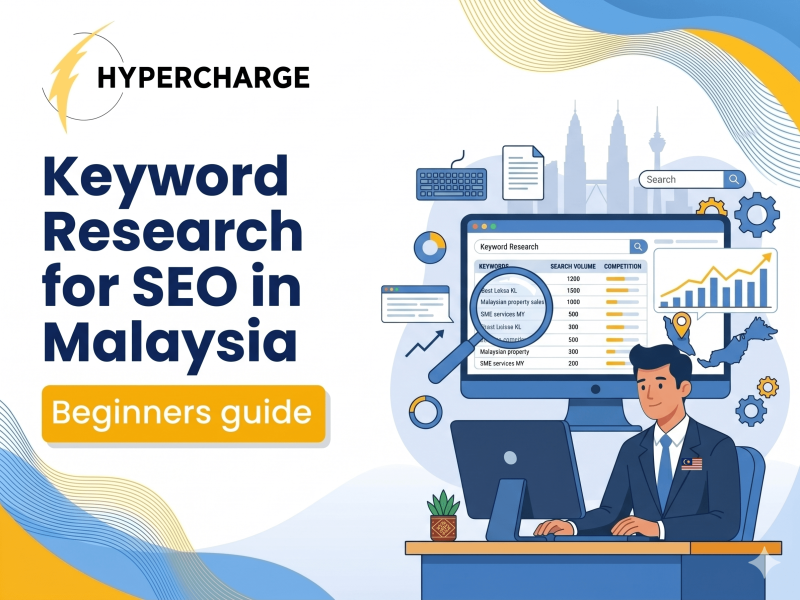
Keyword research is the process of finding and analysing the exact search terms your potential customers type into Google — so your website shows up when it matters most. Done correctly, it shapes every piece of content you create, every service page you build, and every ringgit you invest in SEO. This guide walks through how to do it properly, with the Malaysian market specifically in mind.
What Keyword Research Actually Tells You
Keyword research is not simply a list of popular phrases. It tells you three things at once: what your audience is looking for, how difficult it is to rank for those terms, and whether the searcher is ready to buy or just browsing.
According to Ahrefs’ keyword research documentation, every keyword carries a search intent — the underlying reason behind the query. Get the intent wrong, and even a first-page ranking will not convert into leads.
The Four Types of Search Intent
Informational — the user wants to learn. Example: “what is SEO.” These readers are not buying yet, but they are entering your world.
Commercial — the user is comparing options. Example: “best SEO agency Malaysia.” High value. They are almost ready.
Transactional — the user wants to act. Example: “hire SEO agency KL.” These are your warmest leads.
Navigational — the user is looking for a specific brand or website. Less useful for organic traffic unless it is your own brand name.
For most Malaysian SMEs, the sweet spot is commercial and transactional intent — these are the keywords that generate actual enquiries, calls, and walk-ins, not just page views.
How to Build a Keyword List for a Malaysian Business
Step 1: Start With What Your Customers Say, Not What You Think
The most reliable starting point is the language your customers actually use — not industry jargon, and not what sounds professional to you.
A physiotherapy clinic might call their service “musculoskeletal rehabilitation.” Their patients search “knee pain treatment KL.” These are very different phrases, and Google rewards the one that matches real human searches.
Start by listing 10 to 20 phrases that describe what you do, what problems you solve, and what your customers ask you over the phone or WhatsApp. Include Malay-language variants — searches like “klinik gigi murah Subang” or “kedai aircond berhampiran saya” represent a meaningful segment of Malaysian search behaviour that competitors often ignore.
Step 2: Use Free Tools to Validate and Expand
Once you have a seed list, run it through keyword research tools to get real data.
Google Keyword Planner is free and pulls data directly from Google’s own index. It shows monthly search volume ranges and suggested bid prices, which serve as a rough proxy for commercial intent — higher bids mean more advertisers competing, which usually signals buyer-ready traffic.
Google Search Console is equally valuable if your site already receives some traffic. Under the “Search results” report, you will find the exact queries people typed before landing on your site — including ones you never explicitly targeted. These are gold.
For more detailed data, tools like Ahrefs and Semrush provide precise monthly volumes, keyword difficulty scores, and competitor keyword gaps. These are paid tools, but even a one-month subscription can yield enough data to plan six months of content.
Step 3: Assess Keyword Difficulty Honestly
Search volume alone is not enough. A keyword with 10,000 monthly searches in Malaysia is useless if every competing page is a national news portal or a government health website.
Keyword difficulty (KD) is a score — typically 0 to 100 — that estimates how hard it is to rank in the top 10 results. As a general guide:
- KD below 30: Realistic for a new or small website with some content
- KD 30–60: Achievable with a focused content and link-building strategy over 6–12 months
- KD above 60: Requires significant domain authority — approach only after building foundational rankings
For most Malaysian SMEs starting out, targeting long-tail keywords (three or more words, lower volume, lower competition) is the practical path. “Dental clinic Damansara” is more winnable than “dental clinic Malaysia,” and the patient it attracts is far more likely to be local and ready to book.
The Malay-English Search Split in Malaysia
This is the part most SEO guides written for international audiences miss entirely.
Malaysia is a bilingual search market. A significant portion of searches happen in Bahasa Malaysia — especially on mobile, in suburban areas, and among users under 35. Ignoring Malay-language keywords means leaving a portion of your potential audience unserved.
What makes this more nuanced is the code-switching behaviour common in Malaysian search. Users often mix languages in a single query: “aircond service murah KL,” “dentist review terbaik Ampang,” or “renovation contractor near me Cheras.” These hybrid phrases rarely appear in standard keyword tools — they require manual discovery through Google autocomplete, Google Trends (filtered to Malaysia), and real customer interviews.
If your competitors are not covering Malay-language variants, this is a gap worth filling.
How to Prioritise Which Keywords to Target First
Once you have a validated list, not everything should be written at once. Prioritisation prevents wasted effort and builds topical momentum faster.
Rank your keywords by this logic:
High priority: High commercial or transactional intent + KD below 40 + directly tied to your core services. These become your service pages and landing pages.
Medium priority: Informational intent + moderate volume + related to your services. These become blog posts that feed traffic into your service pages.
Lower priority: Very high volume + high KD + broad intent. Park these for later, when your domain has more authority behind it.
This is exactly the approach behind topical authority building — a strategy where you cover a topic comprehensively across multiple pages, rather than chasing isolated high-volume terms. Google rewards sites that demonstrate depth on a subject.
Mapping Keywords to the Right Pages
Every page on your site should own exactly one primary keyword and one search intent. Two pages targeting the same keyword split your ranking potential — this is called keyword cannibalisation, and it is one of the most common and costly SEO mistakes Malaysian businesses make.
The rule is simple: one intent, one page.
A home renovation company, for example, should have separate pages for “renovation contractor KL,” “kitchen renovation Malaysia,” and “bathroom renovation cost Malaysia” — not one page that tries to rank for all three. Each page satisfies a different, specific search. Understanding how search intent shapes page structure is foundational to getting this right.
Once your keywords are mapped to pages, your internal linking structure should reinforce the relationships — broad pillar pages linking to specific cluster pages, and cluster pages linking back up. This is how you signal to Google that your site has genuine authority on a topic.
What to Do With Your Keyword Data Once You Have It
Keyword research is not a one-time task. Search behaviour shifts — new queries emerge, competitor content rises, and seasonal patterns affect volume. A quarterly review of your keyword performance in Google Search Console should be part of your ongoing SEO process.
Track which pages are gaining impressions but not clicks — those need stronger meta titles or featured snippet optimisation. Track which keywords are rising in position from 11 to 20 — those are close to the first page and worth a content refresh.
Done right, keyword research becomes a living document that guides not just content, but your entire digital marketing strategy. It tells you where your audience is, what they need, and exactly where to show up.
The dental clinic in PJ eventually fixed their strategy. They stopped targeting “dental services” and built individual pages for the specific treatments their patients were actually searching for. Within seven months, organic enquiries had climbed significantly — without spending a single ringgit on ads. Their content was simply meeting people where they already were.
Frequently Asked Questions
A solid initial keyword research exercise — covering your core services, location targeting, and competitor gap analysis — typically takes four to eight hours with the right tools. If you are using free tools like Google Keyword Planner and Search Console only, allow extra time for manual validation. It is worth doing properly the first time rather than rushing.
Ideally, both. English keywords tend to have higher search volumes in urban areas and among professional demographics. Malay keywords often carry less competition and reflect genuine mobile search behaviour. The right balance depends on your industry and target customer profile — a healthcare clinic serving a mixed urban population will benefit from both.
There is no universal minimum, but 50 to 500 monthly searches is a realistic and productive range for most local businesses starting out. A keyword with 200 monthly searches and low competition will generate more actual leads than a keyword with 5,000 searches that you cannot realistically rank for.
Google Keyword Planner is a strong starting point and costs nothing. Its main limitation is that it shows volume ranges rather than precise numbers. For competitive analysis — finding out which keywords your competitors rank for and where the gaps are — a paid tool like Ahrefs or Semrush provides data that Keyword Planner simply cannot. Even one month of access can be enough to build a six-month content plan.
Local SEO depends heavily on location-modified keywords — phrases that include a city, area, or “near me” qualifier. Effective local SEO for Malaysian businesses starts with identifying which location-specific search terms your customers use, then ensuring those terms appear naturally on your service pages, Google Business Profile, and local citations. Keyword research is the first step in that process.