
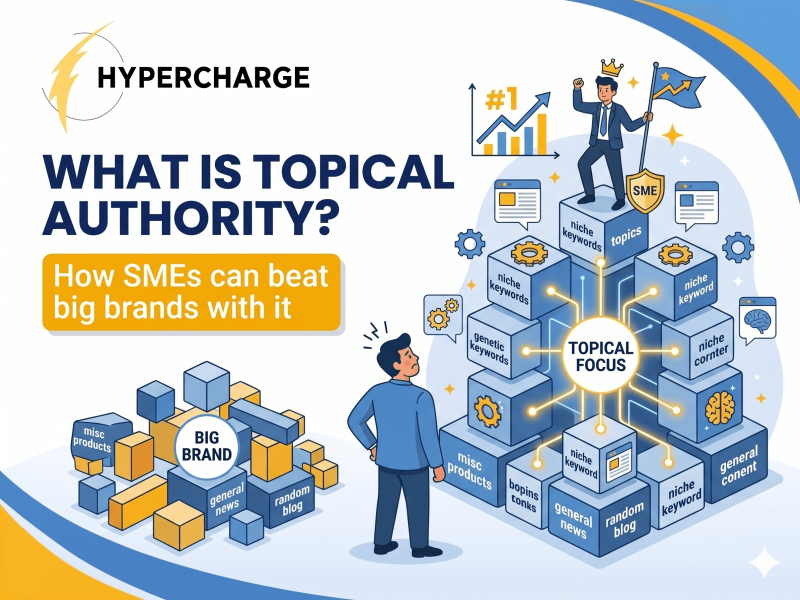
In the Malaysian business world, we all know the “Kedai Specialist”—that one shop in the neighborhood that might be small, but they know everything about one specific thing, whether it’s fixing Continental cars or sourcing the best Bentong ginger.
In SEO, this is called Topical Authority.
For a long time, small businesses felt they couldn’t compete with giants like Maybank, Shopee, or PropertyGuru because those big brands have massive budgets and millions of backlinks. But in 2026, the game has changed. Google’s AI doesn’t just look at who has the most links; it looks at who is the true “Sifu” of a specific topic.
At Hypercharge, we’ve helped over 100 SMEs use this exact strategy to outrank competitors ten times their size. Here is how you can do it too.
What Is Topical Authority?
Topical authority is a measure of a website’s credibility and expertise regarding a specific subject. Instead of ranking for a single “lucky” keyword, a site with topical authority ranks for hundreds of related terms because Google views that site as the definitive source of information for that niche.
If your website only has one page about “Office Renovation,” you are a generalist. If you have 30 pages covering renovation costs in KL, CIDB permit requirements, eco-friendly materials for Malaysian offices, and space-saving layouts for Shophouses—you have Topical Authority.
Why Does Topical Authority Matter in SEO?
For a Malaysian SME, topical authority is your “David vs. Goliath” slingshot. It levels the playing field against corporate giants.
It Builds Trust with Search Engines and Users
When you cover every corner of a topic, Google’s “E-E-A-T” filters (Experience, Expertise, Authoritativeness, and Trustworthiness) give you a green light. Users also trust you more when they see you aren’t just trying to sell them something, but actually helping them solve a problem.
It Supports Natural Link Building
Other Malaysian bloggers, news sites, and industry portals are much more likely to link to a comprehensive guide on “SST for Small Businesses” than a generic homepage. These high-quality, local links are the fuel that keeps your rankings high.
It Can Reduce Marketing Spend
Relying solely on SEM (Google Ads) is expensive in the Klang Valley. The “Cost Per Click” is constantly rising. By building topical authority, you earn “free” organic traffic that keeps coming long after you stop paying for ads.
How Do Search Engines Prioritize Sites with Topical Authority?
Google uses Topic Clusters to organize information. Think of it like a library. Google doesn’t just look for a book with the right title; it looks for the section of the library that is the most complete.
When you link your articles together correctly—connecting your main guide to smaller, specific sub-topics—you are building a “semantic map.” Google sees this map and realizes that your site provides the best user journey, keeping people on your page longer.
How to Build Topical Authority
Building authority doesn’t happen overnight, but the process is straightforward if you follow this roadmap.
Find Topic Groups in Your Niche
Start with your “Pillar.” If you are an accounting firm, your pillar might be “Tax Compliance in Malaysia.”
- Don’t just go broad. Go deep.
- Break it down: Corporate tax, individual income tax, SST exemptions, and LHDN audit preparation.
Conduct Topic-Based Keyword Research
Instead of looking for the keyword with the highest volume, look for the keywords that complete the story. Use tools to find “long-tail” questions that Malaysians are actually asking, like “How to register for SST if I’m an SME?” or “Penalty for late LHDN filing 2026.”
Plan Your Link Building Tactics
Once your content is live, you need to prove its authority through external validation.
Outreach
Reach out to local Malaysian industry influencers or business associations. Offer your in-depth guide as a resource for their members.
Broken Link Building
Find old, dead articles on other Malaysian websites that used to link to resources about your topic. Message the site owner and suggest your new, updated article as a replacement.
Unlinked Brand Mentions
Sometimes people talk about your business on forums like Lowyat.net or in local news but forget to link to you. Reach out and politely ask them to turn that mention into a clickable link.
Create Problem-Solving Content
The best way to win in Malaysia is to solve a local problem. Don’t just write generic SEO tips; write about SEO for Malaysian SMEs (just like we are doing now). Use local examples, mention local regulations (like SSM or LHDN), and speak the language of your customer.
4 Simple Ways to Measure Topical Authority
How do you know if you are becoming the “Sifu” of your niche? Watch these four metrics:
Keyword Overview
Are you starting to rank for “long-tail” keywords you didn’t even specifically target? This is a sign that Google views your entire site as relevant to the topic.
Backlink Analysis
Are other local websites linking to your specific “Cluster” articles? High-quality, niche-relevant links are the best proof of authority.
Position Tracking
Check if your rankings stay stable even after a Google Algorithm update. Sites with high topical authority are usually “update-proof” because they provide genuine value.
Google Analytics
Look at your “Time on Page” and “Pages per Session.” If Malaysians are spending 5 minutes on your site and clicking through multiple articles, you’ve successfully built authority in their eyes.
Track and Monitor Your Topical Authority
Topical authority is a marathon. You need to consistently update your content to reflect new Malaysian laws, trends, and search behaviors. At Hypercharge, we’ve seen that SMEs who commit to this strategy for 6 to 12 months often find themselves outperforming competitors who have been around for decades.
Ready to beat the big brands?
You don’t need a million-ringgit budget; you just need to be the smartest voice in the room.
If you want to build a content engine that turns your business into a local authority, we’re here to help.