

A home renovation contractor in Cheras spent three months writing blog posts about interior design trends, sustainable materials, and minimalist living. Good content. Well-written. Completely ignored by Google. Not because the content was bad — but because nobody in Cheras was searching for it. The searches happening in his catchment area were “renovation contractor Cheras,” “rumah renovation murah,” and “berapa harga renovate rumah 3 bilik.” None of which his content addressed.
Keyword research is the step that prevents this from happening. It’s the discipline of finding out what your actual customers are actually typing into Google — before you spend time and money creating content that answers questions nobody asked.
Done properly for a Malaysian audience, it’s also more nuanced than most guides suggest. Malaysia’s search market spans three languages, layers in local geographical intent, and includes a distinctly Malaysian hybrid of English and Bahasa Malaysia that no keyword tool fully captures. Getting it right is what separates a content strategy that compounds into organic leads from one that generates traffic from the wrong audience — or no traffic at all.
Keyword research is the process of identifying the exact words and phrases your target customers type into Google — so your website content is built around real demand, not assumptions. In Malaysia, effective keyword research must account for three search languages (English, Bahasa Malaysia, and Mandarin), code-mixed Manglish queries, and strong local intent signals like neighbourhood names and “near me” searches.
This guide walks through the full process — from building your initial list through to mapping keywords to pages — with Malaysia-specific context at every step.
📌 Key Takeaways
- Keyword research identifies what your customers actually search for — not what you assume they search for
- In Malaysia, you need to account for English, Bahasa Malaysia, Mandarin, and code-mixed Manglish queries across different audience segments
- Search intent — the reason behind a query — is more important than search volume; targeting the wrong intent is worse than targeting a low-volume keyword
- The four filters for prioritising keywords: search volume, keyword difficulty, intent match, and business value
- Keywords should be mapped to pages — one primary intent per page — not stuffed onto every page you already have
- Free tools (Google Autocomplete, People Also Ask, Keyword Planner) cover the basics; paid tools (Ahrefs, Semrush) reveal competitor gaps and more accurate difficulty data
What Keyword Research Actually Is — And What It Isn’t
Keyword research is not about finding words to repeat throughout your content. That’s an outdated view of how Google works — and it’s the thinking that leads to the keyword stuffing that Google has been penalising for years.
Modern keyword research is demand mapping. You are identifying what questions, problems, and needs your potential customers are expressing through search — and then building content and pages that directly address those needs better than anyone else currently does.
The output of keyword research is not a list of words to insert. It’s a map of topics your website should cover, structured around the actual language your customers use, organised by the intent behind each query. This map then drives your content plan, your service page structure, and your internal linking architecture.
This is also why keyword research is not a one-time task. It feeds into everything else in your SEO strategy — and as the full SEO guide for Malaysian businesses explains, it should be revisited whenever you add a new service, target a new location, or find that your content isn’t generating the leads you expected.
Why Malaysia Makes Keyword Research More Interesting Than Most Countries
In most single-language markets, keyword research is relatively straightforward — identify what people search for, find the volume, assess the difficulty. Malaysia adds layers that most SEO guides written for a Western audience don’t account for.
The Three Search Languages You Need to Account For
Malaysian consumers search in English, Bahasa Malaysia, and Mandarin — often for the same type of service — with meaningfully different volumes depending on the search category, the geographic area, and the demographic.
A dental clinic in Kepong, where a large proportion of residents are Chinese-Malaysian, may find that Mandarin search volume for “牙科诊所” or “洗牙” exceeds English search volume for “dental clinic” in that specific catchment. A legal firm targeting government-adjacent services will find the bulk of search demand in Bahasa Malaysia — “cara daftar syarikat,” “undang-undang pekerjaan Malaysia.” An accounting firm serving the corporate sector will find English dominates its keyword landscape.
This means your keyword research process must include at least an exploratory pass through search demand in all three languages before deciding where to focus. You may find that your English-language opportunity is smaller than you assumed — or that a BM or Mandarin keyword set has almost no competition because every competitor in your category is English-only.
Manglish and Code-Mixed Queries
Malaysian searchers code-switch in search the same way they code-switch in conversation. Real queries that appear in Malaysian search data include: “klinik berhampiran yang ada good reviews,” “contractor renovate rumah berapa harga,” “dentist murah area PJ,” and “accounting firm yang boleh buat SSM.” These mixed-language queries combine Malay grammar, English nouns, and local abbreviations in ways that don’t fit neatly into any single language keyword tool.
Standard keyword tools will often miss these queries entirely — they’re searched frequently enough to drive real traffic but not categorised consistently enough to appear in volume estimates. The best sources for discovering Manglish queries are Google Autocomplete (which surfaces them naturally as you type partial phrases), Google’s People Also Ask boxes in Malaysian search results, and platforms where Malaysians communicate naturally — Reddit Malaysia, local Facebook groups, Lowyat.net forum threads in your industry.
Strong Local Intent in Malaysian Search
Malaysian consumers attach location signals to search queries far more consistently than searchers in some other markets. “Dentist” and “dentist Bangsar” are different searches returning different results, and the volume split between them matters significantly for how you structure your pages and which keywords you prioritise.
Understanding the distinction between local and organic SEO is relevant here — location-modified keywords behave differently from generic category keywords, and your keyword research process needs to surface both so you can decide where to build general content and where to build location-specific pages.
Step 1 — Start With Search Intent, Not Keywords
Before you open any keyword tool, the most important question to answer about any keyword is: why is someone searching this? What do they want to find, do, or decide?
According to how Google interprets search intent to rank content, Google’s primary goal is to match searchers with content that satisfies the intent behind their query. This is why intent alignment is more important than keyword volume — a page that perfectly satisfies a lower-volume intent will outperform a page that partially addresses a high-volume intent.
There are four intent types that cover the Malaysian search landscape for most SMEs.
Informational Intent
The searcher wants to learn or understand something. They are not yet ready to buy. Examples: “what is a root canal,” “cara renovate rumah kos rendah,” “apa itu writ saman.” Informational queries are best addressed through blog articles, guides, and educational content — not service pages with a call-to-action.
The value of informational content in Malaysia is twofold: it attracts searchers earlier in their decision-making journey (building brand awareness and trust before they’re ready to enquire), and it establishes topical depth that supports your authority for commercial keywords in the same topic area.
Commercial Intent
The searcher is researching options — comparing providers, reading reviews, evaluating prices — but hasn’t yet decided. Examples: “best aesthetic clinic KL,” “dental implants cost Malaysia,” “senarai firma guaman terbaik Johor.” These queries are suited to comparison content, service overview pages with pricing information, and case study content that demonstrates results.
Commercial intent keywords are often the highest-value content investment for Malaysian SMEs because they reach people actively evaluating their options — one good piece of content can be the deciding factor in a purchasing decision.
Transactional Intent
The searcher is ready to act — book, call, enquire, or purchase. Examples: “book dental appointment Bangsar,” “emergency plumber Subang Jaya,” “call car towing service PJ.” These queries should map to your service pages and contact pages — with clear, frictionless paths to enquiry. They are typically lower volume than informational keywords but convert at significantly higher rates.
Local Intent
A subset of all three above, local intent queries include an explicit or implied geographic signal. “Physiotherapist near me,” “renovation contractor Petaling Jaya,” “klinik area Cheras buka malam” — all of these carry local intent and should map to location-specific content or to your Google Business Profile rather than generic national-level pages.
Step 2 — Build Your Seed Keyword List
Before using any tool, start with what you already know.
Your Services and Products as Starting Points
List every service and product your business offers, in plain language. For each one, write down: the formal industry term, the colloquial term your customers use, and any Malay or Mandarin equivalents. This is your seed list — the starting vocabulary from which you’ll expand.
A dental clinic’s seed list might include: dental implants / implan gigi / 种牙, teeth whitening / memutihkan gigi / 牙齿美白, dental scaling / membersihkan gigi / 洗牙, braces / pendakap gigi / 牙套. Each of these becomes a branch to explore in your keyword research.
Google Autocomplete and People Also Ask
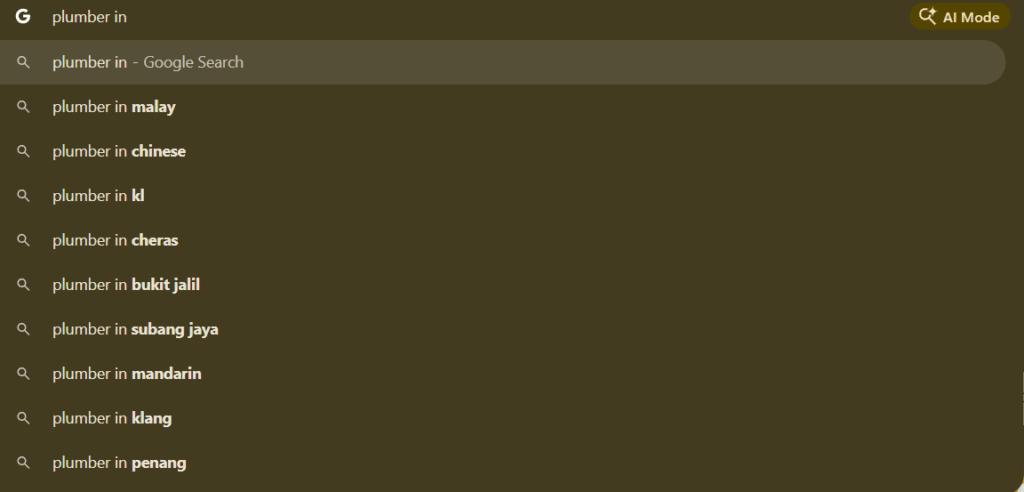
These two features are the most underused free keyword research tools available, and they’re particularly valuable in Malaysia because they reflect actual local search behaviour rather than globally averaged data.
For Autocomplete: open a private browser window (to avoid personalised results) and begin typing a seed keyword. Watch what Google suggests as you type — each suggestion is a real query that enough Malaysians are searching to trigger a suggestion. Try completing the query in different ways: starting with the service (“dental implants…”), starting with a question (“how much does…”), starting with a location (“dental clinic in…”).
For People Also Ask: search your primary keyword and look at the expandable questions that appear in the search results. These are question-format queries that Google has identified as closely related to your search — each one is a potential piece of content you could create. Click to expand one question and more appear — a chain of related queries your potential customers are typing.
Competitor Research
Search your primary service terms in Google — privately, from a Malaysian IP — and identify which competitors consistently appear in the top 5 results. These are the websites you need to understand. What keywords are they targeting that you haven’t considered? What topics have they covered that you haven’t? Where are they ranking that you aren’t?
Free tools like Ubersuggest allow limited competitor domain analysis. Paid tools like Ahrefs and Semrush show you the full picture — every keyword a competitor ranks for, the traffic each brings, and the pages on their site that perform best. This competitor keyword data is often the fastest way to identify meaningful opportunities: terms with proven search demand, a proven content format, and a clear gap between what exists and what you could provide.
Step 3 — Expand With Keyword Research Tools
Once your seed list is built, tools extend your reach — surfacing related queries, providing volume estimates, and offering competitive difficulty assessments you can’t get manually.
Google Keyword Planner (Free)
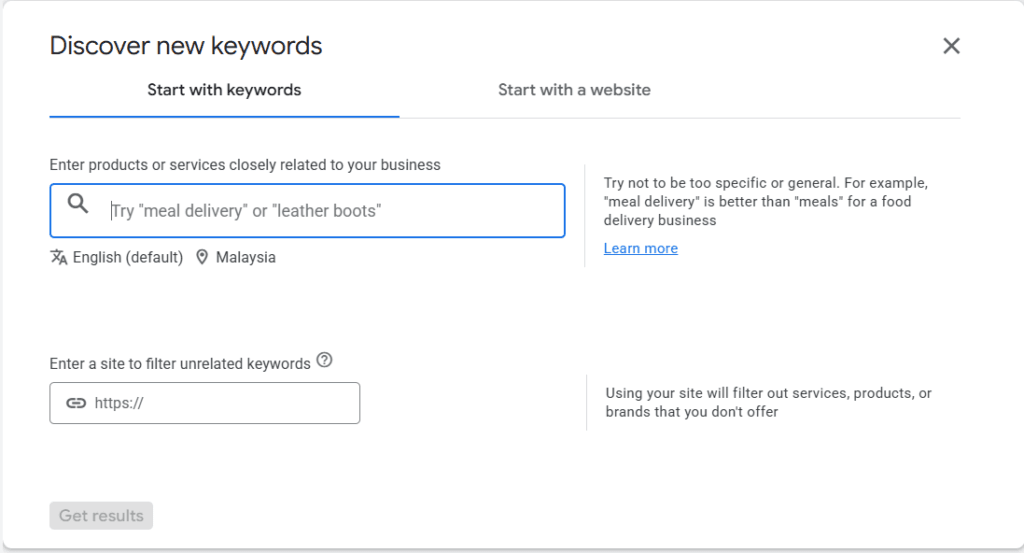
Google Keyword Planner is the entry-level tool — free, and the only tool with data sourced directly from Google’s own search index. Its limitations are worth knowing: volume figures are shown in ranges rather than exact numbers (a keyword might show “1,000–10,000 monthly searches,” which is frustratingly imprecise), and the tool is designed primarily for Google Ads users, which can skew its suggestions toward commercial rather than informational queries.
Use Keyword Planner to validate that demand exists for your seed keywords, discover related terms and variants, and get a rough sense of relative volume between different keyword options. Enter your domain URL in the “Start with a website” option to see what Google associates with your existing content — this often surfaces keyword opportunities tied to your current pages that you haven’t intentionally targeted.
Ahrefs and Semrush (Paid)
For serious keyword research at scale, paid tools provide data that free tools simply can’t match: accurate monthly search volumes (not ranges), keyword difficulty scores calculated from real SERP analysis, competitor keyword gap reports, and click-through rate estimates that account for features like featured snippets and People Also Ask boxes that absorb clicks without sending visitors to websites.
According to Ahrefs’ explanation of how keyword difficulty is calculated, their KD score estimates how hard it would be to rank in the top 10 based on the number and quality of backlinks the top-ranking pages have earned. A KD of 10 means you could plausibly rank with minimal link building; a KD of 70 means you’re competing against well-established pages with strong backlink profiles.
Both tools also provide keyword gap analysis — a direct comparison between your website and a competitor’s to show which keywords they rank for that you don’t. For Malaysian SMEs, this competitor gap report is often the most valuable single output of the keyword research process: a prioritised list of proven opportunities.
What the Data Actually Tells You
No tool gives you certainty. Search volume estimates vary between tools — sometimes significantly — because each tool uses its own data collection methodology. Keyword difficulty scores are estimates based on available data, not guarantees of rankability. A keyword with a KD of 35 may be easier or harder to rank for depending on the specific pages competing for it.
Use tool data as directional guidance, not absolute truth. A keyword showing 500 monthly searches in Ahrefs might actually generate 300 or 800 — the important thing is that meaningful demand exists and the number is large enough to justify the content investment. Cross-reference volume estimates between two tools when making significant content decisions.
Step 4 — Filter and Prioritise Your List
After expanding your seed list with tools and competitor research, you’ll typically have hundreds of keyword candidates. You can’t target all of them at once. Four filters help you build a prioritised short list.
Search Volume — Is There Enough Demand?
The minimum viable volume threshold depends on the value of a customer in your industry. A dental clinic where a single implant case is worth RM8,000 might justify creating a comprehensive page targeting a keyword with only 100 monthly searches, because even one conversion per month makes the content investment worthwhile. A RM30 product business needs meaningfully higher volume to justify the same investment.
As a general benchmark for Malaysian SMEs: keywords with under 50 monthly searches are usually worth addressing only within existing content (as a secondary keyword) rather than as the primary target of a dedicated page. Keywords with 100–500 monthly searches are viable targets for well-focused content. Keywords with 500+ monthly searches represent significant opportunities worth prioritising.
Keyword Difficulty — Can You Realistically Rank?
Keyword difficulty is a relative measure — it only tells you how competitive the top-ranking pages are, not whether you can outrank them. A website with a well-developed backlink profile and strong topical authority in dental care has a realistic shot at ranking for KD 50 dental keywords. A new website in the same category, starting from scratch, does not.
The practical approach for most Malaysian SMEs: prioritise keywords with KD under 30 in the first 6–12 months. These are achievable targets where well-written, well-structured content can rank without an established domain authority. As your site accumulates authority over time, progressively target higher-difficulty terms that were out of reach initially.
Intent Match — Does This Keyword Fit Your Page?
Every keyword you target should map to a page whose purpose matches the search intent behind the query. This is the filter that prevents keyword cannibalization — the scenario where multiple pages on your site compete for the same query — and ensures your content actually satisfies what the searcher wanted.
An informational query (“how to prevent cavities”) should map to a blog article or educational page. A transactional query (“book dental cleaning KL”) should map to a service page with a clear call-to-action. Mixing these on the wrong page type is one of the most common content strategy errors — and it’s why pages that seem well-optimised for a keyword still fail to rank because Google can tell the page isn’t what the searcher actually wants.
Business Value — Will This Keyword Drive Revenue?
Some keywords attract significant traffic but don’t convert into business. A physiotherapy clinic that ranks for “physiotherapy exercises for back pain” will attract people who want to exercise at home, not book an appointment. A financial advisory firm that ranks for “how to save money monthly” attracts general savers, not people looking for investment advice.
Evaluate each keyword against a simple question: is the person searching this likely to become a customer? If yes, prioritise it. If the searcher’s goal is to do something themselves that your service provides — and they’re unlikely to convert — that keyword may still have brand awareness value but shouldn’t take priority over keywords with higher commercial relevance.
Step 5 — Map Keywords to Pages (Not the Other Way Around)
The final step in keyword research is assigning each keyword to a specific page — either one that already exists or one you need to create. This is keyword mapping, and it’s the bridge between keyword research and your content plan.
The foundational rule: one primary intent per page. Two pages that target the same intent and compete for the same keyword pool will undermine each other. This is how keyword cannibalization develops — not through carelessness but through a missing keyword map that would have prevented the overlap.
The structure that prevents this at scale is a topic cluster model — one pillar page covering a broad topic at a high level, with multiple cluster pages each covering a specific sub-topic in depth. Understanding how topical authority is built through this cluster approach explains why this architecture produces better rankings than an equivalent number of isolated, unconnected pages.
Each cluster within your keyword map should also have a clear internal linking plan — the pillar page links to every cluster page, every cluster page links back to the pillar, and related cluster pages link laterally to each other. This architecture is what content silos achieve for your website’s structure — making your topical authority legible to Google at a structural level, not just at the page level.
Your keyword map is a living document. Update it when you add services, when you identify new opportunities from Search Console data, and when you audit existing content for gaps or overlaps. In practice, a keyword map in a spreadsheet — with columns for the keyword, monthly volume, KD, intent, mapped page URL, and page status (existing / needs update / new page needed) — is the most useful working tool you can maintain for ongoing SEO management.
Common Keyword Research Mistakes Malaysian Businesses Make
Targeting only English keywords. For many Malaysian businesses, their largest single keyword opportunity is in Bahasa Malaysia or Mandarin — and they’ve never researched it because they assumed English was sufficient. Run your seed keywords through Keyword Planner and Ahrefs in all three languages before finalising your strategy.
Choosing keywords based on volume alone. A keyword with 10,000 monthly searches but KD 80 and fierce competition from established national brands is a poor use of your content budget. A keyword with 300 monthly searches, KD 15, and direct commercial intent for your exact service is a far better target. Volume without context is a vanity metric.
Targeting broad category keywords too early. “Dental clinic Malaysia,” “accounting firm,” “renovation contractor” — these are high-volume, high-difficulty keywords dominated by established players. Starting an SEO strategy by targeting these is like entering your first 10km race at the Olympics. Begin with specific, location-modified, or long-tail variants where competition is lower, build authority in those, then work toward broader terms as your domain strengthens.
Ignoring the keywords your pages are already ranking for. Google Search Console shows you which queries your existing pages receive impressions for — including queries you didn’t intentionally target. This data often reveals keyword opportunities where you’re already appearing at positions 11–20 (page two), meaning a content update or optimisation effort could push you to page one without creating anything new.
Treating keyword research as a one-time exercise. Search behaviour evolves. New services create new search demand. Competitor activity changes the difficulty landscape. A keyword map done once and never revisited becomes stale within 6–12 months. Schedule a keyword audit at least twice a year — and review Search Console data monthly for emerging opportunities.
If the keyword research process surfaces more opportunity than your team has the capacity to execute — whether in content creation, technical implementation, or page structuring — the work of converting a keyword map into actual rankings is where an SEO partner focused on Malaysian markets accelerates the outcome most efficiently.