
If you run a business in Malaysia today, you’re not just competing for visibility on Google—you’re also competing for attention in AI-driven search results like Google’s AI Overviews and conversational search tools.
And while many SME owners focus heavily on ads, keywords, or social media, one of the most underrated growth levers sits quietly inside your own website: internal linking.
Done right, internal linking turns a simple website into a structured system that helps Google understand your business, improves rankings, and guides visitors naturally toward becoming customers.
Why Internal Linking Matters More Than Most SMEs Realise
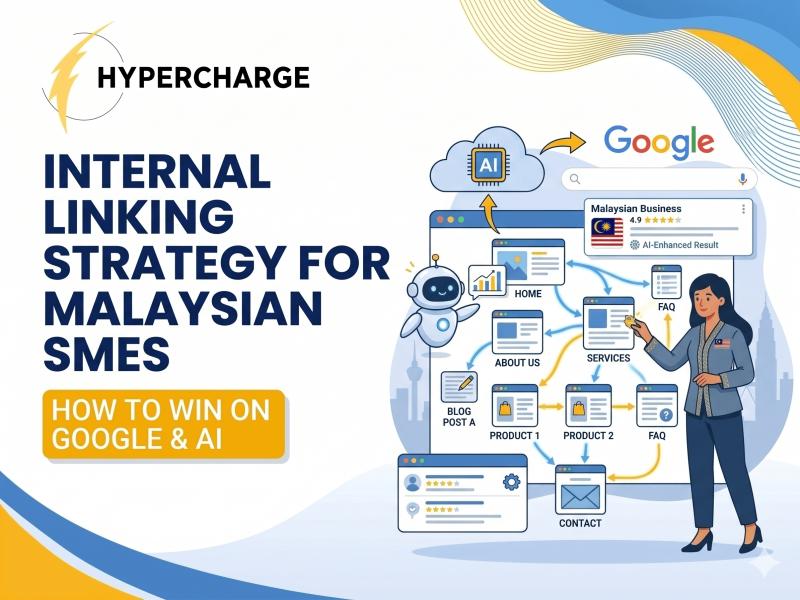
Think of your website as a city.
Your pages are buildings. Your content is the rooms inside those buildings. Without roads connecting them, nobody can move around efficiently—not users, and not search engines.
Internal links are those roads.
For Malaysian SMEs, this matters even more because competition is highly localised. Whether you’re a clinic in KL, a café in Penang, or a contractor in Johor, Google is constantly trying to answer one question:
“Is this business truly relevant and trustworthy in this specific location and service?”
Internal linking helps answer that question clearly.
When your pages consistently connect related topics—services, locations, blogs, FAQs—you are essentially telling Google:
“Yes, we specialise in this area, and here is the full proof.”
How Google and AI Actually “Read” Your Website
Modern search is no longer just keyword matching. Google now uses systems influenced by semantic understanding and AI models that try to map relationships between pages.
This means it doesn’t just look at what you say—it looks at how everything connects.
If your website is scattered, with random blog posts and disconnected service pages, Google struggles to understand:
- What your core services are
- Which pages are most important
- Whether you are an authority in your niche
- How your business fits into a local market like Kuala Lumpur or Penang
But when your internal links are structured properly, something powerful happens: your website becomes easier to interpret not just for Google, but for AI systems that summarise and recommend businesses.
This is where SMEs can gain a real advantage over bigger competitors who often have messy, legacy websites.
The Core Idea is to Build “Topical Clusters”, Not Random Pages
Most SME websites fail because they are built like a collection of standalone pages.
A better approach is to think in clusters.
For example, a renovation company in Malaysia should not just publish random articles like:
- “Kitchen Design Ideas”
- “Bathroom Renovation Cost”
- “Best Tiles in Malaysia”
Instead, these should all connect back to one central authority page:
Pillar Page: Complete Guide to Home Renovation in Malaysia
Each supporting article then becomes a “spoke” that reinforces the pillar.
When done correctly, internal linking transforms your website into a structured knowledge system rather than a blog archive.
Google loves this because it sees depth, not randomness.
Internal Linking and Local SEO in Malaysia
Local SEO is where internal linking becomes especially powerful.
Many SMEs assume Google Maps ranking depends only on their Google Business Profile. That’s only partially true.
Your website plays a major supporting role.
For example, if you run a dental clinic in Subang Jaya, your internal linking should consistently reinforce:
- Treatments (teeth whitening, braces, implants)
- Location pages (Subang Jaya, PJ, KL)
- Trust content (pricing guides, FAQs, patient education)
When these pages are interconnected, you are no longer just “a clinic website”—you become a structured local authority.
Even something as simple as linking a blog post like “How Much Does Braces Cost in Malaysia?” to your “Orthodontic Treatment” page helps Google connect intent with service.
That connection improves both organic rankings and local map visibility.
The Role of Anchor Text (Where Most SMEs Go Wrong)
Anchor text is the clickable part of a link. It sounds simple, but it’s one of the most powerful signals in SEO.
Many businesses make the mistake of using vague phrases like:
- “Click here”
- “Read more”
- “Learn more”
These provide zero context.
Instead, anchor text should describe meaning clearly. For example:
Instead of:
Click here for services
Use:
Affordable air conditioning servicing in Kuala Lumpur
This tells Google exactly what the linked page is about before the user even clicks.
Over time, this improves your site’s semantic clarity and strengthens your rankings for local search terms.
Internal Linking for AI Search (The New SEO Frontier)
Search is evolving fast. AI-powered systems like Google’s AI Overviews and conversational search engines are changing how content is discovered.
Instead of just listing websites, these systems summarise answers.
To be included in those summaries, your content must be:
- Structured
- Clearly connected
- Topically deep
- Easy to interpret as a “source of truth”
Internal linking plays a direct role in this.
When your website has strong content clusters, AI systems can easily identify:
- Your main topics
- Supporting evidence
- Service relationships
- Geographic relevance
For example, a well-linked network of pages about “SME accounting services in Malaysia” makes it easier for AI to confidently cite your site when users ask questions like:
“What is the best accounting service for small businesses in Malaysia?”
Without internal linking, your content becomes isolated fragments. With it, your site becomes a coherent knowledge graph.
Multi-Language SEO in Malaysia (Often Ignored, Very Powerful)
Malaysia is unique because users search in English, Bahasa Malaysia, and sometimes Mandarin—all within the same market.
Internal linking becomes even more important in multilingual websites.
If you have content in multiple languages, each version should be:
- Clearly connected to its equivalents
- Properly separated to avoid confusion
- Structured so Google understands language intent
For example:
- English page → “Business Loan Malaysia”
- Malay page → “Pinjaman Perniagaan Malaysia”
These should not compete with each other. Instead, they should be linked as language alternatives using proper structure.
This improves both SEO clarity and user experience.
The Hidden Problem Most SME Websites Have: Orphan Pages
One of the most common SEO issues is something most business owners never think about: orphan pages.
An orphan page is a page with no internal links pointing to it. To Google, it is essentially invisible.
You might have created a great promotion page or blog post, but if nothing links to it, search engines may never fully index or rank it.
This is why internal linking is not optional—it is foundational.
A simple rule works well for SMEs:
Every new page should be linked from at least three other relevant pages.
This ensures visibility, crawlability, and authority flow across your site.
From Structure to Revenue: Why Internal Linking Impacts Sales
Internal linking is not just an SEO tactic—it directly influences conversions.
When done properly, it guides users through a logical journey:
- They discover a blog post
- They explore a related guide
- They move to a service page
- They contact your business
Without internal links, users often read one page and leave.
With internal links, you are essentially building a guided path toward conversion.
For Malaysian SMEs where trust is critical, this journey matters even more. People rarely buy on the first visit—they need guidance.
Internal linking provides that guidance without feeling like advertising.
Final Thought: Internal Linking Is Your Website’s Growth System
Most SMEs treat internal linking as a technical SEO task.
In reality, it is a business system.
It shapes how Google understands your authority, how AI systems interpret your expertise, and how users move through your website.
If your goal is to win on Google Maps, organic search, and future AI-driven discovery, then internal linking is not something to “optimize later.”
It is something to build correctly from the start.
Because in modern SEO, visibility doesn’t just come from content—it comes from how everything connects.
FAQ for Internal Linking
There is no magic number, but for a standard 500-word blog post, 3 to 5 internal links is usually plenty. Don’t overdo it, or the page will look like spam to your customers
Yes. By using localized anchor text (like “Best Cafe in KL”) in your links, you send a strong signal to Google that your business is relevant to people searching in that specific area
Technically, those are external links. While they are great for sales, they don’t help your website’s internal SEO. You should link to your own product pages first, and then have a button to Shopee from there.
Rank Math and Yoast SEO are both excellent. They provide “Link Suggestions” while you are writing, which helps you find relevant pages to link to without having to search your whole site
Absolutely. AI models like Google’s SGE use the relationship between pages to understand your business. A well-linked site helps the AI “understand” that you are a legitimate local authority.