
A salon owner in Ampang once showed us two Google Maps searches on her phone. For “hair salon Ampang,” her business appeared at number one. She typed “hair salon Cheras” — just 6km away — and her listing was nowhere to be found. Same business, same profile, completely different result. She assumed something was broken. It wasn’t.
This is one of the most common frustrations Malaysian SME owners have with Google Maps: your business seems to rank well for some searches and become invisible for others. The pattern usually comes down to geography — and understanding exactly why this happens is the first step to doing something about it.
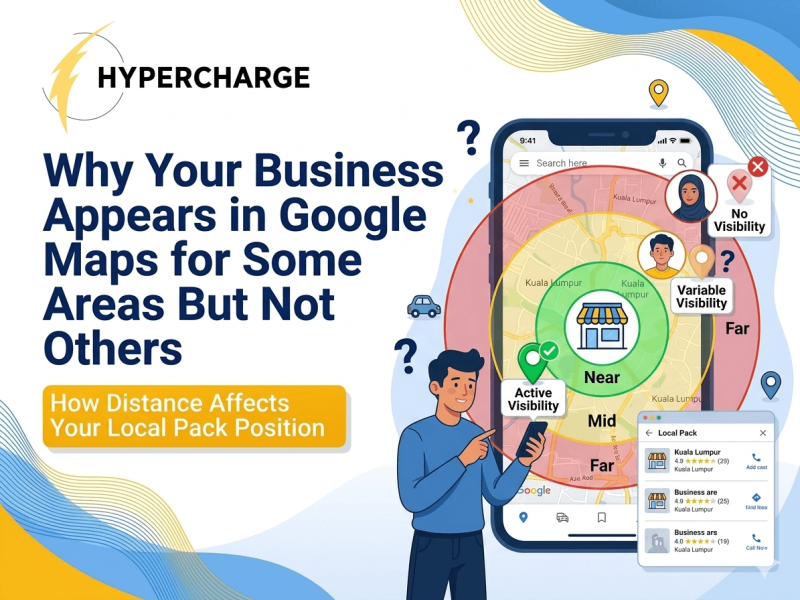
Google Maps ranking is heavily influenced by the physical distance between a searcher and your business. This is why you might rank in the top 3 for searches near your office but disappear for searches from the next neighbourhood. Proximity is one of three core local ranking signals — alongside relevance and prominence — and it can’t be fully overridden, only supplemented.
The Proximity Signal: How Distance Affects Your Local Pack Position
When someone searches for a service on Google, the algorithm doesn’t treat all businesses as equal candidates. It applies a geographic filter — prioritising businesses that are closest to where the search is coming from.
According to Google’s explanation of how distance affects local results, the location of the searcher (or the location they specify in their query) is a primary input. A person searching from a café in Cheras will see different results than someone searching the same query from Ampang — even if both searches are made at the same time.
What “Near Me” Actually Means to Google
When someone types “dentist near me,” Google uses their device’s real-time GPS location to determine what “near me” means. The radius it considers varies by industry and query type — broader for some services, tighter for others. A restaurant search might surface options within 2–3km; a search for a specialist medical service might pull results from a wider area.
For a business with one location, this creates a natural visibility ceiling. You can rank at number one for every searcher within 2km of your shopfront and not appear at all for someone 8km away searching the same term. This isn’t a bug — it’s an intentional design feature that makes Maps useful.
Why Being Relevant Isn’t Enough When Distance Works Against You
Businesses sometimes assume that if they optimise their Google Business Profile thoroughly — choosing the right category, collecting reviews, adding photos — they’ll rank everywhere. That’s not how it works.
Relevance and prominence can compensate for distance to some degree. A business with 200 reviews and a fully optimised profile will outperform a nearby competitor with 10 reviews and a sparse profile. But there are limits. A business in Petaling Jaya is unlikely to consistently appear in the local 3-pack for someone searching from Johor Bahru, regardless of how optimised the profile is.
This is why understanding how to rank on Google Maps in Malaysia involves thinking about both what you can control (relevance and prominence) and what you can only partially influence (proximity).
The local SEO ranking factors research by Moz shows that prominence signals — especially review volume and quality — are the levers that most help businesses extend their effective ranking radius. A business with exceptional prominence can outrank nearby competitors and sometimes appear for searches from farther distances.
How to Improve Visibility in Areas Farther From Your Location
You can’t move your shopfront, but you can extend your effective reach through three complementary strategies.
Setting Up Your Service Area Correctly
If your business serves customers at their location — plumbers, electricians, cleaning services, mobile pet groomers — you should set up a service area in your GBP rather than, or in addition to, a physical address. According to how service area businesses should set up their GBP, you can define up to 20 areas or regions you serve.
Be specific. Don’t just add “Kuala Lumpur” as a service area. Add “Bangsar,” “Bukit Bintang,” “Chow Kit,” “Titiwangsa” as individual entries. Google uses this data to determine your relevance for location-specific queries in those areas.
One important note: hiding your address and using only a service area does reduce your prominence signal slightly, since a verified physical location is a stronger trust signal. For businesses that have a physical office but also serve customers on-site, consider displaying your address and setting a service area.
Using Location-Specific Pages on Your Website
Your website supports your GBP ranking. If you want to appear in Maps searches from Subang Jaya and Shah Alam, creating dedicated pages for those locations helps Google understand your geographic relevance there.
The guide on where to include city names for local SEO covers the specific on-page elements — title tags, H1s, body copy, and schema — that signal location relevance to Google.
Avoid creating thin “city pages” that just swap out a location name. Each page should have genuinely useful local content: specific testimonials from customers in that area, local landmarks referenced naturally, or service details relevant to that neighbourhood.
Building Local Citations for Target Areas
Local citations — your business name, address, and phone number listed in online directories — help Google verify that you serve a particular area. Building citations on directories that are relevant to your target areas strengthens your prominence signal there.
Understanding what local citations are and how to use them strategically gives you a full picture of which directories matter most for Malaysian businesses and how to prioritise citation building by target location.
When Multiple Offices or Branches Help
For businesses with genuine multi-location operations, creating separate GBP listings for each physical location is the most effective way to rank in multiple geographic areas. Each listing represents a distinct location with its own address — and therefore its own proximity advantage for nearby searchers.
This only applies when you have an actual, staffed location. Creating fake addresses or “virtual offices” to generate additional listings violates Google’s policies and can lead to all your listings being removed.
If you have a second genuine branch — a clinic in both Cheras and Petaling Jaya, for example — each deserves its own fully optimised profile, its own review collection effort, and ideally its own dedicated page on your website.
How Far Can Your Listing Realistically Rank?
For most Malaysian SMEs in urban areas, the practical ranking radius in a competitive category (dentists, clinics, salons, restaurants) is 3–8km. In less competitive categories or in smaller towns, it can extend to 15–20km.
For service-area businesses with high prominence, exceptional review scores, and well-built service area pages, that radius can extend further. But there are no guarantees — and anyone promising that you’ll rank in Google Maps for a location 50km from your business is overpromising.
The most sustainable approach is to dominate your immediate catchment area first, then systematically build the signals needed to extend your reach outward. If you want a structured plan for your specific business and location, our local SEO services for Malaysian businesses are built around exactly this kind of proximity-first strategy.
Frequently Asked Questions
Yes, significantly. Your registered address is a core proximity signal. Changing it — even to a location just a few kilometres away — will shift which searches you’re most visible for. Plan any address change carefully and monitor your rankings before and after.
Yes, it’s possible — especially in low-competition areas or categories. But a website dramatically strengthens your prominence signal and gives Google more data to understand what your business does and where it operates. Most businesses that rank consistently in the top 3 for competitive terms in Malaysia have a well-built supporting website.
Your listing position doesn’t change based on time of day. However, your listing may appear or disappear based on your business hours settings — Google may suppress listings for businesses that are currently closed in some search contexts. Keeping your hours accurate matters.