
Somewhere in Malaysia right now, a business owner is signing an SEO contract with an agency that charges RM500 a month and promises first-page Google rankings within 60 days. In three months, the rankings arrive. The business owner is delighted. Six months later, a Google algorithm update rolls through — and the website disappears from search results entirely.
This scenario plays out more often than it should. The SEO industry in Malaysia, like everywhere else, has a spectrum of practitioners — from agencies doing rigorous, sustainable work to operators running link farms and selling short-term ranking boosts to clients who don’t know the difference. The problem isn’t that business owners are naive. It’s that black hat tactics and white hat tactics can look identical in a monthly report for the first few months.
By the time the difference is visible, the damage is already done.
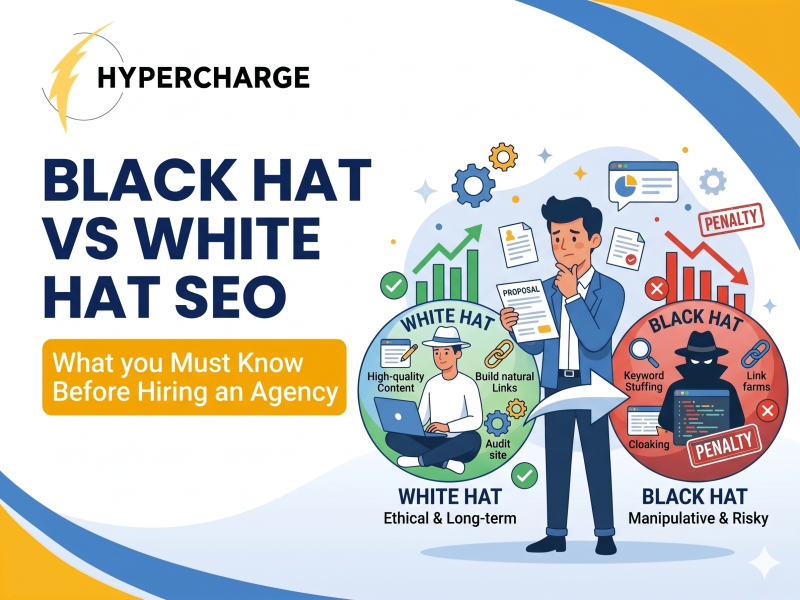
Black hat SEO refers to tactics that violate Google’s guidelines to manipulate rankings artificially — buying links, stuffing keywords, cloaking content. White hat SEO builds rankings through legitimate means: quality content, earned backlinks, and technical optimisation. In Malaysia, black hat tactics can produce short-term ranking gains that collapse when Google updates its algorithm or issues a manual penalty against your domain.
This article explains exactly what each approach looks like, what the risks are, and — most practically — the seven questions to ask any agency before you hand over your domain.
📌 Key Takeaways
- Black hat SEO uses tactics that violate Google’s guidelines — it can produce fast rankings that collapse suddenly when Google catches up
- White hat SEO builds rankings through content quality, earned links, and technical optimisation — slower but durable
- Google issues two types of penalties: manual actions (a human reviewer flagged your site) and algorithmic penalties (an update demoted your site automatically)
- Recovering from a Google penalty takes months and is not guaranteed — prevention is significantly easier than recovery
- The clearest red flag: any agency that guarantees specific rankings within a fixed timeframe
- Seven questions in this article will help you vet any Malaysian SEO agency before signing
What Black Hat SEO Actually Means — Beyond the Buzzword
“Black hat” gets thrown around loosely — sometimes used to describe any aggressive SEO tactic, which isn’t accurate. The precise definition is: any tactic that violates Google’s Spam Policies for web content. Not tactics Google dislikes. Not tactics that are risky. Tactics that Google has explicitly classified as manipulative and subject to penalty.
Here are the four that appear most commonly in the Malaysian market.
Link Schemes and Bought Backlinks
Backlinks — links from other websites to yours — are one of Google’s strongest ranking signals. The temptation to buy them is obvious. Pay a service, receive 200 backlinks from various websites, rankings go up.
The problem is twofold. First, most purchased backlinks come from low-quality sites — content farms, expired domain networks, irrelevant foreign websites — that Google’s algorithm has already devalued or flagged. Second, Google’s link spam guidelines explicitly classify buying or selling links that pass ranking credit as a violation, regardless of how natural the link looks.
A Malaysian legal firm that buys 300 backlinks from a link vendor may see a rankings jump in month one. By month six, if Google’s SpamBrain system identifies the pattern — or a competitor files a spam report — those links can trigger a manual review that results in the domain being penalised.
Keyword Stuffing
Keyword stuffing is the practice of loading a page with keywords beyond what reads naturally — repeating the target phrase in every paragraph, listing keywords in the footer, or hiding keyword-dense text behind white-on-white formatting.
A clinic page that says “dental implants Kuala Lumpur” seventeen times in 600 words is keyword stuffing. Google’s algorithm identifies unnatural keyword density and discounts or penalises those pages. What’s worse: it makes the page actively unpleasant to read for actual visitors, reducing engagement and conversion rates even when rankings do appear.
Cloaking and Hidden Text
Cloaking means showing different content to Google’s crawler than to human visitors. An agency might optimise a page heavily for a target keyword and serve that version to Googlebot, while actual users see a different, less keyword-heavy version. This tricks Google into ranking content based on something visitors never actually see.
Hidden text works similarly — white text on a white background, or text positioned off-screen using CSS — making keyword-stuffed content invisible to visitors but readable by crawlers.
Both tactics are among the clearest violations in Google’s guidelines and among the fastest to trigger a manual action when discovered.
Private Blog Networks (PBNs)
A PBN is a network of websites built specifically to link to target domains — appearing to Google as independent third-party endorsements when they’re actually controlled by a single operator. A link from a PBN looks like a genuine backlink from another website. It isn’t.
PBNs are widely used in the Malaysian SEO market, often sold as “high DA backlinks” or “authority backlinks” in agency packages. The quality of the network varies enormously — some PBNs pass ranking signals for months or years before Google deindexes them; others collapse within weeks. When the PBN sites are deindexed, the links they carried disappear — and rankings built on those links disappear with them.
What White Hat SEO Looks Like in Practice
White hat SEO isn’t a specific set of tactics so much as a philosophy: build rankings by making your website genuinely better, not by manipulating signals artificially. In practice, it involves three things.
Content That Earns Its Rankings
White hat content is written for people, not crawlers. It answers real questions that real searchers are typing into Google. It’s accurate, detailed, and more useful than competing pages. Understanding what Google’s E-E-A-T guidelines mean for your content — Experience, Expertise, Authoritativeness, and Trustworthiness — gives you the framework Google uses to evaluate whether your content deserves to rank.
This is why white hat SEO takes longer. Writing genuinely useful content, building a track record of accuracy, and earning the trust of both readers and Google cannot be faked or shortcut. But once earned, those rankings are durable.
Backlinks That Are Actually Earned
Legitimate backlinks come from other websites choosing to link to you because your content is worth referencing — a local news site covering your business, an industry directory listing, a genuinely useful resource that other websites cite in their own articles.
This is harder to scale than buying links. But earned backlinks from relevant, authoritative Malaysian websites — media outlets, professional associations, local business directories — carry far more long-term value than any volume of purchased ones.
Technical Optimisation Without Manipulation
White hat technical SEO makes your website faster, more accessible, and easier for Google to crawl and index — not to trick the algorithm but because those improvements genuinely serve visitors. Fixing Core Web Vitals, improving site structure, adding appropriate schema markup, resolving indexing issues — all of these help Google understand and rank your site without manipulating signals.
The Real Cost of Black Hat SEO for Malaysian Businesses
The risk of black hat SEO is not just theoretical. Google penalises sites in two distinct ways, and both can be devastating.
Manual Penalties
A manual action occurs when a human reviewer at Google evaluates your site and determines it violates their guidelines. This is typically triggered by a spam report from a competitor, an algorithmic flag that escalates to human review, or a routine quality evaluation.
When a manual action is applied, Google notifies you in Search Console — specifically which pages or your entire domain are affected, and why. Depending on the severity, your site may drop significantly in rankings or be removed from search results entirely for affected pages.
Removing a manual action requires submitting a reconsideration request — after genuinely fixing the violations. Google reviews these manually, which takes weeks. Approval is not guaranteed. Some sites never recover fully.
Algorithmic Penalties
Unlike manual actions, algorithmic penalties don’t come with a notification. They occur when a Google algorithm update — like a core update or a spam update — rolls through and reweights signals in a way that demotes sites engaging in manipulative practices.
One week your site ranks on page one. The next week, after an update, it’s on page four. No warning, no explanation, no reconsideration process. The only solution is to identify and fix the underlying practices — and wait for the next algorithm update to hopefully restore rankings.
The Recovery Problem
Here’s what makes black hat penalties particularly painful for Malaysian SMEs: recovery takes longer than the initial optimisation did. A site penalised after six months of black hat link building may take 12–18 months of clean work before rankings meaningfully recover — if they recover at all. Domain trust, once damaged, rebuilds slowly.
The business cost during that recovery period — lost leads, lost revenue, the cost of cleanup work — almost always exceeds whatever was saved by choosing the cheaper agency in the first place.
Why Black Hat SEO Is Still Sold in Malaysia
If black hat SEO carries such clear risks, why do agencies still sell it? Three reasons.
The lag between tactic and consequence. Rankings from manipulative tactics can hold for months before Google catches up. During that window, the agency looks effective and the client is happy. By the time the penalty hits, the client may have renewed the contract — or the agency blames the penalty on a “Google algorithm change” rather than their own tactics.
Client knowledge gaps. Most Malaysian business owners don’t know what a backlink audit looks like, what a PBN is, or how to read a Google Search Console manual actions report. What they see is rankings going up and a monthly report with green arrows. That’s all they’re shown.
Price pressure. White hat SEO — real content creation, genuine outreach, technical work — costs more than automated link building. Agencies that cut corners on tactics can undercut agencies doing legitimate work on price. For a business owner comparing two proposals without knowing the underlying methodology, the cheaper option looks equivalent.
This is the same pattern seen in Google review manipulation in Malaysia — where business owners purchase fake reviews for fast social proof, not realising that Google detects and removes manipulated reviews, and that the practice risks listing suspension.
Seven Questions to Ask Any SEO Agency Before You Sign
These questions won’t guarantee you pick the right agency — but they will immediately expose agencies that can’t or won’t answer them.
1. Can you show me examples of backlinks you’ve built for clients in my industry? A legitimate agency can show you real links on real websites. If the answer is vague or they offer a “backlink report” with dozens of unrecognisable foreign domains, press for specifics.
2. What does your content creation process look like? White hat agencies write original, well-researched content based on keyword and intent research. If the answer involves “content packages” with no mention of keyword mapping or topical strategy, the content is likely thin or templated.
3. How do you define and measure success for my business? Ranking position is a means, not an end. An agency focused purely on rankings without discussing traffic, leads, or conversions is optimising for the metric that’s easiest to manipulate.
4. Have any of your clients received Google manual actions? How did you handle it? Every experienced agency has encountered algorithm volatility. How they describe handling penalties — and whether they acknowledge it has ever happened — tells you a lot about their transparency and accountability.
5. Do you use PBNs or any link networks to build backlinks? Ask directly. Most agencies using PBNs will deflect or use euphemisms (“high-authority link placements,” “curated link networks”). A direct no — with an explanation of what they do instead — is what you want to hear.
6. What happens to my rankings if I stop working with you? White hat rankings, built on content and earned links, generally hold after an engagement ends (though they decline gradually without maintenance). Manipulated rankings often collapse immediately. The honest answer acknowledges some decline but explains what durable assets have been built.
7. Can I have access to my own Search Console, Analytics, and any accounts you create? Your data belongs to you. Agencies that create accounts in their own name rather than yours, or resist giving you admin access, are creating dependency. Always insist on ownership of all accounts from day one.
If you want a more structured approach to finding and evaluating the right SEO partner for your Malaysian business, Hypercharge’s engagement starts with a technical audit and a clear methodology document — no vague promises, no locked accounts.
Red Flags You Should Never Ignore
Beyond the seven questions, these are immediate disqualifiers regardless of price or pitch quality:
| Red Flag | What It Usually Means |
| “Guaranteed page-one rankings in 30 days” | PBNs or link schemes — no legitimate tactic delivers this reliably |
| “We have a special relationship with Google” | False — no agency has preferential ranking treatment from Google |
| Monthly reports with rankings but no traffic data | Rankings may be for terms nobody searches for |
| Resistance to sharing account access | Agency owns your data, not you — a dependency trap |
| Prices dramatically below market rate | Corners are being cut somewhere in the methodology |
| No clear explanation of link building methodology | The methodology they won’t explain is usually one they shouldn’t be using |
| Pressure to sign immediately with a “limited offer” | High-pressure sales is incompatible with strategic, long-term SEO work |
The full SEO guide for Malaysian businesses covers what a complete, ethical SEO engagement should look like from month one through to ongoing optimisation — which gives you a useful benchmark for evaluating any agency proposal against.
Frequently Asked Questions
No. Aggressive SEO means pursuing rankings assertively — publishing frequently, building links proactively, optimising technically in depth. None of that is black hat if it’s done within Google’s guidelines. Black hat specifically means violating those guidelines. An agency can be highly aggressive and entirely white hat simultaneously.
Yes, recovery is possible — but it’s slow and not guaranteed. For a manual action, you need to remove or disavow the violating backlinks, fix any on-site issues, submit a reconsideration request, and wait for Google’s review. For algorithmic penalties, the process is the same minus the formal review — you fix the issues and wait for the next relevant update to re-evaluate your site. Full recovery typically takes 6–18 months, and some domains never fully regain their pre-penalty position.
A disavow file is a document you submit to Google through Search Console telling Google to ignore specific backlinks to your site — essentially saying “I didn’t build these links and I don’t want them counted.” It’s used when your site has accumulated spammy or manipulative backlinks (whether built by a previous agency or pointing at you by a competitor in a negative SEO attack) and you can’t get them removed manually. Disavow files should be used carefully — incorrectly disavowing legitimate links can hurt your rankings. This is a task for an experienced SEO practitioner, not a DIY fix.
Yes — though the timeline is longer. Healthcare, legal, and financial services businesses in Kuala Lumpur have reached and maintained page-one positions through white hat SEO alone. The key is topical authority — building comprehensive, high-quality content clusters around specific service areas rather than trying to rank a single page for a broad competitive term. It takes 9–18 months in the most competitive categories, but those rankings are durable and continue compounding in value.
Start by checking Google Search Console for any manual actions (under Security & Manual Actions → Manual Actions). Then request a full backlink report from your agency and review the domains linking to you — a sudden spike of hundreds of links from unrelated foreign websites is a warning sign. If you have concerns, an independent SEO audit from a separate practitioner can assess your link profile and on-site practices objectively.