
TLDR: AI tools — ChatGPT, Google Gemini, Perplexity, Microsoft Copilot — are increasingly being used as the first stop in a purchase decision. Not as a novelty, but as a genuine research tool. Malaysian consumers use them to ask for recommendations, compare options, and shortlist businesses before visiting Google or WhatsApp. If your business doesn’t appear in those AI-generated answers, you’re invisible at the top of a buying journey you never knew existed.
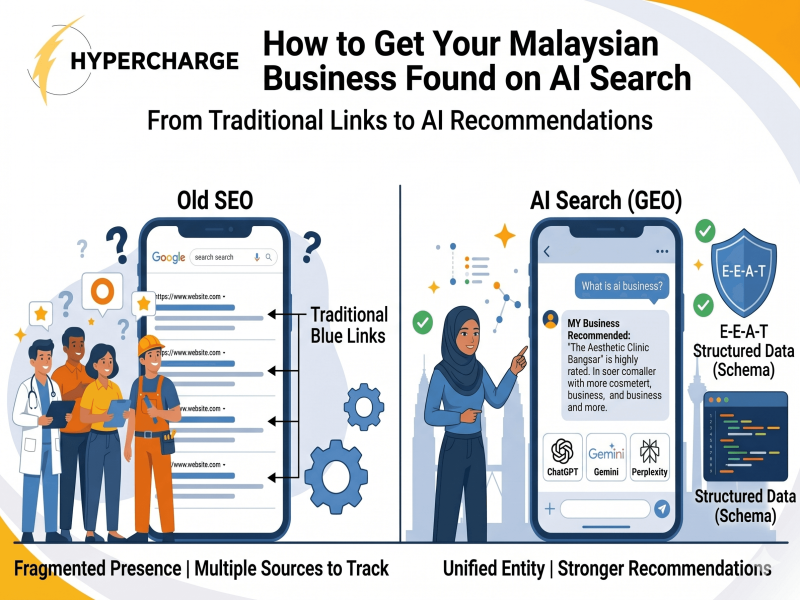
AI tools like ChatGPT, Google Gemini, and Perplexity recommend businesses based on what they’ve learned from the internet — specifically from authoritative websites, structured business data, reviews, and consistent brand mentions across multiple sources. To appear in AI-generated recommendations, your business needs to be clearly defined, consistently described, widely cited, and trusted by the sources these AI tools train on and reference
A potential patient in Kuala Lumpur opens ChatGPT and types: “What’s a good aesthetic clinic in Bangsar?” ChatGPT names three clinics. None of them is yours — even though you have 80 Google reviews, a fully optimised GBP, and a website that ranks on page two for the same search term.
This is the new visibility gap. And it’s catching Malaysian business owners off guard.
The important thing to understand is that AI visibility is not random and it is not reserved for large brands. It follows a logic — and that logic is learnable.
📌 Key Takeaways
- AI tools like ChatGPT and Gemini recommend businesses based on what they’ve absorbed from the internet — your visibility in those tools depends on how clearly and consistently your business is described across trusted online sources
- Most Malaysian SMEs are invisible to AI right now because their online presence is fragmented, inconsistent, or lacking in authoritative third-party citations
- The six factors that drive AI visibility are: entity clarity, authoritative content, E-E-A-T signals, structured data, third-party citations, and a strong Google Business Profile
- GEO (Generative Engine Optimisation) and AEO (Answer Engine Optimisation) are not separate strategies from SEO — they are extensions of it, built on the same foundations
- Google AI Overviews and Gemini favour content that Google already trusts in organic search — which means good SEO is the prerequisite for AI visibility, not an alternative to it
- AI visibility builds over months, not weeks — but businesses that start now will have a meaningful advantage as AI search adoption accelerates in Malaysia
How AI Tools Actually Decide Which Businesses to Recommend
Before you can optimise for AI visibility, you need to understand how different AI tools source their recommendations. They don’t all work the same way — and the differences matter for how you prioritise your effort.
What ChatGPT Knows — And Where It Learned It
ChatGPT (built on OpenAI’s large language models) was trained on vast amounts of text from the internet — articles, websites, directories, reviews, forum posts, news coverage, and more — up to a certain knowledge cutoff date. When it recommends a business, it’s drawing on patterns in that training data: which businesses were mentioned frequently, in what context, with what level of confidence, and across how many independent sources.
This has an important implication: ChatGPT’s knowledge of your business is essentially a reflection of how well-represented you are across the wider internet as it existed during its training period. A business mentioned in ten independent, credible sources — a news article, a few directory listings, a case study, some review platform profiles — is far more likely to be recommended than one that exists only on its own website.
ChatGPT with web browsing enabled (in its newer versions) can also pull real-time information — but the underlying bias toward well-established, widely-cited entities remains. The more your business is mentioned across trusted sources, the more confidently ChatGPT can recommend it.
How Google Gemini and AI Overviews Pick Their Sources
Google Gemini and Google’s AI Overviews — the AI-generated summaries that appear at the top of some Google Search results — operate differently from ChatGPT. They draw directly from Google’s own search index and apply a ranking logic closely aligned with how Google AI Overviews selects content to feature.
The critical insight here: if your content ranks well in Google’s organic search results, it is significantly more likely to be featured in Google’s AI-generated answers. Google AI Overviews are not an entirely separate system — they are a layer on top of Google’s existing trust and relevance evaluation. Pages that Google trusts in organic search are the ones Google’s AI features in its generated responses.
This means the best investment for appearing in Google Gemini is exactly the same as the best investment for ranking in Google Search — well-structured, authoritative, trustworthy content. The two goals reinforce each other completely.
How Perplexity Decides What to Cite
Perplexity AI is a real-time AI search engine that actively crawls the web and cites its sources explicitly. When a user asks Perplexity to recommend a dental clinic in Petaling Jaya, Perplexity searches the web, evaluates the results, and generates a response — listing the sources it drew from.
This makes Perplexity the most SEO-adjacent of the AI tools. The businesses that appear are the ones that rank well in web search for the relevant query, have clear and credible websites, and are mentioned in reputable directories and review platforms. If your website ranks on page one for a query that a Perplexity user asks, your business has a strong chance of being cited in Perplexity’s answer.
Why Most Malaysian Businesses Are Invisible to AI Right Now
The honest diagnosis: most Malaysian SME websites give AI very little to work with.
They have a homepage with a short paragraph describing the business. A services page with bullet points. A contact page. No blog content. No authoritative third-party mentions. No structured data. No named individuals with verifiable credentials. No consistent description of what the business does and who it serves across multiple independent sources.
When an AI tool tries to identify businesses to recommend for “physiotherapy clinic Cheras,” it’s looking for signals of legitimacy, expertise, and identity. A website with thin content and no external presence provides almost none. The clinics that get recommended are those that exist meaningfully across the internet — not just on their own website.
The encouraging part is that this is fixable. And the businesses that fix it now — while most competitors are still unaware this gap exists — will hold the AI visibility advantage for years.
The 6 Things That Make a Business AI-Visible
1 — A Clear, Consistent Entity Definition
AI systems work with entities — clearly defined real-world things with specific attributes. Your business is an entity. For AI to confidently recommend it, that entity needs to be defined consistently everywhere it appears online.
Your business name, location, services, and specialisation should read identically across your website, Google Business Profile, social media profiles, directory listings, and any press or third-party mentions. Inconsistencies — different names, conflicting addresses, varying service descriptions — create ambiguity. AI tools avoid recommending ambiguous entities because they cannot be confident the recommendation is accurate.
This is a direct extension of the NAP consistency principle in local SEO — but applied to your entire entity footprint across the internet, not just your address and phone number.
2 — Authoritative Content That Answers Specific Questions
AI tools are trained to find answers to questions. The businesses that appear most reliably in AI-generated responses are those whose online content directly and clearly answers the questions people are asking.
A dental clinic whose website has a detailed FAQ answering “how much do dental implants cost in Malaysia?”, “what is the recovery process after implant surgery?”, and “are you suitable for dental implants?” is giving AI something specific and useful to reference. A dental clinic whose website says only “we offer dental implants — call us” gives AI nothing to work with.
Building topical authority through comprehensive, question-answering content is one of the most direct investments in AI visibility you can make. The depth and specificity of your content determines whether AI tools can extract meaningful answers to cite.
3 — E-E-A-T Signals That AI Systems Can Verify
AI tools — particularly Google’s — place enormous weight on signals of Experience, Expertise, Authoritativeness, and Trustworthiness. Understanding what Google’s E-E-A-T framework means for your business is foundational to understanding what AI systems look for when evaluating whether to recommend you.
For a clinic, this means: named doctors with verifiable credentials, specific medical specialisations clearly stated, clinic accreditations mentioned, and content that demonstrates genuine clinical knowledge rather than generic health information.
For a law firm: named attorneys with bar registration, specific legal specialisations, case outcomes (where shareable), and content that demonstrates jurisdiction-specific legal knowledge.
For a home service provider: certifications, years of experience, specific project types completed, named team members. The more verifiable real-world detail your online presence contains, the more confidently an AI system can evaluate and recommend your business.
4 — Structured Data That Speaks AI’s Language
Structured data — specifically schema markup — is code added to your website that describes your business in machine-readable form. It tells AI systems and search engines not just what your page says, but what type of entity you are, what you offer, where you’re located, what your credentials are, and how customers rate you.
Schema markup is one of the most direct technical signals available for AI visibility. A LocalBusiness schema with accurate service types, location, hours, and aggregate rating gives AI tools structured, unambiguous data to work with. A MedicalOrganization schema with named physicians and medical specialties is even stronger for healthcare businesses.
According to Google’s documentation on structured data in AI-generated answers, pages with clear structured data are better candidates for AI-generated response features. This makes schema markup one of the highest-ROI technical investments specifically for AI visibility.
5 — Citations From Trusted Third-Party Sources
The most powerful signal in AI visibility is not what your website says about you — it’s what other credible websites say about you. Third-party citations from independent, trusted sources tell AI systems that your business is real, established, and recognised by others.
For Malaysian businesses, valuable citation sources include:
- Local media mentions — The Star, Malay Mail, Sin Chew Daily, Free Malaysia Today, Harian Metro
- Industry directories — for clinics: DoctorOnCall, KKiAHealth; for legal firms: Malaysian Bar directory; for home services: Recommend.my, ServisHero
- Review platforms — Google Reviews, Clutch, Trustindex — where volume and authenticity signal credibility
- Professional association listings — Malaysian Medical Council, Malaysian Bar Council, CIDB for contractors
- Educational or government references — any mention in .edu or .gov.my domains carries significant weight
Each independent source that mentions your business with consistent identifying information — name, location, specialisation — strengthens your entity footprint in the data AI tools draw from.
6 — A Strong Google Business Profile
For AI tools that reference real-time web data — particularly Google Gemini and Perplexity — your Google Business Profile is one of the most directly indexed sources of business information available.
A fully optimised GBP with accurate category, complete service list, regular photo updates, and a strong review profile feeds directly into the data Google’s AI systems use when generating local business recommendations. The GBP is Google’s own structured entity record for your business — and Google’s AI naturally trusts its own data.
This is why local SEO and GBP management have become even more important in the AI search era — the foundational local signals that drive Maps rankings are the same ones that feed AI-generated local recommendations. The two are not parallel strategies. They are the same strategy.
GEO vs AEO vs SEO — What’s the Difference and Do You Need All Three?
These three acronyms appear frequently in discussions about AI search and they can be confusing. Here’s the plain-language distinction.
SEO (Search Engine Optimisation) — optimising your website and online presence to rank in traditional search results (the blue links in Google). This is the foundation. Everything else builds on it.
AEO (Answer Engine Optimisation) — structuring your content to appear directly in answer boxes, featured snippets, and AI-generated responses when someone asks a specific question. If someone asks “what is the best dental clinic in Bangsar?” and an AI tool generates an answer, AEO is what determines whether your clinic is mentioned. The core tactic: write content that directly and concisely answers the specific questions your customers ask.
GEO (Generative Engine Optimisation) — the broader strategy of making your business visible across AI-generated content at any stage of a user’s query — not just question-answering, but brand mentions, comparisons, recommendations, and summaries. GEO encompasses AEO and extends it to the full range of AI-generated outputs.
Do you need all three? In practice, a well-executed SEO strategy already creates the foundation for both AEO and GEO. The additional steps specific to AI visibility — schema markup, entity consistency, third-party citations, authoritative question-answering content — are extensions of good SEO, not a separate discipline. The businesses that pursue all three together build the strongest and most durable visibility across both traditional and AI-generated search.
What You Can Do This Month to Start Building AI Visibility
You don’t need to overhaul your entire digital presence immediately. These six actions, done in order, create meaningful AI visibility improvement over the next three to six months.
Week 1 — Audit your entity consistency. Search your business name on Google. Check every result: your website, GBP, social media, directories. Does your business name, address, phone number, and service description read identically across all of them? Document every inconsistency and fix them one by one, starting with the highest-authority sources (GBP first, then your website, then directories).
Week 2 — Add or update schema markup. If your website doesn’t have LocalBusiness schema, implement it this week. If you’re in healthcare or legal, add the appropriate subtype (MedicalOrganization, LegalService). If you have reviews on your site, add AggregateRating schema. If you have an FAQ section, add FAQPage schema. These are the structured signals that AI systems read most reliably.
Week 3 — Create a question-and-answer content plan. Identify ten specific questions your customers ask before buying. These are your AI content targets. Plan one article or FAQ page per question. The goal is to have your website be the clearest, most direct answer to each of those questions anywhere on the internet.
Week 4 — Build one authoritative citation. Reach out to one credible third-party source and get your business mentioned. This might be a guest article in a Malaysian business publication, a listing in a professional association directory, or a press mention tied to a case study or result you’ve achieved for a client. One quality citation a month compounds significantly over 12 months.
Ongoing — Collect and respond to reviews consistently. Review velocity — the rate at which you collect genuine reviews — is an ongoing signal to both AI systems and Google that your business is actively serving customers. Set a target of three to five new reviews per week and build a simple system to collect them.
How Long Before Your Business Appears in AI Recommendations?
There is no fixed timeline — and anyone who promises one is guessing. AI visibility depends on factors partly outside your control: when AI tools next update their training data, how competitive your category is, and which AI tool a user happens to be asking.
What you can control is the strength and completeness of your entity footprint. Businesses with strong SEO foundations, consistent entity data, schema markup, and genuine third-party citations are already better positioned than competitors who have none of these things. The AI visibility advantage accrues to the businesses that start building these signals earliest.
For Google AI Overviews and Gemini specifically — which draw from Google’s live index — the timeline mirrors your SEO improvement timeline. Content that achieves strong organic rankings within six months of publication becomes eligible for AI Overview features on an ongoing basis.
For ChatGPT and similar training-data-dependent tools, visibility improves as your citation footprint grows across the web — a gradual process that benefits from consistent effort over 12 to 24 months.
If you want to understand how Hypercharge approaches AI visibility as a structured service — including entity optimisation, schema implementation, and citation strategy — our AI search optimisation services cover the full scope.
Frequently Asked Questions
No. Neither ChatGPT nor Google Gemini accepts payment for inclusion in AI-generated recommendations. The businesses that appear are those with the strongest organic authority signals — credible websites, authoritative content, verified entity data, and citations from trusted sources. This is both the challenge and the opportunity: AI visibility cannot be bought, only earned.
Probably because your competitor has a stronger entity footprint online — more third-party mentions, more structured data, more question-answering content, or a longer history of being cited across reputable sources. AI tools don’t evaluate “better business” the way a human would. They evaluate representational strength: how clearly, consistently, and widely a business is described and cited across the sources they draw from. Improving your entity footprint is how you close that gap.
No. Google Ads affects your paid search visibility, not your organic or AI visibility. Google AI Overviews and Gemini draw from organic search quality signals — content relevance, authority, E-E-A-T — which are entirely separate from paid advertising. Running Google Ads while investing in AI visibility optimisation serves different goals and is a sensible combination; the paid campaigns do not, however, improve your AI visibility directly.
Focus on the foundation first: consistent entity data, authoritative content, E-E-A-T signals, schema markup, and third-party citations. This foundation improves your visibility across all AI tools simultaneously because all of them draw from the same underlying web data. Only once the foundation is strong does it make sense to optimise specifically for individual tools — for example, writing FAQ-style content specifically to target Google AI Overview features.
Not in the near term. Most Malaysian consumers still use Google Search as their primary discovery tool. AI tools are a growing supplementary channel, not a replacement. The businesses that thrive in the next three to five years will have strong visibility in both — and the good news is that the foundations required are largely the same. Investing in strong SEO and entity authority today is simultaneously an investment in AI visibility for tomorrow.
Read This Next
Understanding why your business isn’t appearing in AI search often reveals the same root cause as why it isn’t converting from traditional search either: unclear positioning, thin content, and insufficient trust signals. Before exploring AI visibility further, make sure the foundations are right.
👉 How to Choose an SEO Agency in Malaysia — And What They Should Actually Cover If you’re going to invest in the content, entity, and technical work that drives both SEO and AI visibility, knowing exactly what to look for in an agency prevents the most expensive mistakes.