
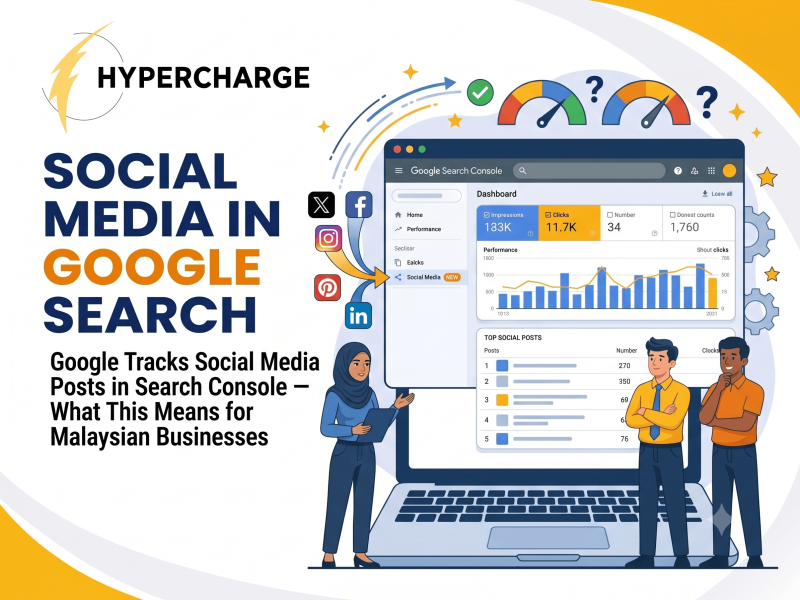
Google just made a move that quietly changes the relationship between social media and search — and most Malaysian businesses haven’t heard about it yet.
On 7 July 2026, Google announced platform properties in Google Search Console. For the first time, businesses can connect their Instagram, TikTok, X (formerly Twitter), and YouTube accounts directly to Search Console and see exactly how their social media posts perform in Google Search and Google Discover. No website required.
This isn’t a minor tweak to an existing report. It’s Google formally acknowledging that social media content is part of the search ecosystem — and giving businesses the data to prove it.
Here’s what it is, what it means, and what you should do with it.
What Google Just Announced
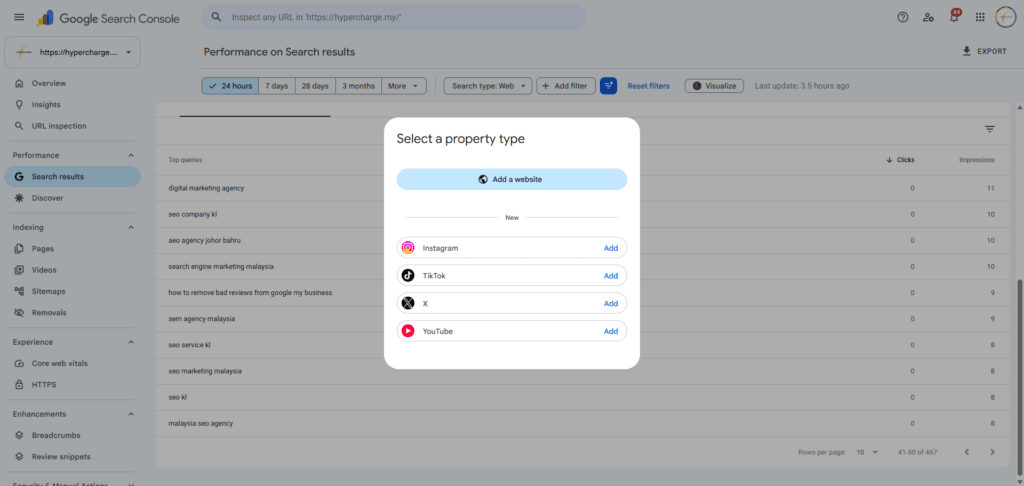
Google has introduced a new property type in Search Console called platform properties. Previously, Search Console only tracked websites. Now it also tracks social accounts.
According to Google’s Search Central announcement and reporting by Search Engine Journal, four platforms are supported at launch: Instagram, TikTok, X, and YouTube. Once connected, each platform property shows you the same kind of data you’d expect from a website property — clicks, impressions, query data — but applied to your social media posts.
The rollout is gradual. If you open Search Console today and don’t see the option to add a platform property, it may not have reached your account yet. Google says it will be widely available over the coming weeks.
What You Can Actually See in Platform Properties
Three reports are included with each platform property.
The Performance report — the core report. It shows total clicks, impressions, and the search queries that led people to your posts. You can filter by post, by query, and sort to find what’s driving the most traffic. The data is exportable.
The Insights report — a higher-level summary of recent traffic patterns, your best-performing posts, and how users discover your account on Google Search and Discover.
Achievements — milestone tracking, such as hitting a new total click threshold within a 28-day window. A gamification layer, but useful for reporting and motivation.
What this data tells you is significant: not just that your posts are appearing on Google, but specifically what search terms people were using when they found them. That’s information that has never been available to social media managers before.
Three Things This Changes for Malaysian Businesses
1 — Google Is Officially Treating Your Social Profile as a Business Entity
This is the most important implication, and it connects to something we’ve been saying for a while: entity SEO has been quietly displacing keyword SEO as the primary framework for how Google understands businesses.
An entity, in Google’s terms, is a clearly defined, well-documented real-world thing — a business, a person, an organisation. Google uses entities to structure its knowledge of the world, and it draws entity data from multiple sources: your website, your Google Business Profile, third-party mentions, review platforms, and increasingly, your social media presence.
Platform properties are Google making that last point explicit. By integrating social accounts into Search Console — its primary webmaster tool — Google is formally including your social profiles in the entity data it collects about your business. Your Instagram is no longer just a place your customers follow you. It is now a source Google uses to understand and surface your business.
The implication: consistency matters more than ever. Your business name, location, services, and identity should read the same across your website, your Google Business Profile, and all four of the newly supported social platforms. Inconsistency creates entity ambiguity. Entity ambiguity reduces visibility.
2 — You Can Now See What People Search to Find Your Social Content
This is the feature that should immediately change how Malaysian businesses approach their social media captions and descriptions.
Until now, social media strategy was largely driven by engagement metrics — likes, shares, reach, saves. These tell you what existing followers respond to. They tell you almost nothing about what people who don’t follow you are looking for.
The platform properties Performance report changes that. When someone searches “Muslimah spa Bangsar” on Google and clicks through to your TikTok or Instagram post, that query is now visible to you in Search Console. You know, with certainty, that this specific search term is bringing people to your content.
Run this data for a month and you’ll know exactly which topics, formats, and content types are attracting organic discovery through Google. That’s your content strategy. The guesswork is gone.
3 — Businesses Without Websites Now Have a Google Foothold
Not every Malaysian SME has a website. Many — particularly sole traders, home-based businesses, and early-stage founders — operate entirely through Instagram or TikTok.
Previously, these businesses had no way to measure or optimise their presence in Google Search. Search Console required a verified website.
Platform properties remove that requirement. A hair salon run entirely through Instagram can now connect that account to Search Console, see which posts appear in Google results, and understand which queries are driving discovery. They can optimise their bio, captions, and hashtags based on actual search data, without ever building a website.
For Malaysian SMEs still in Phase A — validating their offer before investing in a website — this is a material change in the available toolkit.
How to Connect Your Social Accounts to Google Search Console
Setup is straightforward and doesn’t require DNS verification or technical skills.
- Open Google Search Console
- Click on the property selector dropdown (top left)
- Select Add property
- Choose Platform property from the options
- Select your platform — Instagram, TikTok, X, or YouTube
- Follow the on-screen authorisation steps to connect your account
Once connected, data will begin populating within a few days. Google’s official platform property setup documentation walks through each step with screenshots.
One note: if the platform property option isn’t visible in your Search Console yet, the rollout may not have reached your account. Check back over the coming weeks.
The Bigger Picture — What This Tells Us About Where Google Is Going
This update doesn’t exist in isolation. It’s part of a clear directional shift that Google has been making for several years: broadening its definition of a business’s digital presence beyond the website.
Google Business Profile made location and reviews part of your presence. AI Overviews integrated content from across the web. The December 2025 experiment that first integrated social channel data into Search Console was the signal. This July rollout is the commitment.
Why local SEO excels in the AI era comes down to exactly this: the signals Google uses to understand, trust, and surface local businesses have been expanding — from website alone to website plus GBP plus reviews plus social presence plus third-party mentions.
Platform properties are Google formally adding social media to that mix. And this connects directly to what we wrote about GEO — how third-party brand mentions and social media presence increasingly influence AI-generated recommendations. Google is building the infrastructure to surface social content not just in Search results, but as inputs into its AI understanding of your business.
The businesses that build a coherent, consistent presence across all of these surfaces — website, GBP, reviews, social media — are the ones that appear when it matters most. Whether in organic results, Google Maps, AI Overviews, or an answer in ChatGPT, the underlying question is always the same: how well-documented and how widely trusted is this business across the internet? The more channels that consistently describe and endorse you, the better your answer.
What You Should Do With This Right Now
A few concrete actions worth taking in the next two weeks.
Connect your platforms today — even if you can’t see the data yet, connect Instagram, TikTok, and YouTube to Search Console now. Data collection starts from the moment you connect, not from the moment you first look at the report.
Audit your social bio for consistency — your business name, location description, and service description on each connected platform should match what appears on your website and Google Business Profile. This is the simplest entity consistency improvement you can make in under an hour.
Give it 30 days, then review the query data — don’t draw conclusions from one week of data. Wait a full month, then look at the Performance report. Which posts are getting Google clicks? What queries are driving them? Use this to identify which content angles have organic search traction and create more of them.
Update your captions with search intent in mind — once you see which queries lead to your posts, weave those terms naturally into future captions and descriptions. Not keyword stuffing — genuine, relevant language that matches what your audience searches for.
Integrate this into your GEO and AI visibility strategy — social media presence is now a documented input into how Google understands your business. If you’re working on appearing in AI search results like ChatGPT and Gemini, your social profiles are now part of the same brand entity footprint that AI tools draw from.
If you want help thinking through what this means for your specific business — how to align your website, GBP, social profiles, and content strategy into a coherent entity presence — our AI search optimisation service is built around exactly this kind of integrated visibility work.