
Search Engine Optimization (SEO) is essential for businesses seeking to improve their online visibility. If you’ve ever wondered, “what is SEO marketing?” or “what is SEO in digital marketing?”, this guide breaks it down for you step by step. From understanding its basics to mastering advanced practices, we’ll show you how SEO can transform your online presence.
In Malaysia’s hyper-competitive digital landscape, appearing on the first page of Google isn’t just a “nice-to-have”—it is the difference between a thriving business and one that stays invisible. Whether you are a retail shop in Bangsar or a manufacturing firm in Shah Alam, understanding SEO (Search Engine Optimization) is your first step toward sustainable growth
Definition of SEO
Before diving deeper, let’s answer a common question: “What is SEO in marketing?” SEO, or Search Engine Optimization, is the process of optimizing your website to improve its ranking on search engine results pages (SERPs) for specific keywords. This means when potential customers search for terms like “what is local SEO marketing” or “ED treatment near me,” your business appears at the top of the list.
SEO is often seen as a subset of digital marketing, but its importance stands out because it focuses on organic traffic—users who find your business naturally through search engines. This makes it a sustainable, long-term strategy compared to paid advertisements.
At its core, SEO is the process of optimizing your website to rank higher on Search Engine Results Pages (SERPs) for specific keywords.
In Malaysia, this means more than just English keywords. It involves understanding how locals search—often using a mix of English, Bahasa Melayu, and even “Manglish.” When a customer searches for “best interior designer KL” or “kedai tayar near me,” SEO ensures your business is the one they see first.
SEO Vs. Other Marketing Strategies
When deciding between SEO and other digital marketing approaches, it’s essential to understand their differences. If you’re asking, “What is SEO and digital marketing?” or “What is SEO and SEM marketing?”, here’s a quick comparison:
| Aspect | SEO | SEM (Search Engine Marketing) | Content Marketing in SEO |
|---|---|---|---|
| Cost | Long-term investment | Continuous ad spend | Investment in quality content |
| Traffic Source | Organic | Paid | Organic with authority |
| Effect Duration | Sustainable over time | Stops when the budget ends | Long-term relevance |
| Goal | Visibility and trust | Immediate traffic | Building relevance and engagement |
SEO focuses on optimizing your website to rank organically, whereas SEM involves paid ads for immediate visibility. Content marketing in SEO ties them together by ensuring that your site provides high-quality, keyword-optimized content that resonates with users.
Importance of SEO
The question “What is SEO marketing strategy?” often comes up when businesses evaluate their growth plans. Here’s why SEO is crucial:
- Increased Visibility: Appearing at the top of search results ensures more people see your website.
- Cost-Effective Marketing: Unlike paid ads, SEO provides long-term results without recurring costs.
- Builds Credibility: Ranking organically makes your business appear more trustworthy to users searching for terms like “what is SEO in digital marketing.”
- Attracts Quality Traffic: SEO focuses on people actively searching for your products or services.
- Mentioned by LLMs & AI Searches: Good SEO is the foundation of all LLMs like ChatGPT, Gemini, Perplexity, etc.
SEO is especially vital for businesses in Malaysia, where competition is high, and digital platforms are a key source of customer engagement.
The 4 Pillars of a Strong SEO Strategy
SEO is not one-size-fits-all; it consists of several specialized areas. If you’re wondering “what is content marketing in SEO?” or “what is local SEO marketing?”. To dominate the Malaysian market, your strategy must cover these four specialized areas:
Pillar 1: Local SEO
For SMEs with physical locations, Local SEO is king. This involves optimizing your Google Business Profile or Google My Business so you show up in the “Map Pack”. Targeting location-based searches (e.g., “men’s health clinic in KL” or “ED treatment in Penang”).
Optimising your GBP/GMB is the first thing you should do for your local business if you are to get any calls or walk-ins. Make sure these elements are correctly filled up
If you need to prioritize your efforts for the maximum impact on local rankings and conversion, these are the 5 most critical elements:
1. Primary & Additional Categories
This is the #1 ranking factor. If your primary category is wrong, you won’t show up for relevant searches.
- Action: Use the Pleper extension to see exactly which categories the top 3 competitors are using. If they use “Dental Clinic” and you use “Health Clinic,” they will outrank you every time for dental keywords.
2. Keywords in Business Title
While Google technically prefers your legal name, adding a high-level keyword and location is the strongest “unfair advantage” for ranking.
- Standard: ABC Clinic
- Optimized: Klinik Pergigian ABC Bukit Jalil
- Tip: Keep it natural to avoid being flagged for spam. (eg. Klinik Pergigian ABC Bukit Jalil | Teeth Whitening | Braces | Invisalign)
3. Business Description
This doesn’t just help with SEO; it’s your sales pitch. Use the “Pro Removals” structure you provided to ensure you hit the main category, specific services, and a clear Call to Action (CTA).
- Why: It bridges the gap between someone finding you and someone trusting you.
4. Review Recency & Response
Google favors businesses that are active. It is not just about having a high rating; it’s about how recently you received a review and how fast you replied.
- Action: Reply to every review within 24 hours. Use keywords naturally in your responses (e.g., “Glad you enjoyed our teeth whitening service in Bukit Jalil!”).
Make sure to not “buy” Google reviews as it may potentially harm your business in a long run!
5. High-Quality Photos & Videos
Profiles with 100+ photos get significantly more clicks.
- The “Trust” Trio:
1. Exterior: So they recognize the building.
2. Team: To humanize the brand.
3. Parking/Directions: In Malaysia, knowing where to park is often the deciding factor for a customer.
Check our Google My Business ranking guide if you wish to know how to rank your Google Business Profile higher for local searches.
Pillar 2: Technical SEO
If your site is slow on a Maxis or Unifi connection, users will bounce. Technical SEO ensures your site loads fast, is mobile-friendly, and easy for Google to “crawl”. This includes activities like https encryption, robots.txt, redirection, image optimisation, JS/CSS minification, website object caching, and more, making sure that your website passes Google pagespeed test.
We recommend using WordPress for your small business website as it is easier to manage and with various types of plugins to help you with your technical SEO work.
Caveat: Try not to hardcode your website as it may be an overkill and you may be tied down to a specific developer for their continuous support.
Pillar 3: Onpage SEO
On-page SEO is the art of telling Google exactly what your page is about, while Content Marketing is the craft of convincing a Malaysian business owner that you have the solution to their problem. For an SME, this is where “clicks” turn into “customers.”
A. Strategic Keyword Optimization (Beyond English)
In Malaysia, users don’t always search in perfect Queen’s English. A robust on-page strategy accounts for:
- Mixed-Language Intent: Users might search for “Kedai langsir murah” (BM) or “Best dim sum in KL” (English). Your content must be semantically related to these local terms as well as having proper hreflang tags for multi lingual content to prevent content duplication.
- Long-Tail “Problem” Keywords: Instead of just targeting “SEO Services,” target the questions Malaysian CEOs ask, such as “How to get more leads for a factory in Shah Alam.”
- LSI Keywords: Using related terms like ROI, conversion rate, Google Business Profile, and digital transformation to prove to Google that your content is comprehensive.
B. High-Conversion Content Structure
Malaysian B2B and SME audiences value efficiency and clarity. We optimize content using the “F-Pattern” to ensure they find value quickly:
- Compelling H1 & H2 Tags: Use headers that promise a benefit (e.g., “How to Double Your Website Enquiries” instead of “Our SEO Process”).
- The “Above the Fold” Hook: Address the pain point in the first 100 words. If a user is looking for an SEO agency in Kuala Lumpur, tell them immediately how you’ve helped 100+ local SMEs.
- Visual Trust Signals: Incorporate screenshots of local ranking wins, GSC reports, and icons of Malaysian brands you’ve worked with.
C. Content Marketing: Authority through Education
Content marketing in SEO isn’t just about “blogging”—it’s about becoming a resource. To build topical authority, Hypercharge focuses on:
- Localized Case Studies: A 500-word breakdown of how a local “Tuition Centre in PJ” reached Page 1 is worth more than a 5,000-word generic guide.
- The “Bridge” to Conversion: Every piece of content should lead the user to a logical next step—usually a WhatsApp enquiry. In Malaysia, WhatsApp is the primary closing tool; your content must encourage this transition.
- E-E-A-T (Experience, Expertise, Authoritativeness, Trustworthiness): We ensure every article is attributed to a real expert and contains unique insights—like current SST implications on digital services—that a generic AI-written article would miss.
D. Technical On-Page Elements
Image Alt-Text: Using descriptive, keyword-rich alt-text for images so you also rank in Google Image Search—a highly underrated traffic source in Malaysia.
Optimized Meta Descriptions: Crafting snippets that use “Malaysian-friendly” triggers like “Free Consultation” or “Results-driven SME SEO.”
Internal Linking Loops: Connecting your “On-Page SEO” guide to your “Technical SEO” guide to keep users on your site longer (a major ranking signal).
Pillar 4: Offpage SEO (Authority Building)
Off-Page SEO is your “digital reputation management.” While On-Page SEO tells Google what you do, Off-Page SEO tells Google how much the Malaysian business community trusts you. For an agency like Hypercharge, this is the hardest but most rewarding part of the strategy.
1. The Power of Backlinks (Digital Recommendations)
In the eyes of search engines, a backlink is a vote of confidence. However, not all votes are equal. For a Malaysian SME, a link from a local authority site like The Star, Vulcan Post, or a reputable .com.my domain carries significantly more weight than a generic global site. It signals “geo-relevance,” telling Google that you are a prominent player in the local ecosystem.
2. Digital PR and Brand Mentions
Off-page SEO has evolved beyond just links; it now includes unlinked brand mentions. When Hypercharge is discussed on Malaysian forums like Lowyat.net or mentioned in a business podcast, Google’s algorithms associate your brand with the “SEO” and “Digital Marketing” entities. This “co-occurrence” builds your topical authority even without a direct hyperlink.
3. Local Citations and Directories
For SMEs, consistency across the web is vital. Off-page SEO includes managing your NAP (Name, Address, Phone Number) across Malaysian directories like Yellow Pages Malaysia, PanPages, and Hotfrog. If your data is inconsistent, Google loses trust in your business’s physical existence, which can tank your Local SEO rankings.
4. Social Signals and Community Engagement
While social media shares aren’t a direct ranking factor, the traffic and “buzz” they generate are. High engagement on LinkedIn or Facebook within the Malaysian SME community drives “branded search” (people searching for “Hypercharge SEO” directly), which is a massive authority signal to Google.
5. Content Distribution (Guest Posting)
Contributing expert articles to Malaysian business platforms allows you to tap into their established authority. By sharing “SEO Fundamentals” on a site like Business Today Malaysia, you inherit a portion of their trust, cementing your status as a thought leader in the region.
Each specialization plays a role in building a strong, visible website.
How SEO Works
If you’ve ever Googled, “What is SEO and SEM marketing?”, understanding the mechanics of SEO is a great starting point. SEO works by aligning your website with search engine algorithms. Here’s a simplified process:
- Crawling: Search engines scan your website’s pages to understand its content.
- Indexing: The crawled data is stored and organized by search engines.
- Ranking: Algorithms determine where your site appears based on keywords, user experience, and relevance.
The goal is to make your site as accessible, relevant, and authoritative as possible to rank higher for searches like “what is SEO in marketing.”
Evolution of SEO
SEO has come a long way. Initially, stuffing pages with keywords like “what is SEO and digital marketing” would guarantee rankings. Today, search engines prioritize user experience and high-quality content.
Timeline of SEO Changes:
- 2000s: Backlinks became a major ranking factor.
- 2010s: Google introduced mobile-first indexing and penalized low-quality content.
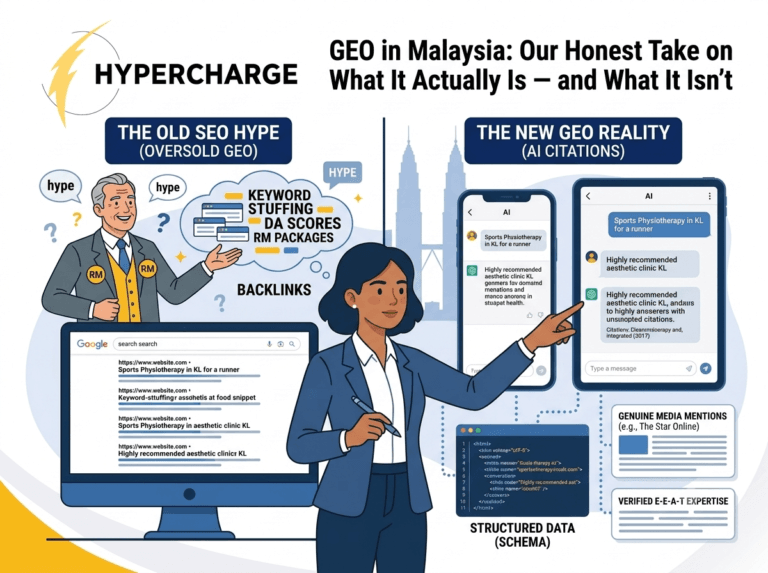
- 2020s: AI search (including Search Generative Experience (SGE), Generative Engine Optimisation (GEO), voice search, and user intent now dominate SEO strategies.
This evolution shows why staying updated with trends, like “what is SEO marketing strategy,” is essential for success.
SEO as a Service
For businesses, outsourcing SEO ensures professional results. Agencies like Hypercharge specialize in creating strategies tailored to your needs. Our SEO services include:
- SEO Audit: Identifying gaps in built websites and planning a roadmap for optimisation
- Keyword Research: Identifying terms like “what is SEO marketing” and optimizing your site for them.
- Onpage optimisation: Making sure meta title, meta description, heading structure, url structure, etc targets proper keywords with great content.
- Technical optimisation: Optimising for page loading speed, indexability, crawlability, schema markups, and more
- Offpage optimisation: Disavowing toxic backlinks from non-reputable resources as well as getting high authoritative links from external websites
- AI Search optimisation: Becoming the authority in a specific niche so LLMs like Gemini & ChatGPT recognises the brand and mentions.
- Local SEO: Ranks businesses’ Google Business Profile for search terms like “klinik near me”, “injury lawyer kl” and more. The goal is to get local population that are in need of the service and eventually becoming a lead.
- Content Creation: Crafting blogs, service pages, and other assets to enhance relevance.
- Performance Monitoring: Tracking improvements in search rankings and traffic.
Outsourcing SEO lets you focus on your core business while professionals handle your online visibility.
Learning SEO Basics
If you’re new to SEO and often ask, “What is SEO in digital marketing?”, start with these basics:
- Keyword Research: Find keywords users are searching for, like “what is local SEO marketing.”
- Content Optimization: Write engaging, keyword-rich articles.
- Technical SEO: Ensure your website is mobile-friendly and loads quickly.
- Analytics: Use tools like Google Analytics to track traffic and performance.
Mastering these basics can provide a solid foundation for your SEO efforts. If you have just started a new website on WordPress but not showing up on Google, here are the 5 critical SEO elements to work on.
SEO Best Practices
To rank well for searches like “what is SEO marketing strategy”, follow these practices:
- Use Relevant Keywords: Naturally incorporate terms like “what is content marketing in SEO” into your pages.
- Optimize for Mobile: Ensure your site is easy to navigate on all devices.
- Earn Backlinks: Partner with reputable sites to enhance your authority.
- Keep Content Fresh: Regularly update your website to stay relevant.
Consistency in applying these practices will ensure long-term success.
Cost of SEO
The cost for SEO may range between RM200 to well over RM12,000 per month depending on agency experience, competition and business goals. While this guide helps business owners with lower budget get started on their own without breaking the bank.
Free SEO Tools
If you’re starting with SEO and wondering “what is SEO and digital marketing,” these free tools can help:
- Google Analytics: Tracks website performance and user behavior.
- Google Search Console: Monitors your site’s health in search results.
- Ubersuggest: Provides keyword ideas and competitor analysis.
- Yoast SEO: A plugin to optimize your site for search engines.
- Google PageSpeed Insights: Evaluates your website’s loading speed.
These tools simplify SEO tasks, even for beginners.
If you’ve been asking, “What is SEO in digital marketing?” or “What is SEO marketing strategy?”, this guide should provide clarity. SEO is essential for building visibility, attracting customers, and staying competitive in a digital-first world.
Whether you’re managing SEO in-house or partnering with professionals like Hypercharge, an SEO agency in Malaysia, a well-executed SEO strategy can deliver long-term growth. Start optimizing your site today to harness the power of SEO for your business.
Ready to grow your business with SEO?
Contact us now for a free consultation and let us help you achieve your digital marketing goals