

📌 Key Takeaways
- Keyword cannibalization happens when two or more of your pages compete for the same search query — splitting your ranking power instead of focusing it
- The most common cause in Malaysian businesses: blogs written without a keyword map, service pages with overlapping topics, and copy-paste location pages
- You can detect it in 10 minutes using Google Search Console or a simple
site:search on Google - There are four ways to fix it: consolidate, redirect, differentiate, or set a canonical tag
- Prevention is easier than cure — a keyword map before you publish is all it takes
- Fixing cannibalization typically takes 4–12 weeks to show ranking improvements
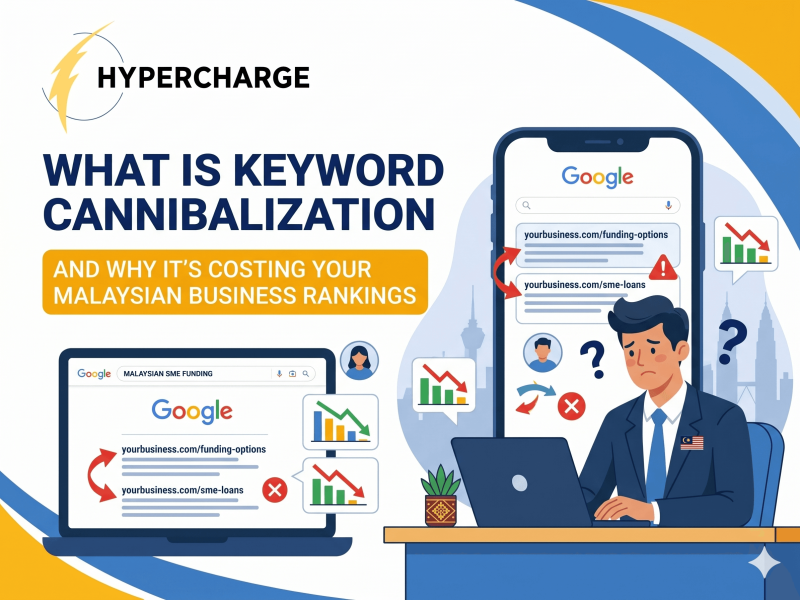
Here’s a situation that plays out more often than most Malaysian business owners realise. A dental clinic in Bangsar publishes a blog post titled “Teeth Whitening in Bangsar.” Months later, their web developer adds a service page called “Teeth Whitening Treatment — Bangsar Dental Clinic.” Both pages target the same keyword. Both pages go into Google’s index. And then something unexpected happens — neither page ranks particularly well.
The problem isn’t that the content is bad. It’s that the website is essentially competing against itself. Google has two nearly identical candidates for the same search query and no clear signal about which one to prioritise. So it hedges — sometimes showing one, sometimes the other, usually ranking both lower than a single consolidated page would achieve.
This is keyword cannibalization. It’s one of the most common structural problems in Malaysian business websites, and it’s often completely invisible to the business owner — until you look for it.
Keyword cannibalization happens when two or more pages on your website target the same keyword and search intent. Instead of one strong page competing for that ranking, you end up with two weak pages competing against each other. Google struggles to decide which page to show — and often ranks neither well. The result is lower rankings than a single, well-built page would achieve.
The Problem in Plain Language: Two Pages Fighting Over One Spot
Google’s search results have one slot for each position. Position 1 is occupied by one page. Position 2 by another. At any given time, only one URL from your website is going to rank for a specific query in that specific position.
When you have two pages competing for the same keyword, you’re not doubling your chances — you’re halving your strength. Each page earns its own backlinks, its own engagement signals, and its own ranking potential. But instead of that authority pooling behind one strong page, it’s diluted across two weaker ones.
Think of it like running two separate stalls at a pasar malam selling the exact same food. You’re not capturing more customers — you’re splitting the queue, paying for two stalls, and possibly confusing people who see both and wonder which one is better.
According to Moz’s explanation of how Google interprets multiple pages competing for the same query, cannibalization doesn’t just affect rankings — it can also confuse Google’s crawlers, waste crawl budget, and reduce the overall authority signals that flow to your most important pages.
The good news is that once you identify cannibalized pages, the fix is usually straightforward. The challenge is spotting the problem in the first place.
How Keyword Cannibalization Happens (And Why It’s So Common)
Cannibalization rarely happens on purpose. It creeps in over time as websites grow without a clear content plan. There are three patterns that account for most cases in Malaysian business websites.
Growing a Blog Without a Content Plan
A business starts publishing blog posts — which is a good thing. But without a keyword map, writers naturally gravitate toward topics that have already been covered. A physiotherapy clinic might publish “How to Treat Lower Back Pain” in February, then “Lower Back Pain Treatment Options” in August, and “Best Exercises for Lower Back Pain Relief” in December.
These three posts may feel distinct to the person writing them, but to Google — and to a user searching for lower back pain treatment — they’re essentially competing for the same search intent. The result is three average-ranking pages where one well-built authority piece could have ranked strongly.
This is precisely why thinking in terms of topical authority rather than isolated keyword targeting changes how you build content — you plan for depth and differentiation from the start, not after the problem has already developed.
Service Pages That Overlap Without Meaning To
Service businesses in Malaysia often create multiple pages to cover slight variations of what they offer. A law firm might have separate pages for “Corporate Legal Services,” “Business Legal Advisory,” and “Company Legal Consultation.” If those pages all target the same high-level search intent — someone looking for a corporate lawyer — they’re cannibalising each other.
The fix here isn’t always to delete pages. Sometimes it’s to rewrite each page to target a genuinely different sub-intent: one for company incorporation queries, one for ongoing legal retainer queries, one for dispute resolution queries. Distinct intent justifies distinct pages.
Location Pages Built in Bulk
This one catches many Malaysian home service businesses. A pest control company creates separate pages for every area they serve — “Pest Control Shah Alam,” “Pest Control Klang,” “Pest Control Subang Jaya” — and populates each one with nearly identical content, just swapping out the location name. Google identifies these as thin, near-duplicate pages and often fails to rank any of them well.
Location pages genuinely work for local SEO — but only when each page has distinct, locally relevant content. Copying a template and changing the city name creates a cannibalization problem and a thin content problem simultaneously.
How to Tell If Your Website Has a Cannibalization Problem
There are three methods for detecting cannibalization, ranging from quick manual checks to more thorough data-driven approaches.
The Google Search Console Method
This is the most reliable detection method. Log into Google Search Console and navigate to the Search Results report. Filter by a keyword you want to rank for — say, “dental implants Kuala Lumpur.” Then switch the view to show data by page (click the “Pages” tab).
If two or more of your pages appear in the results for that query — both receiving impressions — that’s a cannibalization signal. Pay attention to whether the positions fluctuate between those pages over time. Alternating rankings for the same query between two of your own URLs is a classic cannibalization symptom.
The Manual Site Search Method
Go to Google and type: site:yourdomain.com “your target keyword”. For example: site:hypercharge.my “local SEO Malaysia”. Review every page that appears. If multiple pages show up that look like they’re targeting the same intent, investigate further.
This won’t catch everything — Google’s index isn’t fully surfaced through site: searches — but it’s a useful quick check before running a more thorough audit.
The SERP Overlap Check
Search for your target keyword in a private browser window (to avoid personalised results) and note which of your pages, if any, appear. Then monitor whether a different page from your site appears for the same query a week later. Fluctuating between two of your own pages is a strong signal that Google is uncertain which one to rank.
How to Fix Keyword Cannibalization — Four Options
Once you’ve identified the competing pages, you have four tools available. The right one depends on the specific situation.
Option 1 — Consolidate (Merge Two Pages Into One)
This is the cleanest fix when two pages cover genuinely overlapping content. Take the best content from both pages, combine it into one stronger, more comprehensive page, and redirect the weaker URL to the consolidated version.
The combined page inherits the backlinks, engagement signals, and crawl history of both original pages — making it immediately stronger than either was individually. This is generally the best option when neither page is performing particularly well on its own.
Option 2 — Redirect (Remove the Weaker Page)
When one page is clearly outperforming the other — more traffic, better rankings, more backlinks — the simpler fix is a 301 redirect from the weaker page to the stronger one. This passes the ranking authority of the redundant page to the page you want to keep.
Be careful to use a 301 (permanent) redirect, not a 302 (temporary). A 301 tells Google to transfer all ranking credit to the destination URL.
Option 3 — Differentiate (Rewrite Pages to Target Different Intent)
Sometimes two pages cover genuinely different angles of the same topic but are currently written too similarly. In this case, consolidation isn’t necessary — differentiation is. Rewrite each page to focus on a clearly distinct search intent, use different primary keywords, and strengthen the on-page signals for each.
This approach works when both pages have meaningful traffic or backlinks that you don’t want to lose by combining or redirecting.
Option 4 — Set a Canonical Tag
A canonical tag (<link rel=”canonical”>) tells Google which version of a page you consider the “master” version. This is useful when you need to keep both URLs live — for example, if removing one would break a system or user flow — but want to consolidate the ranking signals behind one specific page.
As Google’s guidance on consolidating duplicate content explains, canonical tags are a signal, not a directive — Google may choose to ignore them if it disagrees with your designation. They’re most reliable when used alongside other consolidation signals like consistent internal linking to the preferred page.
Speaking of which: internal linking is one of the most powerful tools for signalling your preferred page to Google. After fixing cannibalization, make sure all relevant internal links point to the page you’ve designated as the primary — not to the redirected or removed URL.
How to Prevent Cannibalization Before It Happens
Prevention is significantly easier than cure. The most effective preventive measure is a keyword map — a document that assigns each keyword to exactly one page, so no two pages ever target the same query.
Before publishing any new page, check your keyword map and ask: is this intent already covered somewhere on the site? If yes, either update the existing page or design the new page to serve a clearly distinct intent.
This connects directly to doing keyword research properly before building content for Malaysian audiences — the keyword mapping stage is where cannibalization gets prevented before a single word is written.
The architectural solution that prevents cannibalization at scale is a content silo or hub-and-spoke structure. In a silo, each section of your website owns a specific topic territory. A dental clinic might have one pillar page on cosmetic dentistry, with separate cluster pages on teeth whitening, veneers, and dental bonding — each targeting a distinct sub-intent under the broader cosmetic dentistry topic. No two pages compete; each one supports the others.
What Cannibalization Looks Like in Real Malaysian Businesses
To make this concrete: consider a home renovation company in Petaling Jaya that had published 14 blog posts over two years. Several were variations on the same core topic — “renovation contractor KL,” “renovation services Petaling Jaya,” “home renovation company Klang Valley” — each with slightly different titles but essentially the same content and the same intent.
None of those pages ranked in the top 10. After a content audit identified the overlap, eight posts were consolidated into three stronger pages — one targeting renovation contractors by service type, one targeting location-based queries, and one covering renovation costs. Internal links were updated to point consistently to the new consolidated pages.
Within about 90 days, the consolidated pages began ranking for queries that none of the original eight had achieved. The total traffic to those consolidated pages exceeded the combined traffic of all eight original posts — from fewer pages.
This is the compounding benefit of solving cannibalization. Fewer, stronger pages consistently outperform many weak, overlapping ones. And if you’re unsure where to start on your own site, a proper SEO audit from Hypercharge’s team will surface these issues before the first recommendation is made.
Frequently Asked Questions
They overlap but aren’t identical. Duplicate content refers to pages with identical or near-identical text. Keyword cannibalization refers to pages targeting the same search intent — even if the actual text is different. You can have cannibalization without duplicate content (two pages written differently but targeting the same query) and duplicate content without cannibalization (copied text that targets different intents or different geographic markets).
Yes. Homepages sometimes compete with dedicated service pages for high-level brand or service terms. If your homepage is targeting “SEO agency Malaysia” and you also have a service page targeting the same term, they may cannibalize each other. The fix is to clearly differentiate the intent each page serves — the homepage for brand navigation, the service page for service-specific queries.
Typically four to twelve weeks. After a consolidation or redirect, Google needs time to re-crawl the affected pages, process the change, and adjust its ranking signals. You may see a temporary dip in traffic before the stronger consolidated page settles into an improved position. Don’t revert the change if rankings dip initially — give it at least eight weeks before evaluating the outcome.
Not automatically, but the risk increases with website size. Websites with 200+ pages and no keyword map are far more likely to have cannibalization than a 20-page site built with clear intent differentiation. The larger your site, the more important a content audit becomes as a regular maintenance task — not just a one-time fix.
Read This Next
You’ve identified the problem — pages competing against each other. The next question is: do you even have the right keywords to begin with? Before rebuilding your content structure, make sure you’re targeting terms that Malaysian customers are actually searching for.
👉 Keyword Research in Malaysia: How to Find the Terms That Actually Drive Business A practical guide to finding, filtering, and prioritising keywords for the Malaysian search market — without the jargon.