
A home renovation contractor in Petaling Jaya walks into a marketing consultation with a clear question. He’s been running Google Ads for three months — steady leads, manageable cost — but his agency is now recommending he add SEO to his plan. The additional monthly investment is significant. He wants to know: is it worth it? Or should he just put that money back into Google Ads?
It’s a fair question. And the honest answer isn’t “both” — that’s the lazy answer agencies give when they want to sell you more. The honest answer is: it depends on what your business needs in the next 12 months, and which phase of growth you’re currently in.
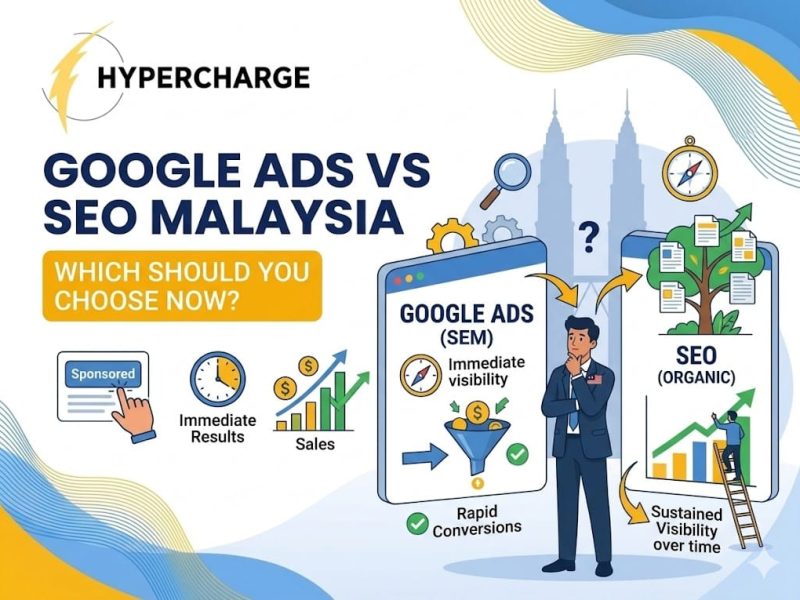
Google Ads and SEO serve fundamentally different purposes. Google Ads buys immediate visibility for high-intent searches — you pay per click and leads arrive quickly, but stop the moment you stop spending. SEO builds organic visibility over time — slower to start, but the traffic compounds and the cost per lead decreases with every passing month. For most Malaysian SMEs, the right answer is sequenced: Google Ads first, SEO when the foundation is ready.
This article gives you a clear framework for making that decision for your specific business, right now.
📌 Key Takeaways
- Google Ads and SEO are not competitors — they serve different time horizons and different stages of business growth
- Google Ads delivers leads quickly but stops entirely when you stop paying; cost per lead stays fixed or increases as competition grows
- SEO takes 3–6 months to show movement but compounds over time — the cost per lead decreases as rankings build
- Three questions determine which channel is right for your business right now: how urgent are leads, what phase is your business in, and how competitive is your market
- Running both simultaneously makes sense in Phase C — not before the SEO foundation is ready
- The most expensive mistake: choosing SEO because it’s cheaper per month, then expecting Google Ads speed of results
The Fundamental Difference Between SEO & Google Ads
The clearest way to understand Google Ads versus SEO is through the lens of renting versus owning.
When you run Google Ads, you are renting your position in search results. Every time someone searches your target keyword, Google runs an auction. You bid, you win or lose, and if you win, you pay when they click. According to how Google’s auction system works, your position is determined by a combination of your bid and your Quality Score — not by any inherent authority your business has built.
The moment you pause your campaign, your ads disappear. There is no residual value. You’ve rented space, and when the lease ends, you vacate immediately, the day the campaign stops is the day the phone stops ringing from that channel.
SEO works differently. When you build organic rankings through content, backlinks, and technical optimisation, you are building an asset. A page that has earned its position on Google’s first page doesn’t disappear the day you stop actively investing in it. It may gradually decline without maintenance, but the rankings you’ve built have compounding value — like property that continues to generate income even when you’re not actively working on it.
This distinction — renting versus owning — is the most important concept to understand before making any budget decision between the two.
What Google Ads Actually Delivers for Malaysian SMEs
The Strengths of Google Ads in the Malaysian Market
Google Ads works because it places your business in front of people who are actively searching for what you offer, at the exact moment they’re ready to act. Someone typing “aircond repair Subang Jaya” into Google is not casually browsing — they have a problem and they want it solved today. Google Ads puts you in that conversation immediately.
For Malaysian SMEs, this intent-matching capability is the channel’s greatest strength. The conversion rates from Google Search Ads are typically higher than Meta Ads precisely because you’re capturing existing demand rather than creating it. A pest control company that launches a well-structured Google Ads campaign targeting “pest control services Klang Valley” can have its first inbound calls within 48 hours of going live.
Google Ads also gives you control and speed that organic search cannot match. You can turn spend on or off based on your capacity. You can target specific suburbs, specific times of day, specific devices. You can test multiple messages simultaneously and see which one generates enquiries. For a business in Phase B that has validated its offer and needs to scale leads quickly, this precision and speed is genuinely valuable.
The Real Limitations Malaysian Business Owners Overlook
The limitation that matters most is the one almost nobody discusses upfront: Google Ads costs don’t stay the same.
As more Malaysian businesses in your category discover and run Google Ads, the auction becomes more competitive. Cost per click rises. Cost per lead rises alongside it. A dental clinic in Kuala Lumpur that was paying RM12 per lead for “dental implants KL” two years ago may now be paying RM22. That’s not a temporary fluctuation — it’s a structural trend driven by increasing advertiser competition for the same finite search inventory.
This means a business that is 100% dependent on Google Ads is running on a channel with a structurally increasing cost base. At some point, the economics become difficult — particularly for SMEs with tight margins.
The second limitation: Google Ads only works for the keywords you’re bidding on. A page that ranks organically for 50 related search terms generates leads from all 50. A Google Ads campaign targeting 5 keywords generates leads from 5. The breadth of organic reach is something paid advertising simply cannot replicate at equivalent cost.
For a deeper look at how common Google Ads mistakes affect Malaysian businesses, particularly around keyword strategy and campaign structure, the patterns appear consistently across industries.
What SEO Actually Delivers for Malaysian SMEs
The Compounding Advantage of Organic Traffic
SEO builds differently from Google Ads. The first three months of investment produce little visible output — content is published, technical issues are fixed, some early ranking signals begin to emerge. This period frustrates many Malaysian business owners who are accustomed to the near-immediate feedback loop of paid advertising.
But something important is happening during those early months. Google’s process of evaluating and rewarding content quality takes time because it requires real user signals — people visiting the page, staying, engaging, returning. Those signals accumulate. And once they do, rankings improve — and they compound.
A page that breaks into the top 3 for a target keyword doesn’t just get clicks from that keyword. It gets clicks from every related variant that Google decides it’s relevant for. A dental clinic’s page on teeth whitening, once well-ranked, might appear for “teeth whitening KL,” “teeth whitening near me,” “how much does teeth whitening cost Malaysia,” and “best teeth whitening clinic Bangsar” — all from one piece of well-built content. No Google Ads campaign generates that breadth from a single keyword investment.
The cost structure improves over time rather than deteriorating. As the honest SEO timeline for Malaysian businesses shows, the investment in months one through six produces the foundation that months seven through twenty-four build upon. The monthly agency retainer stays roughly flat while the number of ranking keywords, organic clicks, and organic leads grows. Cost per organic lead decreases with each passing month that rankings hold.
What SEO Cannot Do (And Who Tells You Otherwise)
SEO cannot deliver leads next week. Anyone who tells you it can is either uninformed or deliberately misleading you.
For a business that opened six months ago and needs leads this month to make payroll, SEO is the wrong primary channel. The timeline doesn’t match the need. Choosing SEO in this situation — because the monthly cost is lower than Google Ads — and then expecting Google Ads-speed results is the most common and most expensive mistake Malaysian business owners make with this channel.
SEO also cannot fix a broken offer, an unconverted enquiry process, or a website without trust signals. Organic traffic arriving at a website that doesn’t convert is not an SEO failure — it’s a conversion and offer problem. The channel delivers the visitor. What happens next is up to the business.
The Cost Comparison Over Time — The Honest Numbers
The conversation about cost is almost always framed incorrectly. Business owners compare monthly spend — “Google Ads costs me RM3,000 a month, SEO costs RM2,500 a month” — and conclude that SEO is cheaper. The more meaningful comparison is cost per lead over 12, 24, and 36 months.
Consider a Malaysian home services business. Running Google Ads at RM3,000 per month, generating 30 leads per month, the cost per lead is RM100. That cost per lead stays at approximately RM100 for as long as the campaign runs — or rises as competition increases. At 36 months: RM108,000 spent, approximately 1,080 leads generated, cost per lead holding at RM100.
Running SEO alongside at RM2,500 per month from month one: months 1–4 produce few organic leads (the investment phase). From month 5 onward, organic leads begin arriving. By month 12, the business might generate 20 organic leads per month. By month 24, 45 organic leads per month. By month 36, 60+ organic leads per month — from an investment that hasn’t materially increased.
At 36 months: RM90,000 spent on SEO, approximately 1,200+ organic leads generated at a declining cost per lead. The actual cost breakdown of SEO services for Malaysian businesses shows that this compounding return is what separates the economics of organic from paid over any meaningful time horizon.
The correct framing is not “which is cheaper per month” but “which delivers better economics over the timeframe I care about.”
The Decision Framework — Three Questions That Give You the Answer
Question 1: Do You Need Leads This Month or This Year?
If your business needs leads in the next 30–60 days — because you’ve just launched, because revenue is under pressure, because you’re entering a competitive market — Google Ads is the right answer. It’s the only digital channel that delivers leads at that speed for businesses without existing organic authority.
If your business has stable lead flow and you’re thinking about the next 12–24 months, SEO belongs in the plan. The timeline of SEO is a feature, not a bug, for businesses with a long-term perspective on growth.
Question 2: What Phase Is Your Business In Right Now?
Understanding which phase of digital marketing growth your business is currently in determines which channel makes strategic sense.
Phase A (RM0–RM20k/month): Neither Google Ads nor SEO are primary priorities. Your focus is GBP, reviews, and validating your offer with light Meta Ads. Google Ads in Phase A without a validated offer and a converting website produces expensive, disappointing results.
Phase B (RM20k–RM50k/month): Google Ads enters the plan. You’ve validated your offer, you have 50–100 reviews, your landing page converts. Now Google Ads makes sense as a lead scaling tool. SEO is not yet the priority — you haven’t built the content foundation needed for it to work.
Phase C (RM50k–RM100k+/month): Both channels running in parallel. Google Ads maintains lead flow while SEO builds the long-term asset. As SEO matures, the proportion of leads from organic grows, and ad dependency gradually reduces.
Question 3: What Does Your Competitive Landscape Look Like?
In highly competitive categories in urban KL — aesthetic clinics, dental implants, corporate law — Google Ads competition is fierce and expensive. New entrants face high cost per click from day one. For these businesses, investing in SEO earlier (even in Phase B) makes sense because it takes longer to build organic authority in saturated markets, and starting later means competing against businesses that have already established it.
In lower-competition niches or suburban locations, Google Ads can deliver at very reasonable cost per lead for longer. SEO can wait until Phase C without significantly penalising the business.
When Running Both Makes Sense
The question frames Google Ads and SEO as an either/or decision. For Phase C businesses, it isn’t — it’s a sequencing decision.
Running both simultaneously works when:
- Your Google Ads campaigns are producing a reliable, profitable lead stream that funds the SEO investment
- Your website is technically sound enough to support both paid landing pages and organic content
- You have the operational capacity to handle an increase in leads from both channels
- You’ve identified which keywords you want to own organically — so your SEO content targets the same high-value terms your Google Ads are winning paid clicks for
The most efficient version of this combined approach: use Google Ads data to identify which keywords convert best for your business, then target those exact terms with SEO content. As your organic rankings build for those terms, you can gradually reduce your ad spend on them — effectively buying yourself out of the per-click cost while maintaining visibility through organic.
This is the compound strategy that the SEO services team at Hypercharge builds for Phase C clients — and it’s why the two channels work better together than either does alone, once the timing is right.
For businesses earlier in their journey, Google Ads management as a standalone Phase B investment produces the fastest lead results while the broader digital foundation is built.
The Mistake Malaysian Businesses Make When Choosing Between Them
The most common error is choosing based on monthly cost rather than expected return.
A Malaysian business compares a RM2,500/month SEO retainer against a RM2,500/month Google Ads budget and concludes they’re equivalent investments. They’re not. The Google Ads budget is entirely consumed generating leads in that month — with zero residual value. The SEO retainer is building an asset whose value increases every month it’s maintained.
The second most common error is expecting results from SEO on a Google Ads timeline. A business owner starts SEO in January, sees no meaningful organic traffic by March, and concludes “SEO doesn’t work” — then switches back to ads entirely. In doing so, they’ve abandoned an investment just before the compounding phase was about to begin.
Both channels work. Both have their place. The mistake is applying the wrong expectations to the wrong channel — or investing in either before the prerequisites are in place.
If you’re unsure which channel is right for your business at its current stage, the answer starts with an honest assessment of where you are — not which option is cheaper this month.
Frequently Asked Questions
No — and this is a common concern worth addressing directly. When you start SEO, keep your Google Ads running. SEO takes 3–6 months to show early movement and 6–12 months to deliver meaningful organic leads. Stopping your Ads during that window would create a lead gap that the business can’t absorb. Run both, then gradually rebalance budget toward SEO as organic rankings mature and generate consistent leads.
No. Google has confirmed that organic rankings and paid ad performance are entirely separate systems. Spending more on Google Ads does not improve your organic ranking position. The two channels operate in parallel, not in tandem, from Google’s perspective. Any agency that suggests otherwise is either misinformed or misrepresenting how the system works.
For most Malaysian local service businesses — clinics, contractors, salons, law firms — both channels have genuine value but at different stages. Google Ads is particularly strong for local businesses because you can target specific suburbs and postcodes, matching the geographic intent of local searches. Local SEO (Google Maps) is often even more impactful than either paid search or organic web rankings for these businesses, and should be the first investment before either Google Ads or organic SEO is considered.
Yes — and arguably more so. AI-generated search results (Google’s AI Overviews, Perplexity, ChatGPT Browse) draw from the same pool of high-quality, authoritative web content that organic SEO builds. The businesses that rank organically today are the same businesses whose content gets cited in AI-generated answers. Building organic authority now positions you for both traditional search results and the AI search layer that’s developing alongside them.
A combined Phase C investment typically looks like this: RM2,000–RM5,000 per month for Google Ads (depending on industry competitiveness and geography) plus RM2,000–RM4,000 per month for SEO (content production, technical optimisation, link building). Total: RM4,000–RM9,000 per month. This sounds significant — and for a Phase A or Phase B business, it is too much too soon. Phase C businesses at RM50k–RM100k per month should be able to fund this investment from existing revenue while the organic channel builds toward reducing overall marketing cost over time.