
Most Malaysian business owners who struggle with digital marketing share a common story. They tried Facebook Ads — “wasted money, no results.” They boosted posts for months. They hired an agency that promised rankings and delivered a report full of numbers they didn’t understand. Eventually, they concluded that digital marketing either doesn’t work or is too complicated for a small business to figure out.
Here’s what working with over 100 Malaysian SMEs across healthcare, legal, automotive, home services, beauty, and education has shown us: digital marketing works. The problem is almost never the tools. It’s the sequence.
Businesses spend on Google Ads before they have enough reviews to convert the traffic. They invest in SEO before they’ve figured out which service makes them money. They build a website before they know who their customer is. They run at Phase C speed while still in Phase A condition — then blame the channel when results don’t come.
This guide exists to fix that. It maps the full journey from a business making its first RM10,000 a month online to one that reaches RM1 million annually — with the right tools, in the right order, built specifically for the Malaysian market.
Digital marketing for Malaysian SMEs is not about using every channel at once. It is about using the right channels at the right stage of your business growth. Most Malaysian SMEs fail at digital marketing not because the tools don’t work, but because they apply Phase C strategies — paid ads, SEO, branding — before completing Phase A: validating their offer and building a trusted local presence.
📌 Key Takeaways
- Malaysian SMEs don’t fail at digital marketing because the tools don’t work — they fail because they use the wrong tools at the wrong stage
- Growth follows three predictable phases: Validation (RM0–RM20k), Growth (RM20k–RM50k), and Scale (RM50k–RM1 million+)
- The most important free digital tool in Malaysia is Google Business Profile — set it up and optimise it before spending on any paid channel
- Malaysian consumers are trust-first buyers — reviews, specialisation, and social proof convert more reliably than clever ad copy
- SEO is a Phase C investment for most SMEs; local SEO (Google Maps) is relevant from Phase A onward
- The 90-day plan in this guide gives you a sequenced starting point regardless of which phase you are in right now
Why Most Malaysian SMEs Get Digital Marketing Wrong From the Start
According to SME Corp Malaysia’s digitalisation research, the majority of Malaysian SMEs fall under the Basic Digital Adoption category — meaning no structured web presence, no customer tracking, no review strategy, and inconsistent or absent digital foundations. Yet many of these same businesses run paid advertising.
This is the fundamental misalignment. Ads amplify what already exists. If your offer is unclear, ads amplify the confusion. If your reviews are sparse, ads drive traffic to a profile that doesn’t convert. If your operations can’t handle volume, ads create a customer service problem at scale.
Malaysia’s digital opportunity is genuinely large. MCMC data shows that over 96.8% of Malaysians are internet users, spending more than seven hours online daily. And according to DOSM’s economic census, SMEs represent 97.2% of all Malaysian business establishments — meaning competition for digital attention is intense across almost every service category.
The businesses that break through are not those with the biggest budgets. They’re the ones who understand which stage they’re at, build the right foundation for that stage, and resist the pressure to skip ahead.
The One Million Digital Framework — Three Phases Every SME Must Move Through
Every Malaysian SME moves through three natural growth stages. The tools, priorities, and marketing channels that belong to each phase are different. Trying to implement Phase C strategies while in Phase A conditions is the single most common reason Malaysian businesses waste their digital marketing investment.
Phase A — Validation (RM0 to RM20,000/month)
Phase A is not about scaling. It is about learning.
Your business is in Phase A if you generate between RM0 and RM20,000 per month and are still figuring out which service resonates most, which customers return, and whether your operations handle demand consistently.
The only marketing goal at this stage is validation — proving that your offer works before spending to scale it.
What belongs in Phase A:
Google Business Profile. Set it up completely — claim it, verify it, fill in every field, upload photos. This is the foundation that everything else is built on. It’s free and generates local visibility immediately. Even without a website, a fully optimised GBP listing generates calls and walk-ins for Phase A businesses.
20–50 genuine Google reviews. Not from family or friends. From real customers who experienced your service. Reviews are the primary trust signal for Malaysian consumers at this stage. A business with 40 honest reviews converts walk-ins far better than one with a RM5,000 website and 8 reviews.
Light Meta Ads at RM15–RM30 per day. Not to scale, not to get rich. To test messaging. Which service gets enquiries? Which customer type responds? This intelligence shapes Phase B and saves thousands in wasted spend later.
Stable operations. Before any digital investment makes sense, the business must be able to deliver what it promises consistently. Ads that drive traffic to a service that disappoints create negative reviews — the opposite of what Phase A needs.
What does NOT belong in Phase A: SEO investment, expensive agency retainers, heavy Google Ads spend, elaborate websites, expanding services.
Outcome target before entering Phase B: RM15,000–RM20,000 per month consistently, 20–50 strong reviews, a clear picture of your best-performing service, and stable operations that don’t break under demand.
Phase B — Growth (RM20,000 to RM50,000/month)
Phase B is where specialisation happens — and where most Malaysian SME founders face their biggest emotional challenge.
The data from Phase A reveals which service makes the most money, attracts the best customers, and generates the fewest complaints. Phase B requires doubling down on that service and letting go of the others, at least for now. Most founders resist this. It feels like leaving money on the table. In practice, it’s the opposite.
What belongs in Phase B:
Specialisation. Pick the one service that Phase A data validated. A dental clinic might discover that dentures drive 40% of revenue. A spa might find that Muslimah facials dominate bookings. A home contractor might realise that aircond chemical washing drives 70% of inbound calls. That’s the anchor. Build Phase B around it.
Meta Ads scaled to RM50–RM70 per day. Now that messaging is validated and the offer is refined, you can scale what you know works rather than testing blind.
Google Search Ads at RM50 per day. Unlike Meta, which creates demand, Google captures it. Someone searching “root canal Subang Jaya” is already ready to act. Google Ads places your business in front of that intent at the exact moment it exists.
100+ Google reviews. At this volume, reviews become a conversion engine. Malaysian businesses with 100+ reviews consistently outperform competitors on both click-through rates and enquiry-to-booking conversion.
A functional website or landing page. Not a showcase. A page that communicates your niche clearly, displays reviews prominently, loads quickly on mobile, and makes it immediately obvious how to contact you or book.
What does NOT belong in Phase B: Full SEO investment, expanding new services before the core one is scaled, heavy branding projects, hiring before operations are stable.
Outcome target before entering Phase C: RM40,000–RM50,000 per month consistently, 100+ reviews, a clear niche, predictable ROI from paid channels, and a defined customer profile.
Phase C — Scale (RM50,000 to RM100,000+/month)
Phase C is where the business transitions from running campaigns to building systems. At this stage, paid ads alone cannot sustain RM100k months at healthy margins. The channels that compound — SEO, brand authority, geographic expansion — become the growth engine.
What belongs in Phase C:
Full SEO investment. A business ranking organically for “aesthetic clinic Bangsar” receives traffic at zero per-click cost that a competitor pays RM15–RM30 per click for through Google Ads. The investment takes 6–12 months to mature but compounds indefinitely. Phase C is when the business foundation is stable enough to let that timeline work.
Average ticket size increases. The fastest path from RM50k to RM100k is not more customers. It is more revenue per customer — through service bundles, package pricing, premium tiers, and relevant upsells. Adding RM30–RM50 per transaction across existing volume can add RM10,000–RM20,000 per month without acquiring a single new customer.
Geographic expansion. Once you dominate your core 3–5km radius, systematically expand outward — through increased ad geography, location-specific website content, and GBP service area settings.
SOPs and systemisation. Scaling requires a business that operates without the founder managing every customer interaction. Documented processes for service delivery, customer communication, and review collection are the infrastructure that makes growth sustainable.
Brand positioning. At Phase C, you’re no longer just “a dental clinic in Cheras.” You’re the specialist people name when recommending their dentist. Branding at this stage is about owning a category in your customers’ minds — which compounds into referral velocity that no ad spend can replicate.
Step Zero — Identify Which Phase You Are In Right Now
Before any other action, correctly identifying your phase prevents the majority of digital marketing mistakes.
Ask three honest questions:
Do you consistently generate RM15,000–RM20,000 per month? If no — you are in Phase A. Focus on GBP, review collection, and offer validation before spending on any paid channel beyond light testing.
Do you know specifically which service drives most of your revenue and attracts your best customers? If no — you are still in Phase A. Validation is incomplete.
Do you have 100+ Google reviews and consistent monthly revenue between RM40,000 and RM50,000? If no — you are in Phase B. Scale your validated offer before investing in SEO or branding.
If yes to all three — you are ready for Phase C. SEO, geographic expansion, and systemisation are your priorities.
The single most expensive mistake in Malaysian digital marketing is a Phase A business spending on Phase C channels. Everything that follows in this guide is most useful when you know which section applies to you right now.
The Digital Channels Malaysian SMEs Actually Need
Not every channel belongs at every stage. Here is what each one does, when it belongs, and where to go for depth on each topic.
Google Business Profile — The Most Powerful Free Tool in Malaysia
Your Google Business Profile is your listing on Google Maps and in local search results. It is free. And for most Malaysian SMEs in Phase A and Phase B, it generates more qualified leads than any paid channel they run alongside it.
When someone in your area searches “dentist near me” or “aircond service Petaling Jaya,” your GBP listing determines whether they call you or call your competitor. Three factors govern local listing rankings: relevance (how well your profile matches the search), distance (how close you are to the searcher), and prominence (how established and trusted your business appears online).
Understanding how to rank on Google Maps in Malaysia covers each of these factors in depth. A supporting element most Malaysian businesses overlook is local citation consistency — your business name, address, and phone number appearing identically across every directory and platform. Inconsistency creates conflicting signals that suppress your Maps ranking without any obvious explanation.
The specific ranking factors that move your GMB position go deeper into the signals Google weights most — particularly for competitive urban categories in KL and Selangor.
Phase relevance: Phase A, B, and C. Consistent highest ROI of any channel across all stages.
Meta Ads (Facebook and Instagram) — Creating Demand
Meta Ads are the most widely used digital channel among Malaysian SMEs — and the most frequently misused. Facebook and Instagram ads interrupt people who are scrolling, not searching. They create awareness. They do not capture intent.
This distinction matters enormously. Meta Ads work well for getting discovered by the right demographic, retargeting visitors who’ve already engaged with your GBP or website, promoting specific seasonal offers, and testing messaging before scaling. They work poorly for driving immediate sales from cold audiences with no trust signals and for replacing channels that capture active search intent.
Phase relevance: RM15–RM30 per day for message testing in Phase A. RM50–RM70 per day for structured campaigns in Phase B. RM100+ per day with sophisticated retargeting in Phase C.
Google Ads — Capturing Demand
Where Meta creates demand, Google captures it. When a Malaysian searches “lawyer tenancy dispute KL” or “car aircond repair Cheras,” they are actively seeking a solution — often within hours of a purchase decision.
Google Search Ads place your business in front of that high-intent traffic. The cost per click is higher than Meta, but conversion rates are significantly better because the searcher already knows what they want. Google Ads belong in Phase B and C — not Phase A. Without validated messaging, clear offers, and a website that converts, the traffic Google Ads send produces expensive, disappointing results.
Phase relevance: Phase B (RM50/day to start). Phase C (RM100+/day, expanded geography and remarketing).
SEO — Building a Long-Term Traffic Asset
SEO is the process of building your website’s visibility in Google’s organic search results. Unlike ads, which stop the moment you stop paying, SEO compounds. A well-ranked page continues to generate traffic month after month at zero per-click cost.
The trade-off is time. SEO in Malaysia typically takes 3–6 months to show meaningful movement and 6–12 months to deliver consistent traffic. This makes it a poor fit for Phase A businesses needing immediate revenue — and an essential investment for Phase C businesses building competitive moats that outlast their ad spend.
Understanding the difference between local and organic SEO helps you prioritise correctly: local SEO (Google Maps) belongs in Phase A; organic website SEO belongs in Phase C.
Effective SEO starts with keyword research specific to the Malaysian market — identifying which terms your customers actually search, how competitive those terms are, and what content serves the intent behind them. Content built around topical authority rather than isolated keywords compounds faster and holds rankings more durably.
Before any SEO investment lands correctly, your website needs to be technically accessible — meaning Google can discover and index your pages without hidden technical blockers preventing it from doing so. Many Malaysian SME websites are effectively invisible to Google for reasons the business owner never sees.
Phase relevance: Local SEO from Phase A. Full organic SEO in Phase C.
Your Website — The Hub Everything Points To
In Phase A, a website is optional. GBP and social media handle your digital presence adequately at this stage. By Phase B, it becomes necessary. By Phase C, it is your most important owned digital asset.
A Phase B website doesn’t need to be elaborate. It needs to communicate your niche clearly, display reviews prominently, load quickly on mobile, and make it immediately obvious how to contact you. A single well-built service page with a WhatsApp CTA converts better than a five-page website with slow load times and vague messaging.
By Phase C, your website is the hub that all other channels drive traffic to. SEO content lives on it, Google Ads land on it, social media links to it. Its technical performance — speed, mobile experience, Core Web Vitals — directly affects both ranking potential and conversion rate.
Phase relevance: Optional in Phase A. Recommended in Phase B. Essential in Phase C.
Content Marketing — Building Trust Before the Sale
Malaysian consumers research before they buy. A patient considering a dental implant reads articles and checks multiple clinic profiles before booking a consultation. A business owner evaluating an SEO agency reads case studies before shortlisting agencies to call. Content marketing meets potential customers during that research phase.
A clinic whose blog answers “how much do dental implants cost in Malaysia?” and “what should I expect during implant recovery?” educates and builds trust simultaneously. By the time that reader is ready to book, the clinic that answered their questions is the first one they call.
Effective content marketing in Malaysia is not about publishing frequently. It is about publishing content that genuinely helps your specific customer make informed decisions. Understanding what Google’s E-E-A-T framework means for your content — Experience, Expertise, Authoritativeness, Trustworthiness — gives you the quality standard that separates content that ranks and converts from content that disappears.
Phase relevance: Light content in Phase A. Offer-focused content in Phase B. SEO-driven content clusters in Phase C.
WhatsApp — Malaysia’s Most Underrated Marketing Channel
WhatsApp is not a marketing platform in the traditional sense. In Malaysia, it is the primary channel through which purchase decisions are finalised and sales are closed.
Most Malaysian customers who find your business online will WhatsApp you before they call, before they visit, and before they book. The speed and quality of your WhatsApp response determines whether you convert that enquiry or lose it to a competitor who responds faster.
WhatsApp Business allows for automated greeting messages, quick-reply templates, and a product catalogue — all of which reduce response time and improve the first impression. Businesses that reply within minutes convert enquiries at significantly higher rates than those that respond hours later. Every WhatsApp enquiry is a warm lead. Treat it accordingly.
Phase relevance: From Phase A. Automation becomes more important in Phase B and C.
Understanding How Malaysian Customers Actually Buy
No digital marketing strategy works without understanding the psychology of the people it’s aimed at. Malaysian consumers have specific, consistent buying behaviours that differ meaningfully from Western markets — and from how many business owners assume their customers behave.
Malaysians Are Trust-First, Not Price-First
The most persistent belief among Malaysian business owners is that customers choose on price. The evidence consistently contradicts this. Malaysians will pay more for a dentist with 200 reviews and a professional profile over a cheaper option with 15 reviews. They will hire a law firm with clear specialisation over a cheaper generalist.
Trust is the currency that converts Malaysian consumers. Price is what they use to rationalise a decision already made on trust signals. Digital marketing that invests in building trust — reviews, professional presentation, clear specialisation, before-and-after proof — consistently outperforms digital marketing that competes on price.
Reviews Are the New Word of Mouth
Malaysia has always been a referral-driven market. “My friend recommended” has historically been the most powerful buying trigger. Google reviews have become the digital equivalent — word of mouth that scales beyond personal networks to reach every potential customer searching in your area.
How Google reviews convert into customers shows that businesses with 100+ reviews convert enquiries at measurably higher rates than those with fewer. Volume signals that many people have trusted the business. Recency signals it is actively operating and satisfying customers.
One important caution: review manipulation in Malaysia carries real legal and platform risk. Purchased reviews violate Google’s policies, are detected and removed with increasing accuracy, and can result in listing suspension. The only sustainable strategy is earning reviews legitimately — by asking satisfied customers consistently through a simple WhatsApp follow-up or QR code at the point of service.
Specialists Win Over Generalists Every Time
Malaysian consumers associate specialisation with competence. “Denture Specialist” outperforms “General Dentist” in click-through rates. “Criminal Lawyer” outperforms “Full-Service Law Firm” in conversion. “Aircond Specialist” generates more calls than “General Repairman.”
This is deeply cultural and it directly shapes how Phase B businesses should position themselves. Choosing your specialisation is not about limiting your business. It is about giving Malaysian customers the clarity they need to choose you with confidence — and the mental shortcut they need to recommend you to others.
The 10 Most Expensive Mistakes Malaysian SMEs Make
After working with hundreds of Malaysian businesses across industries, the same self-inflicted mistakes appear repeatedly. Recognising them is worth more than any single tactic.
1. Spending on ads before validating the offer. Ads amplify what already exists. An unvalidated offer with RM3,000 per month in ads produces expensive, demoralising results.
2. Offering too many services. Trying to be everything to everyone means customers can’t associate your business with anything specific. Specialise before you scale.
3. Ignoring Google reviews. A business with 15 reviews cannot convert the traffic that paid ads are buying. Reviews are a prerequisite to scaling, not an afterthought.
4. Treating SEO as a luxury. SEO is the most cost-effective long-term lead generation channel for Malaysian SMEs — but only when started at the right phase, with the right foundation.
5. Using black hat SEO tactics or hiring agencies that do. Bought links, keyword stuffing, and private blog networks produce short-term rankings and long-term Google penalties. Recovery takes 12–18 months. Prevention takes one informed hiring decision.
6. Having keyword cannibalization on the website. Multiple pages competing for the same keyword divide your ranking power. One strong page beats two weak ones every time — and most Malaysian business websites have this problem without knowing it.
7. Never checking whether Google can index the website. Many Malaysian SME websites have technical blockers — a leftover noindex setting from development, a misconfigured robots.txt file — that prevent Google from finding their pages entirely. Content cannot rank if it is not indexed.
8. Not tracking cost per lead. Spending RM2,000 per month on ads without tracking which leads came from which channel means you cannot optimise. You are guessing, and guessing at scale is expensive.
9. Inconsistent branding across platforms. Your GBP, website, Facebook page, and WhatsApp Business should look and say the same thing. Inconsistency erodes trust before a customer even contacts you.
10. Trying to skip phases. The most expensive mistake of all. Phase A provides the data that makes Phase B efficient. Phase B provides the foundation that makes Phase C sustainable. There are no shortcuts that hold.
Your 90-Day Digital Marketing Starter Plan
Regardless of which phase you are in, the next 90 days can produce meaningful progress with the right focus.
Month 1 — Stabilise Your Foundation
Claim and fully complete your Google Business Profile — every field, minimum 10 photos, accurate hours. Set up Google Search Console and submit your XML sitemap so Google can find your pages. Send a review request via WhatsApp to the last 30 satisfied customers. Identify your single best-performing service based on revenue, margin, and customer quality. Run Meta Ads at RM15–RM30 per day testing two to three different messaging angles.
By the end of Month 1: clean digital presence, early review momentum, first data on which messaging resonates.
Month 2 — Focus and Build
Narrow your advertising to the messaging and service that Month 1 data validated. Create or improve your website landing page for your primary service — clear offer, clear CTA, visible reviews. Set a weekly review collection target; aim for 30–50 total by end of Month 2. Publish one piece of content per fortnight answering a specific customer question. If you are in Phase B or above, add Google Search Ads at RM50 per day for your highest-intent keywords.
By the end of Month 2: consistent digital presence, primary offer clearly communicated, reviews building steadily.
Month 3 — Accelerate What Works
If Phase B: scale Meta Ads to RM50–RM70 per day, expand Google Ads budget and keyword coverage. If Phase C: commission a technical SEO audit and begin keyword-mapped content production around your primary service cluster. Target 50–80 reviews by end of month — the threshold at which GBP visibility meaningfully improves. Implement WhatsApp automation for enquiry responses and post-service review requests. Set up basic lead source tracking so you know which channel is producing results.
By the end of Month 3: clear picture of which channels produce leads and at what cost, and a concrete plan for the next 90 days based on actual data rather than assumption.
The Future of Digital Marketing for Malaysian SMEs
The next three to five years will reshape how Malaysian consumers find and evaluate local businesses. SMEs that understand these shifts now will build the systems to benefit from them early.
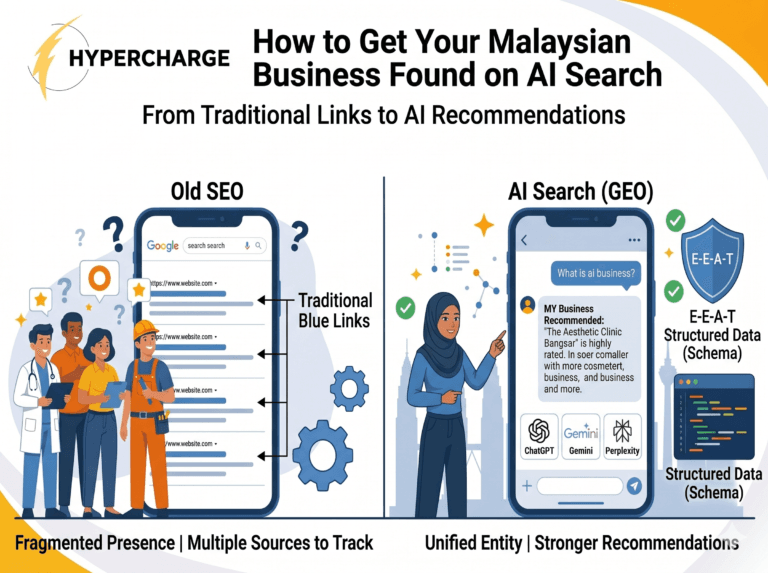
AI search is changing how people discover businesses. Google’s AI-generated search summaries and AI assistants are beginning to surface business recommendations without users clicking through to websites. The businesses that appear in AI-generated answers share common characteristics: strong structured data, clear entity signals, comprehensive content on specific topics, and high review volumes. The foundations of good SEO today are the same foundations that support AI search visibility tomorrow.
Hyperlocal SEO will intensify. Near-me searches continue to grow. Malaysians search for services within short driving distance with increasing specificity. Businesses that dominate their immediate geographic radius — not the entire city, but their specific catchment area — capture this traffic most cost-effectively.
Rising ad costs will push SMEs toward organic channels. Meta CPMs and Google CPCs increase annually as more businesses compete for the same inventory. Businesses entirely dependent on paid ads face a compressing margin problem over time. SEO, content, and review-driven GBP visibility have zero per-click cost once established. Businesses investing in these channels now are building cost advantages that compound as ad costs rise.
Video content will drive trust faster than any other format. Short-form video on TikTok, Instagram Reels, and YouTube Shorts builds familiarity at speed. For Malaysian SMEs in healthcare, beauty, home services, and education — where before-and-after results and process transparency are decisive trust signals — video is increasingly the fastest trust-building medium available to any budget.
The most important principle across all of these trends is the same one that governs the One Million Digital Roadmap: sequence over speed. The businesses that adapt early, build the right foundations, and move through each phase with discipline will not just survive the next five years of digital change — they will dominate their local markets because of it.
Where to Go Deeper — The Complete Resource Map
This guide provides the framework. The articles below go deep on each specific topic. Use this map to find the right resource for whatever you are working on right now.
SEO and Technical Foundations
- How Google discovers and indexes your website — Start here if your pages are not appearing in Google
- How long does SEO take in Malaysia? — Set realistic expectations before investing
- Keyword research for the Malaysian market — Find the terms your customers actually search
- Topical authority vs keyword targeting — Why content strategy beats keyword chasing
- Keyword cannibalization — how to find and fix it — A silent rankings killer on most Malaysian websites
- Black hat vs white hat SEO Malaysia — What to ask any agency before signing
- Google E-E-A-T explained — The quality framework behind Google’s rankings
- The complete Malaysia SEO guide
Local SEO and Google Maps
- How to rank on Google Maps in Malaysia — Step-by-step for SMEs
- GMB ranking factors that actually move the needle
- What are local citations and why they matter
- The difference between local and organic SEO
Google Reviews
- How Google reviews convert into customers
- Is buying Google reviews illegal in Malaysia?
- Is your Google review count important for business?
Hypercharge Services
- Local SEO services for Malaysian businesses
- Organic SEO services
- Google Ads management
- Google Business Profile management
- Website design
- AI search optimisation
Frequently Asked Questions
The answer depends entirely on your phase. In Phase A, RM500–RM1,000 per month is appropriate — mostly on light Meta Ads testing, with the bulk of effort going into free channels such as GBP and review collection. In Phase B, RM2,000–RM5,000 per month across Meta Ads and Google Ads, plus the cost of a functional website. In Phase C, RM5,000–RM15,000 or more per month across paid channels, SEO investment, and content production. The core principle: never spend more than your current revenue can absorb without creating cash flow stress. Phase B tools should not be funded by Phase A cash flow.
For Phase A businesses: Google Business Profile, because it is free and generates local visibility immediately. For Phase B: Google Search Ads, because intent-based targeting converts at higher rates than social advertising for most service categories. For Phase C: SEO, because the cost per lead decreases over time while paid ads become more expensive annually. The right answer for your specific business depends on your industry, location, competitive landscape, and current phase.
Not immediately. In Phase A, a well-optimised GBP combined with an active social media page handles enquiries and validates your offer adequately. By Phase B, a landing page or simple website becomes necessary to support Google Ads and provide a professional conversion hub. By Phase C, a well-built, SEO-optimised website is the most important asset in your entire digital marketing stack.
It depends on the channel. Google Business Profile and Google Ads produce measurable results within days to weeks of proper setup. Meta Ads validation takes four to six weeks to generate reliable data. Local SEO shows movement within 60–90 days. Organic SEO takes 3–6 months for early signals and 6–12 months for consistent traffic and leads. Be suspicious of any agency promising fast results from channels that are structurally slow to produce them.
The framework is the same across industries. The tactics, timelines, and channel mix differ. Healthcare businesses face stricter content quality requirements from Google and longer trust-building cycles. Legal firms rank more effectively on specific query-based content than on broad service terms. Home service businesses see faster local SEO results because competitors are typically less digitally sophisticated. Beauty and wellness businesses benefit strongly from visual content and transformation proof. The Validate → Grow → Scale sequence applies universally — the execution is industry-specific.
Phase A can be handled independently by most business owners — setting up GBP, collecting reviews, running basic Meta Ads — with the right guidance. Phase B benefits from professional support on Google Ads and website optimisation, where technical errors are costly. Phase C typically requires specialist expertise for SEO, content architecture, and integrated campaign management. The right approach: learn enough to evaluate what an agency is doing and hold them accountable to real business outcomes, not vanity metrics.