
The most common question Malaysian business owners ask before starting SEO is also the one that gets the most dishonest answers: how long will this take?
Some agencies promise first-page rankings in 30 days. Some say three months. Others are vague enough to avoid the question entirely. None of these responses are particularly useful — because the honest answer depends on factors specific to your business, your industry, and your starting point. A dental clinic in Bangsar with a two-year-old website competes in a very different landscape from a pest control company in Kuantan launching a brand-new site.
What follows is a realistic, industry-by-industry breakdown of what to expect from SEO in Malaysia — based on actual market conditions, not optimistic projections.
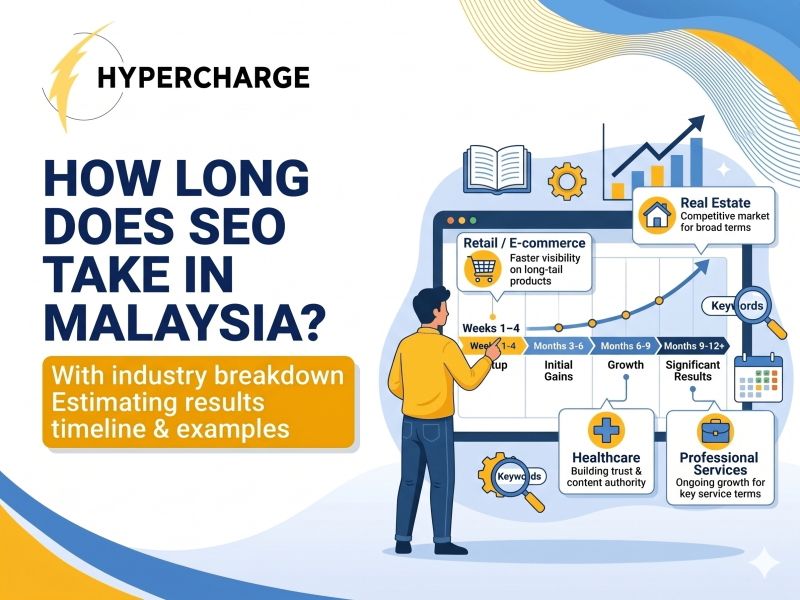
SEO in Malaysia typically takes three to six months to show meaningful ranking improvements, and six to twelve months to deliver consistent organic traffic and leads. The timeline depends on your industry’s competition level, your website’s age and authority, how much content you publish, and the quality of your SEO execution. New websites in competitive industries like healthcare and legal almost always sit at the longer end.
📌 Key Takeaways
- SEO in Malaysia typically takes 3–6 months for early ranking signals and 6–12 months for consistent traffic and leads
- The timeline varies significantly by industry — home services rank faster than healthcare or legal
- Five factors determine your personal timeline: website age, competition level, content volume, backlink strength, and technical health
- New websites face a natural delay of 3–6 months before Google assigns meaningful authority to them
- Local SEO (Google Maps) typically shows results faster than organic web rankings — often within 60–90 days
- No legitimate SEO strategy should promise page-one rankings in under 30 days
Why There’s No Single Answer — And Why Anyone Who Gives You One Is Guessing
SEO is not a fixed-duration service like a website redesign or a logo project. It’s a compounding process — early months lay the groundwork, and results build on themselves over time. The trajectory depends on dozens of variables, many of which differ between every business.
Any agency that quotes you a specific ranking date for a competitive keyword without first auditing your website, analysing your competitors, and reviewing your existing content is guessing. Sometimes an optimistic guess, sometimes a deliberately misleading one.
What responsible SEO practitioners can tell you is a probable range based on your specific conditions — which is exactly what this article provides. The complete SEO guide for Malaysian businesses covers the full picture of what goes into building that foundation; this article focuses specifically on the timing question.
The Five Factors That Determine Your SEO Timeline
Before looking at industry benchmarks, understand the five variables that control how fast your specific website progresses.
How Old Is Your Website?
A website that has been live for three or more years, even without active SEO, has built up some crawl history, some indexed pages, and possibly some organic links. Google has had time to evaluate it.
A brand-new website starts from zero. According to how Google’s indexing process works for new content, new websites can take weeks to be fully crawled and indexed — and several more months before Google develops enough data to assign them meaningful authority. This is sometimes called the “Google sandbox” effect. It is not a penalty; it is simply Google being cautious about promoting sites it hasn’t yet evaluated over time.
If your website is under six months old, add two to three months to any timeline estimate for your industry. Your foundation needs to be established before rankings can compound.
How Competitive Is Your Industry?
Not all industries compete equally in Google search. A search for “dentist Bangsar” might have 40 reasonably optimised competitors. A search for “renovation contractor Kuala Lumpur” might have hundreds. The more competitors who are actively investing in SEO, the longer it takes to outrank them.
Understanding how keyword difficulty shapes your ranking timeline is essential before committing to a content plan — high-difficulty keywords in saturated markets take significantly longer to crack than lower-competition terms where your SEO investment goes further, faster.
How Much Content Are You Publishing?
Websites that publish one new article per quarter rank more slowly than websites publishing two to four pieces per month. This isn’t just about volume — it’s about building topical depth. Google rewards websites that demonstrate comprehensive coverage of a subject area.
The compounding effect of building topical authority through consistent content means that month six’s content benefits from the authority built by months one through five. Slow, infrequent publishing extends the timeline considerably because the compounding never gets a chance to accelerate.
How Strong Is Your Backlink Profile?
Backlinks — links from other websites pointing to yours — remain one of Google’s strongest authority signals. A website with quality backlinks from Malaysian news sites, industry directories, and reputable local businesses ranks faster than an identical website with no backlinks at all.
Building a legitimate backlink profile takes time. Don’t expect rapid results from link building in the first two months — but by months four to six, a consistent effort begins to show in domain authority metrics and ranking improvement.
How Well Is Your Site Technically Optimised?
A technically broken website — slow loading, poor mobile experience, pages blocked from indexing, broken internal links — suppresses rankings regardless of how good your content is. Google cannot rank pages it cannot properly access and evaluate.
Technical SEO issues are often the invisible anchor holding back a website that’s doing everything else right. An audit before or at the start of any SEO engagement identifies these blockers so they can be cleared in months one and two rather than discovered at month five.
SEO Timeline by Industry in Malaysia
These timelines assume consistent, quality SEO execution — not minimal effort. They also assume a website that is at least one year old with basic technical health. Add two to three months for brand-new websites.
Healthcare and Medical Clinics
Realistic timeline: 6–12 months for competitive terms; 3–6 months for local/niche terms
Healthcare is one of the most competitive local SEO categories in Malaysia’s urban centres. Kuala Lumpur and Petaling Jaya have dozens of optimised dental, aesthetic, and specialist clinic websites with years of content and review history. Google also applies elevated quality scrutiny to health-related content (YMYL — Your Money or Your Life), meaning thin or generic content simply won’t rank.
What works faster in this sector: local SEO (Google Maps) for specific neighbourhood searches, and long-tail informational content targeting specific treatments or conditions. A clinic that publishes genuinely helpful content about specific procedures — rather than generic “best clinic in KL” pages — tends to see traction faster than one chasing broad category terms.
Legal Firms
Realistic timeline: 6–12 months for primary practice area terms; 4–6 months for specific legal query content
Legal SEO in Malaysia is competitive for primary terms like “lawyer Kuala Lumpur” or “corporate lawyer Malaysia” but significantly less competitive for specific legal questions. A law firm that publishes content answering “how to file for divorce in Malaysia” or “what does a conveyancing lawyer do” typically sees traction within four to six months on those informational queries — which then drives leads from people actively researching legal help.
The strategy that works: answer specific legal questions in depth, build trust signals through attorney profiles and credentials, and target neighbourhood or area-specific terms (“criminal lawyer Petaling Jaya”) rather than city-wide terms from the outset.
Home Services (Plumbing, Electrical, Pest Control, Renovation)
Realistic timeline: 3–5 months for local terms; 2–4 months with strong Google Maps focus
Home services is one of the most attainable categories for Malaysian SMEs. Search intent is high (people calling because something is broken or urgent), competition is fragmented (most contractors don’t do SEO), and local search terms are moderately competitive outside central KL.
A pest control company in Subang Jaya targeting “pest control Subang Jaya” and surrounding township terms can realistically see Google Maps top-3 visibility within 60–90 days with a properly optimised GBP and 20–30 genuine reviews. Organic web rankings for the same terms typically follow within three to five months.
This is also the category where early SEO investment returns the most measurable leads fastest — making it a strong entry point for businesses new to digital marketing.
Beauty and Wellness
Realistic timeline: 4–7 months for salons and spas; 6–10 months for aesthetic clinics
Standard beauty services — hair salons, nail bars, massage centres — compete in a moderately crowded but inconsistently optimised space. Many have GBPs but weak websites and minimal content. Four to seven months of consistent effort is a realistic window to rank in the top 5 for neighbourhood-level terms.
Aesthetic clinics sit closer to the healthcare timeline due to the YMYL content considerations and the level of competition in urban areas. Results take longer but are also stickier once achieved — high-value treatment searches (“lip filler KL,” “V-shape face treatment Bangsar”) carry strong commercial intent and convert at high rates.
Professional Services (Accounting, Insurance, Real Estate)
Realistic timeline: 5–9 months for service terms; 3–5 months for specific informational content
Accounting firms and financial advisors operate in a space where trust signals matter enormously and most competitors have neglected content marketing. The opportunity: publish genuinely useful content answering the questions Malaysian business owners actually type — “how to register a Sdn Bhd,” “what is SST in Malaysia,” “how to file company tax with LHDN” — and establish authority through specificity rather than broad service pages.
Real estate SEO in Malaysia is a competitive exception. Property portals like PropertyGuru and iProperty dominate broad terms, making it difficult for individual agencies to compete on category-level keywords. The winning strategy is hyper-local and niche-specific content targeting specific developments, areas, or buyer profiles.
What Should Actually Happen Month by Month
This is what a well-executed SEO engagement looks like in practice for a Malaysian SME — and what you should be asking your agency to show you at each stage.
Months 1–2: Foundation Work
Technical audit and fixes. Keyword research and content mapping. Google Business Profile optimisation. Setting up Search Console and Analytics. Fixing any indexing issues. Publishing the first batch of optimised content.
What you should see: Very little ranking movement — this is normal. What you should see is a clean technical report, an agreed keyword map, and the first few pieces of content live on the site.
Months 3–4: Early Signals
Google begins picking up the new content. Some keywords start appearing in Search Console impressions at positions 20–50 — not yet on page one, but moving. Local SEO (Google Maps) may already show improvement if the GBP work was done in month one.
What you should see: Search Console impressions increasing. Two to five keywords entering the top 20. Google Maps position improving for at least some local queries. Your agency should be sharing this data proactively.
Months 5–6: Ranking Movement
Consistent content publication and link building start compounding. Keywords that were at positions 15–30 move into the top 10. First page-one appearances for lower-competition terms. Organic traffic starts to register meaningful numbers — not high volume, but directional.
What you should see: Clear upward trend in clicks and impressions in Search Console. At least some keywords hitting page one. Possibly first organic leads or enquiries that can be attributed to SEO.
Months 7–12: Compounding Growth
This is where the investment starts returning measurably. Rankings consolidate on page one for target terms. New content published in earlier months accumulates authority. Traffic and lead volume increase month on month without proportionally increasing effort.
What you should see: Multiple page-one rankings across your target keyword set. Organic traffic representing a meaningful share of your total website traffic. Leads that can be directly attributed to organic search at a cost-per-lead that compares favourably with paid channels.
Why Your SEO Might Be Taking Longer Than Expected
If you’re past month four with little to show, one or more of these issues is usually the cause:
The technical foundation was skipped. If your site has indexing issues, slow load times, or broken pages, no amount of content will compensate. A technical audit should be the first deliverable in any SEO engagement.
Content is being published but not planned. Random topics published without a keyword map don’t build topical authority. They create isolated pages that each have to earn their own rankings from scratch rather than benefiting from a connected content cluster.
The keywords targeted are too competitive for your current authority. A new clinic website targeting “aesthetic clinic Malaysia” in month two is competing against websites with five years of content and hundreds of backlinks. Progress requires targeting achievable terms first and building toward competitive ones.
Google Maps has been neglected. For most Malaysian SMEs, local search is the fastest return on SEO investment. If your agency isn’t reporting on Maps visibility and GBP performance, that’s a gap worth addressing immediately.
What You Can Do to Speed Up Your Timeline (Without Shortcuts)
There are no shortcuts that work long-term — but there are legitimate ways to compress the timeline.
Start with local SEO. Google Maps rankings move faster than organic web rankings. For any Malaysian business serving a local market, optimising your local search presence first generates results in 60–90 days while your broader SEO foundation is being built.
Publish more content, more consistently. Moving from one article per month to three doesn’t just triple your content volume — it accelerates topical authority building and gives Google more data about your site, faster.
Fix technical issues in month one, not month five. Every week a technical problem goes unresolved is a week of SEO work that lands on a broken foundation. Prioritise the audit.
Don’t chase vanity metrics. Rankings for brand-name keywords you already appear for, or rankings in positions 6–10 for obscure long-tail terms, look good in a report but don’t represent business progress. Focus on ranking movement for terms that bring enquiries and leads.
According to Ahrefs’ research on how long SEO takes, the majority of top-ranking pages are at least two to three years old. This doesn’t mean new sites can’t rank — it means the businesses that start now are building an asset that compounds in value with every passing month. The best time to start was a year ago. The second-best time is today.
Frequently Asked Questions
Three months is enough to judge whether the foundation is being built correctly — technical fixes done, content published, Search Console showing impressions growth. It’s not enough to judge revenue impact. Expecting measurable leads from organic search in under three months is unrealistic for most Malaysian businesses except in low-competition niches. Evaluate the process and early signals at month three; evaluate the outcomes at month six.
Several possible reasons: their website may be older, they may have more backlinks from previous activity, their content may be more aligned with search intent, or their technical setup may be cleaner. Comparing your timeline to a competitor’s without knowing their starting conditions is rarely useful. Focus on your own upward trajectory rather than the gap.
Running Google Ads does not directly improve your organic rankings — Google has confirmed these are separate systems. However, Ads can generate traffic and conversions while your SEO builds, effectively bridging the revenue gap during the 3–6 month organic growth phase. The data from Ads campaigns can also inform which keywords convert best, helping you prioritise SEO content more precisely.
Rankings are not permanently owned. Once you stop publishing content, building links, and maintaining your technical health, competitors who continue doing so will gradually displace you. The rate of decline depends on your industry’s competition level — highly competitive categories see faster displacement than less contested ones. SEO is an ongoing investment, not a project with a fixed end date.
For most Malaysian SMEs, the goal isn’t to replace paid advertising — it’s to reduce dependency on it over time. A business that generates 40% of its leads from organic search and 60% from paid channels is in a much stronger position than one that generates 100% from paid, because organic leads have no per-click cost once the ranking is achieved. The two channels work best in parallel, particularly in the first 6–12 months of an SEO engagement.