
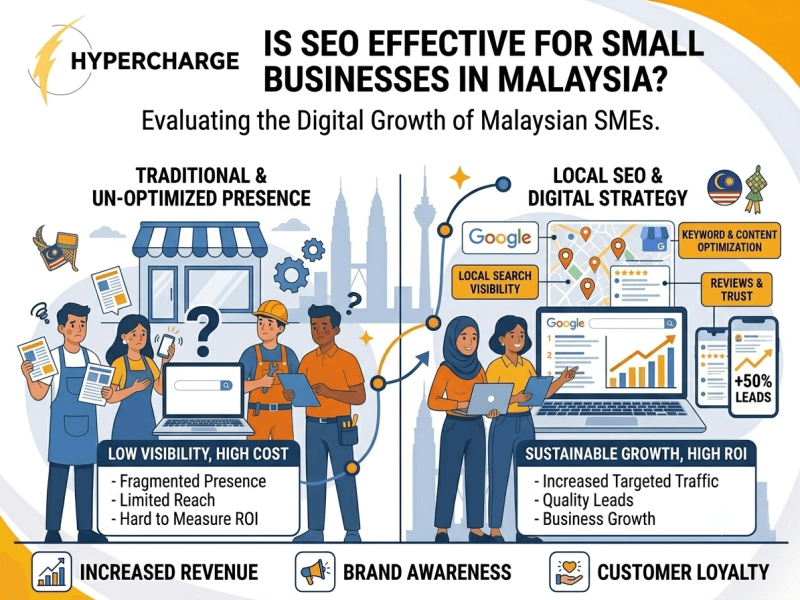
TLDR: Yes — SEO is effective for small businesses in Malaysia, but the results depend heavily on three things: whether the business is at the right growth stage to benefit from it, whether the SEO work is executed correctly, and whether expectations are aligned with realistic timelines. Small businesses that start SEO at the right phase, with quality execution, consistently see lower cost-per-lead from organic search than from paid advertising within 12 months.
Most Malaysian business owners who ask this question have a specific version of it in mind. They’ve either tried SEO before and felt burned — three months of reports, rankings they couldn’t find, no extra phone calls — or they’ve been pitched by an agency and aren’t sure whether the investment is real or optimistic. Sometimes both.
The question deserves a direct answer rather than a sales pitch. So here it is:
Yes, SEO is effective for small businesses in Malaysia. But the results depend on three things: whether the business is at the right stage to benefit, whether the work is executed correctly, and whether expectations match how SEO actually progresses. When all three conditions are met, organic search consistently becomes the lowest-cost lead generation channel a Malaysian SME has — cheaper per lead than Google Ads and fundamentally more sustainable than Meta Ads, because the traffic doesn’t stop the moment the budget runs out.
When those conditions aren’t met, SEO can look like an expensive experiment with nothing to show for it. And those are the cases that generate the scepticism.
This article separates the two. When SEO works for Malaysian small businesses, why it works, when it doesn’t, and what the evidence actually looks like from businesses in Malaysia that have done it correctly.
📌 Key Takeaways
- SEO is effective for Malaysian small businesses — but only when the business has a validated offer, at least basic digital foundations, and realistic timeline expectations
- Local SEO (Google Maps) is the fastest-returning SEO investment for most Malaysian SMEs — results often appear within 60–90 days
- Organic web SEO takes longer (6–12 months) but delivers a compounding return: the cost per lead decreases over time while paid ad costs increase
- SEO works better in some industries than others in Malaysia — home services, healthcare, and legal see among the highest returns because search intent in these categories is very high
- SEO is the wrong investment if your business hasn’t validated its core offer yet, is in Phase A revenue, or needs leads within the next 30 days
- The businesses that start SEO earliest in their growth journey accumulate the largest long-term advantage — every month of delay is a month of compounding authority that goes to a competitor instead
The Short Answer — And Why It Comes With Conditions
Imagine two dental clinics in the same suburb of Kuala Lumpur. Both invest in SEO at the same time with the same monthly budget. Eighteen months later, one is generating 80 to 100 organic leads per month from Google and has reduced its Google Ads spend by half. The other has seen modest rankings for keywords few people search and no measurable increase in patients.
The difference between these two outcomes is not that SEO works for one type of business and not another. It’s that the first clinic had the right conditions in place: a validated service that patients genuinely wanted, 60 Google reviews before SEO started, a website that loaded quickly and communicated its offer clearly, and keyword targeting aligned with what people in their area actually searched for.
The second clinic started SEO in Phase A — still figuring out its core service, with 8 reviews, a slow website, and keyword research that targeted city-wide competitive terms rather than achievable local ones.
This is the most important insight about SEO for Malaysian small businesses: the tool works. What determines whether it works for your business is whether your business is ready for it.
What SEO Actually Does for a Small Business
Understanding the mechanism helps evaluate whether it’s the right fit.
SEO — Search Engine Optimisation — is the process of making your website and online presence more visible in Google’s search results. There are two distinct types, and understanding the difference between local and organic SEO determines which one is most relevant to your business right now.
Local SEO — ranking your business in Google Maps and local search results for location-specific searches like “dental clinic near me” or “plumber Shah Alam.” This is the most immediately valuable type for most Malaysian SMEs and produces results faster — typically 60 to 90 days for meaningful movement.
Organic SEO — ranking your website pages in Google’s main search results for broader queries like “how much do dental implants cost in Malaysia” or “best aesthetic clinic for acne treatment.” This takes longer — 6 to 12 months for consistent results — but reaches potential customers earlier in their research journey, before they’ve committed to a specific clinic or provider.
Together, they mean that when a potential customer in your area searches for what you offer, your business appears — in Maps, in organic results, or both. Unlike a paid ad, these appearances don’t cost per click and don’t disappear when you stop paying. They accumulate authority over time, which is what makes SEO’s return on investment improve the longer it runs.
According to MCMC’s data on Malaysian internet usage, Malaysians spend more than seven hours online daily, and Google search is deeply embedded in how they discover and evaluate local businesses. That search behaviour is the audience that SEO reaches. It’s not a small channel — it’s the primary discovery mechanism for a large portion of every Malaysian SME’s potential customer base.
The Evidence: What SEO Has Produced for Malaysian SMEs
Case studies are more useful than general claims. Here is what SEO has produced for real Malaysian businesses across Hypercharge’s key verticals.
Healthcare Clinics
One of the most well-documented examples in our portfolio is HE Medical Clinic, a men’s health clinic in Malaysia operating in a sensitive YMYL (Your Money or Your Life) category — a space where Google applies elevated quality scrutiny and where thin or generic content consistently fails to rank.
Starting from near-zero organic visibility, the SEO strategy focused on E-E-A-T signals (doctor credentials and profiles), technically sound content on sensitive health topics, and local search optimisation across multiple clinic locations. The outcome: approximately 2,000 organic leads per month across all locations, with individual locations generating over 300 WhatsApp and phone enquiries monthly from organic search alone.
For a healthcare business where each converted patient represents significant lifetime value, this scale of organic lead generation fundamentally changed the economics of customer acquisition.
This is not an outlier. Dental clinics, aesthetic centres, and physiotherapy practices that invest in structured healthcare SEO — with genuine expertise signals and location-specific content — consistently see strong organic results in Malaysia because search intent in healthcare is high and many competitors have weak or absent content strategies.
Home Service Businesses
Home services — pest control, plumbing, air conditioning, renovation — are among the highest-intent categories in Malaysian local search. Someone searching “aircond service Shah Alam” or “plumber Cheras emergency” is not browsing. They have an immediate need and are ready to call the first credible result.
Small home service businesses in Malaysia regularly achieve Google Maps top-3 positions within 60 to 90 days through a combination of complete GBP profiles, consistent review collection, and local citation building. Organic web rankings for service-area keywords typically follow at months 4 to 7.
The competitive advantage in this sector is particularly strong because most home service providers in Malaysia have weak or absent SEO. A plumber with 40 genuine Google reviews, a complete GBP, and a well-structured service page outranks competitors with none of these — not because SEO is easy in this category, but because the bar for entry is so low that basic execution produces visible results.
Professional Services
Law firms and accounting practices in Malaysia operate in a category where clients research extensively before making contact. A potential client considering a conveyancing lawyer will read multiple articles, compare several firms’ websites, and check reviews before shortlisting anyone to call.
Professional services firms that publish genuinely useful content — answering questions like “what does a conveyancing lawyer do in Malaysia?”, “how long does property transfer take?”, “what are the legal fees for buying a house?” — capture this research intent. A law firm generating consistent organic traffic from informational queries becomes the most familiar option to potential clients by the time they’re ready to call.
In this category, organic SEO produces a quality of lead that is distinctly warmer than cold paid advertising — because the potential client has already read your content, established familiarity with your expertise, and made a preliminary trust assessment before their first contact.
Why SEO Works Better for Some Malaysian Businesses Than Others
Four conditions determine whether SEO produces strong results for a specific Malaysian small business.
Condition 1 — Business Phase Readiness
SEO is not a Phase A tool for most businesses. If your monthly revenue is below RM15,000, your offer isn’t fully validated, you have fewer than 20 Google reviews, and your operations aren’t consistently delivering quality service — investing in SEO before those foundations exist is premature.
The digital marketing phase framework for Malaysian SMEs explains this in detail: Phase A requires validation, not amplification. SEO amplifies what already exists. A business with a strong offer, genuine reviews, and a clear niche gets dramatically more from the same SEO investment than a business that started before those signals were in place.
The businesses that feel SEO “didn’t work” most commonly started it in Phase A conditions. The businesses that see strong results started it in Phase B or C — when the foundation was ready to support it.
Condition 2 — Local vs National Competition Level
Not all Malaysian markets are equally competitive. A pest control company in Rawang competes against far fewer optimised websites than one in central Kuala Lumpur. A physiotherapy clinic in Johor Bahru faces a different competitive landscape than one in Bangsar.
How long SEO takes varies by industry and geography — and this variation is significant. In low-competition areas or niche categories, basic SEO execution produces page-one rankings within three to four months. In highly competitive KL categories, reaching page one for primary terms takes nine to eighteen months.
Neither is a failure of SEO. Both reflect the competitive reality of the market. Setting expectations appropriately — and starting with achievable local terms before broader competitive ones — determines whether the early months feel like progress or stagnation.
Condition 3 — Quality of Execution
SEO executed poorly produces poor results regardless of how ready the business is. Keyword targeting that misses search intent, content that doesn’t answer what searchers are looking for, technical issues that prevent proper indexing, and link building that relies on manipulative tactics — all of these produce either no results or results that reverse when Google’s algorithm updates.
Quality execution means: thorough technical foundation before content creation, keyword research aligned with actual Malaysian search behaviour, content that genuinely serves the reader’s intent, and backlinks built through legitimate means. Businesses that invest in this quality of execution see compounding returns. Those that don’t see the results they expected from a cheaper alternative.
Condition 4 — Patience for the Right Timeline
The most common reason Malaysian business owners conclude SEO doesn’t work is evaluating it on the wrong timeline. Checking for leads at month two, deciding it’s failing at month three, and cancelling at month four — before the work has had time to compound — is the equivalent of planting a tree, checking it at week two, and concluding trees don’t grow.
According to Ahrefs’ research on SEO ROI over time, the return from organic search investment typically accelerates rather than declines over time — the opposite of paid advertising, where returns often diminish as costs rise. But accessing that compounding return requires staying in the strategy long enough for it to materialise.
When SEO Is NOT the Right Investment Right Now
Honest advice includes acknowledging when SEO isn’t the right fit — even when we offer it.
If you need leads within the next 30 days, SEO cannot help you at that timeframe. Google Ads or Meta Ads are the appropriate channels for immediate lead generation. SEO should be started in parallel as a long-term investment, not as a replacement for the short-term channel you need right now.
If your business hasn’t validated its core offer, scaling visibility through SEO will amplify an unclear proposition. A potential customer who finds you through organic search and lands on a website that doesn’t clearly communicate what you do and why they should choose you will leave without contacting you. Fix the offer and the website before investing in driving traffic to them.
If you have fewer than 20 genuine reviews and unstable operations, the traffic that SEO brings will convert at very low rates — because the trust signals that convert Malaysian customers (reviews, social proof, professional presentation) aren’t yet in place. Build those first.
If your market has virtually no online search demand, SEO cannot create demand that doesn’t exist. A very niche B2B product or a highly localised service in a small town may have insufficient search volume to justify an SEO investment. A keyword research audit determines this quickly — it’s the first thing to check before committing to an SEO engagement.
SEO vs Paid Ads for Malaysian Small Businesses — An Honest Comparison
This is not an either/or question for most businesses — but understanding the trade-offs clarifies why each has its place.
| Factor | SEO | Paid Ads (Google/Meta) |
| Time to first results | 3–6 months | Days to weeks |
| Cost per lead trend | Decreases over time | Increases over time |
| What happens when you stop | Traffic holds (gradually declines) | Traffic stops immediately |
| Suitability for Phase A | Low — too early | High — for testing |
| Suitability for Phase C | High — primary growth engine | Medium — supports SEO |
| Requires validated offer | Yes | Less critical |
| Builds long-term asset | Yes | No |
The pattern that produces the best outcomes for Malaysian SMEs: paid ads in Phase A and B for immediate lead generation and offer validation, SEO beginning in Phase B and scaling in Phase C as a compounding long-term investment that gradually reduces paid ad dependency.
Treating SEO and paid ads as competitors rather than complements is the framing that leads to underinvestment in both. The businesses with the strongest digital marketing positions in Malaysia run both — with SEO taking an increasing share of the lead generation load over time as it matures.
What Small Business SEO Actually Costs vs What It Returns
Realistic numbers for a Malaysian SME context.
A typical mid-market SEO engagement in Malaysia runs between RM1,500 and RM3,000 per month. At RM2,000 per month, the total 12-month investment is RM24,000.
A business that generates 30 organic leads per month by month 9 — a conservative figure for a moderately competitive service category — with a 30% lead-to-customer conversion rate produces 9 new customers per month from organic. At an average transaction value of RM500 (modest for healthcare or home services), that’s RM4,500 in monthly revenue attributable to organic search.
The annual return from that lead volume, assuming consistent performance: RM4,500 × 12 months (from month 9 forward) = RM54,000 in revenue from a RM24,000 investment. And in year two, the same organic leads arrive at no additional SEO cost increase — because the rankings built in year one continue producing.
This is the compounding argument for SEO in plain numbers. Google’s guidance on how helpful content builds lasting search visibility explains why quality content and authority signals produce this durable return — they aren’t one-time tactics, they’re assets that accumulate value.
The Compounding Argument — Why Early Starters Win
Here’s the most important point about SEO timing for Malaysian small businesses.
Your competitor who started SEO 18 months ago is now ranking on page one for the keywords you’re targeting. Their domain has 18 months of accumulated authority, content history, and backlink equity. Starting today, it will take you 12 to 18 months to reach the same position — assuming you execute correctly.
Your competitor who hasn’t started SEO yet is in the same position as you. The one who starts this month reaches page one 12 months before the one who starts next year. That 12-month head start compounds for the lifetime of the business — because organic rankings, once earned, are defensible and increasingly difficult for later entrants to displace.
This is why the question “is SEO worth it for my small business?” has a time dimension as well as a quality dimension. The answer today is more valuable than the same answer a year from now, because the competitive field in Malaysian local search fills up with earlier entrants every month.
If you want to understand specifically what SEO would look like for your business — which keywords, what timeline, what realistic outcomes — Hypercharge’s SEO services start with a keyword and competitive analysis that answers those questions before any commitment is made.
Frequently Asked Questions
The most common reason SEO produces poor results is misaligned conditions — starting before the offer is validated, targeting the wrong keywords, or working with an agency using low-quality tactics that produce short-term rankings and long-term penalties. The second most common reason is evaluating it too early — cancelling at month three before the compounding returns begin. Understanding which of these factors applied previously helps determine what would need to be different for a new attempt to succeed.
Generally yes — particularly for Malaysian SMEs in low-to-moderate competition categories. Google Maps rankings respond to GBP optimisation, consistent citations, and review velocity faster than organic web rankings respond to content and link building. Many Malaysian businesses see meaningful Google Maps movement within 60 to 90 days of systematic local SEO work. Organic web SEO typically takes 6 to 12 months for the same level of results.
Yes — but the strategy differs from a single-location business. Multi-location businesses benefit from location-specific landing pages, a GBP listing for each staffed physical location, and content targeting area-specific search queries. A renovation contractor serving the Klang Valley would create separate optimised pages for Shah Alam, Petaling Jaya, Subang Jaya, and Cheras — each targeting the search queries specific to those areas. This approach allows a single business to rank in multiple geographic markets simultaneously.
A young business can absolutely start SEO — but expectations should be calibrated for the combination of a new domain (which Google evaluates cautiously until it has established history) and an early-stage business (which may not yet have the reviews and validated offer that convert SEO traffic into leads). For a six-month-old business, local SEO and GBP optimisation are higher priority than organic web SEO — the returns come faster and the foundation they build supports the broader SEO investment later.
Social media marketing builds brand awareness and keeps your business in front of existing followers. It reaches people who aren’t actively looking for your service. SEO reaches people who are — right at the moment they search for what you offer. For a Malaysian SME trying to acquire new customers efficiently, search intent traffic from SEO converts at significantly higher rates than social media traffic because the searcher is already in buying mode. Social media and SEO serve complementary purposes; they’re not substitutes for each other.
Read This Next
SEO works — and the healthcare sector in Malaysia is where it works hardest. Patients search for clinics, doctors, and treatments the same way they’d search for any service — and the clinics that appear when they search win the appointment. Here’s the full digital marketing picture for healthcare businesses in Malaysia.
👉 Digital Marketing for Healthcare in Malaysia: A Complete Guide for Clinics How Malaysian clinics, dental practices, and specialist centres build patient pipelines through SEO, GBP, reviews, and E-E-A-T content — with specific strategies for YMYL healthcare content.