
Open almost any SEO report from a Malaysian agency and you’ll find a DA score somewhere near the top. “Your domain authority is currently 14. Our goal is to bring it to 30 within six months.” It sounds measurable. It sounds like progress. Many business owners take it at face value — because it’s a number, and numbers feel like accountability.
The problem is that Domain Authority is not a Google metric. Google has never used it, does not reference it, and has no awareness of it as a ranking input. It is a score invented by an SEO software company called Moz — a useful benchmark in certain contexts, but frequently misrepresented as a direct measure of SEO performance when it isn’t.
This doesn’t mean DA is worthless. It means understanding what it actually measures — and what it doesn’t — is the difference between making smart SEO decisions and optimising for a number that doesn’t directly determine whether your customers find you on Google.
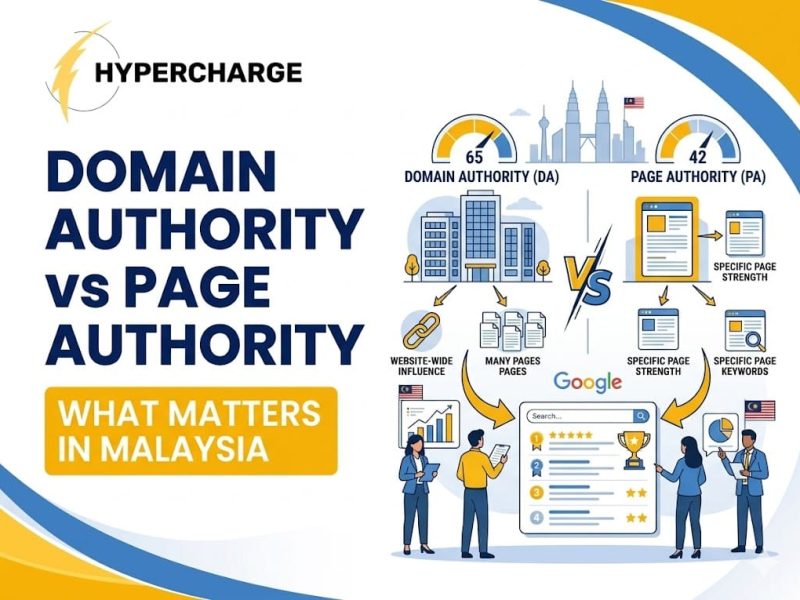
Domain Authority (DA) and Page Authority (PA) are scores created by Moz — a third-party SEO software company — to predict how well a domain or page might rank in Google. Google does not use these scores in its algorithm. They are useful benchmarks for comparing your backlink strength against competitors, but chasing a high DA number is not the same as improving your actual Google rankings.
📌 Key Takeaways
- Domain Authority (DA) and Page Authority (PA) are Moz’s own metrics — Google does not use them as ranking signals
- Different SEO tools (Moz, Ahrefs, Semrush) all have their own authority scores with different methodologies — none of them are Google’s
- DA is useful for benchmarking your backlink profile against competitors and evaluating link building opportunities — not for measuring SEO success
- For most Malaysian SMEs, a DA of 15–35 is a realistic range; what matters more is whether your DA is competitive within your specific niche
- Topical authority — depth of expertise demonstrated through content — often outranks raw domain authority in Google’s actual algorithm
- If an agency’s primary KPI for your engagement is DA improvement, that’s a signal to ask deeper questions about what they’re actually doing
What Domain Authority and Page Authority Actually Are
Both metrics were created by Moz, one of the largest SEO software companies in the world. According to Moz’s explanation of how Domain Authority is calculated, DA is a logarithmic score from 1 to 100 that predicts how competitive a website’s backlink profile is — based on the number of unique domains linking to the site and the quality of those linking domains.
The score is logarithmic, which means moving from DA 10 to DA 20 is relatively easy. Moving from DA 50 to DA 60 requires dramatically more backlink acquisition. Moving from DA 70 to DA 80 is an effort most Malaysian businesses will never need — and rarely justify.
Domain Authority — The Site-Level Score
DA measures the backlink strength of an entire domain. A website with 500 high-quality backlinks from reputable sources will have a higher DA than a website with 10 backlinks from low-quality sites. In that sense, DA is a reasonable proxy for “how much has the internet endorsed this domain overall.”
What DA does not measure: the quality of your content, how well your pages match search intent, how thoroughly you’ve covered your topic area, your technical SEO health, your click-through rates, or your user engagement metrics. All of which Google’s algorithm does consider.
Page Authority — The Page-Level Score
PA applies the same logic at the individual page level. A page with many high-quality links pointing directly to it will have a higher PA than a page with few or no inbound links — regardless of the overall domain’s DA.
PA is useful when evaluating whether a specific piece of content on a competitor’s site is particularly well-linked, or when assessing whether a page on your own site has accumulated meaningful link equity. It’s a more granular lens than DA, but carries the same fundamental limitation: it’s a third-party estimate, not a Google signal.
Why Different Tools Show Different Scores for the Same Website
If you’ve ever run the same website through Moz, Ahrefs, and Semrush and seen three different scores, this is why: each tool has built its own web crawler, its own backlink index, and its own scoring methodology. Moz calls its metric Domain Authority. Ahrefs calls it Domain Rating (DR). Semrush calls it Authority Score. They measure related but not identical things.
According to Ahrefs’ explanation of its Domain Rating methodology, DR specifically focuses on the strength of a website’s backlink profile relative to all other websites in Ahrefs’ index. It’s a relative score, which means it shifts as the entire web evolves — even if your own backlink profile hasn’t changed.
The practical implication: don’t compare a DA score from Moz against a DR score from Ahrefs as if they’re measuring the same thing. Use one tool consistently for trend tracking within your own website.
The Critical Distinction: These Are Not Google Metrics
This bears repeating clearly because it’s so frequently misunderstood in the Malaysian market: Google does not use Domain Authority, Page Authority, Domain Rating, or any equivalent third-party metric as a ranking signal.
Google has its own internal measure of link-based authority — PageRank — which it has used since its founding. According to Google Search Central’s overview of how Search works, PageRank is one signal among hundreds that Google uses to evaluate and rank pages. Google does not publish PageRank scores publicly for individual websites. The last time Google made PageRank toolbar scores visible was 2016.
What Google Actually Uses Instead
Google’s ranking system considers a combination of signals that third-party authority scores only partially approximate:
Link signals — The quantity and quality of links pointing to a page and domain. This is what DA/PA attempt to model, and where their predictive value comes from.
Content relevance and quality — How well the page content matches the search intent. How thoroughly it covers the topic. Whether it demonstrates genuine expertise. This is entirely absent from DA/PA.
Behavioural signals — How users interact with the page after clicking: do they stay or immediately return to the search results? How long do they spend on the page? Do they convert? Google interprets these signals as quality indicators.
Technical signals — Page speed, mobile usability, Core Web Vitals, crawlability, structured data. DA captures none of this.
E-E-A-T indicators — Evidence of real-world expertise, author credentials, site trustworthiness. Not captured by DA.
A website with a DA of 12 and exceptional content that precisely matches search intent will frequently outrank a website with DA 40 and generic content in the same category. This happens regularly in niche Malaysian markets — and it’s why DA as a primary KPI misleads rather than guides.
Why DA and PA Still Matter — Just Not in the Way Most Agencies Imply
Dismissing DA entirely would be overcorrecting. The metric has genuine utility when used correctly.
Using DA to Benchmark Competitors
If your dental clinic website has a DA of 18 and the clinic ranking first for your target keywords has a DA of 35, that gap tells you something useful: your competitor has a meaningfully stronger backlink profile. It suggests that part of your SEO work needs to focus on building more and better inbound links to close that gap.
Conversely, if you have DA 18 and your highest-ranking competitor has DA 15, your backlink profile is already competitive — and the gap in rankings is likely explained by content, technical, or local SEO differences rather than link authority.
Used this way — as a relative benchmark for gap analysis — DA is a practical diagnostic tool. The error is treating it as an absolute target or as a primary measure of SEO success.
Using DA to Evaluate Backlink Opportunities
When deciding whether a website is worth acquiring a backlink from, DA (or Ahrefs DR) provides a quick quality signal. A link from a DA 50 local news site carries more potential weight than a link from a DA 8 blog with no traffic. DA is a fast filter when reviewing link building opportunities — useful precisely because it’s quick, even though it’s imprecise.
What to look for beyond DA when evaluating a link opportunity: Is the site topically relevant to your industry? Does it receive genuine traffic? Is the page linking to you contextually related to your content? A DA 25 Malaysian healthcare website linking to your clinic’s article is worth more than a DA 40 foreign directory link with no topical connection.
What a Realistic DA Looks Like for Malaysian Business Websites
Many Malaysian business owners assume a low DA score means their SEO is failing. Context matters enormously.
A brand-new website with no backlinks starts at DA 1. This is normal and expected. A one-year-old Malaysian SME website that has earned some local directory listings and a few organic mentions might sit at DA 8–15. A business that has been operating for several years, has accumulated local press coverage, and has been actively building links might reach DA 25–40. Established Malaysian media organisations and major commercial websites typically score DA 50+.
For the vast majority of Malaysian SMEs competing in local and regional search — dental clinics, law firms, home service contractors, beauty salons — a DA in the range of 15–35 is sufficient to compete effectively, provided the other ranking factors (content quality, local SEO, technical health) are strong. You do not need to reach DA 50 to rank on page one for “dentist Bangsar” or “plumber Shah Alam.”
What matters far more than your absolute DA number is your DA relative to the specific competitors you’re trying to outrank in your specific location and category.
What Actually Moves the Needle for Malaysian SMEs
If DA is not the primary goal, what should Malaysian SMEs focus on to actually improve their Google rankings?
Topical Authority vs Domain Authority
Topical authority — the depth and breadth of your content coverage across a specific subject area — is increasingly the differentiating factor in Google rankings, particularly since Google’s Helpful Content system updates of recent years.
A physiotherapy clinic that publishes 20 thoroughly researched articles covering different aspects of physiotherapy — sports injuries, post-surgery recovery, specific conditions, treatment methods — builds topical authority in that domain. Google recognises the site as a comprehensive resource on physiotherapy and ranks it more favourably across the entire topic cluster.
This is achievable regardless of domain authority level. A DA 15 physio clinic with deep topical content can outrank a DA 30 competitor with shallow, generic service pages. Topical authority is built through content strategy — something within the control of any Malaysian business willing to invest in quality content production.
Earning Quality Backlinks in the Malaysian Context
Link building in Malaysia doesn’t require reaching international publications. Locally relevant, topically appropriate links carry real weight:
Local media coverage — Malaysian news sites (The Star, Malay Mail, Free Malaysia Today, Sin Chew Daily) with DA scores of 60–80+ provide significant link equity alongside genuine audience reach. Being featured in even one article provides a meaningful boost.
Industry and professional directories — The Malaysian Bar Council directory for law firms, DoctorOnCall and KKiAHealth for clinics, professional association listings for accountants and architects. These are authoritative, topically relevant, and relatively straightforward to be listed in.
Local business partnerships — A renovation contractor who is linked from a developer’s preferred vendors page, or a dental clinic linked from a corporate employee benefits portal. These contextual local links build real authority in the Malaysian search landscape.
Guest contributions — Writing a genuinely useful article for a Malaysian business publication, a professional association newsletter, or an industry blog earns a link while demonstrating expertise. This also contributes to E-E-A-T signals — evidence that your business is recognised as a knowledgeable source by others in the industry.
The key thing to understand about all of these: they’re earned, not bought. As covered in the article on black hat link building and why shortcuts backfire, purchased links may temporarily inflate DA scores without delivering durable ranking improvements — and carry the risk of a Google penalty that can take a year or more to recover from.
Content Depth Over Link Volume
For most Malaysian SMEs in the early stages of their SEO journey — roughly the first 12 months — investment in content quality and depth will produce better ranking outcomes than equivalent investment in link building alone.
A service page that comprehensively answers every question a potential customer has about that service, includes relevant structured data, demonstrates genuine expertise through specific details and case examples, and is technically well-implemented will outperform a thin service page with twice the backlinks in most Malaysian competitive categories.
Proper keyword research identifies which questions and topics your specific Malaysian audience is searching for — ensuring that the content depth you’re building is directed at demand that actually exists, not topics nobody is searching.
And understanding that SEO timelines in Malaysia are measured in months, not weeks, frames the right expectations: domain authority builds slowly, topical authority builds with every article published, and the compounding effect of both is what produces durable page-one rankings.
How to Improve Your Domain Authority — The Right Way
If improving DA is part of your SEO strategy — as a supporting goal, not the primary one — the legitimate path involves three activities.
Earn links from relevant, quality websites. One link from a reputable Malaysian news site, a professional directory, or a topically related business partner is worth more than dozens of links from low-quality sources. Focus on fewer, better links rather than volume.
Remove or disavow toxic links. If your backlink profile contains links from spammy, irrelevant, or manipulative sources — whether you built them, inherited them from a previous agency, or received them through a negative SEO attack — cleaning them up removes drag on your domain’s link quality signals. Google’s Disavow Tool in Search Console allows you to tell Google to ignore specific links.
Build internal link equity systematically. The authority accumulated at the domain level flows to individual pages through internal links. A strong internal linking architecture ensures that link equity earned by your highest-authority pages (typically the homepage and popular blog posts) distributes effectively to your service pages and newer content.
Publish consistently. New content earns new links over time — particularly content that answers specific questions or provides unique data and insights. A consistent publishing cadence is one of the most reliable long-term drivers of gradual DA improvement, because content that’s useful gets linked to.
Red Flags: When DA Is Being Gamed or Misrepresented
DA manipulation is a real phenomenon. Because DA is a third-party metric based on backlink volume, it can be artificially inflated through bulk link purchasing — temporarily boosting the score without any corresponding improvement in actual Google rankings.
Watch for these signals in agency reporting:
DA increased rapidly without explanation. Legitimate DA growth is slow and gradual — a point or two per month is typical for an active link building campaign. A sudden jump of 10–15 DA points in a month almost always indicates bulk link purchasing, which Google devalues and may penalise.
High DA but no meaningful traffic growth. If your DA is climbing but your Search Console shows flat or declining organic traffic and impressions, the DA increase is not translating to real search performance. The links driving the score up are likely coming from low-traffic, low-quality sources that Google doesn’t weight meaningfully.
DA reported as a primary success metric. A legitimate SEO agency tracks rankings, organic traffic, impressions, click-through rates, and leads. DA is at most a secondary reference metric. If your monthly report leads with DA improvement as the main evidence of value delivered, that’s a question worth asking directly: what actual ranking or traffic improvement has this produced?
“We’ll build X backlinks per month” as the core deliverable. Volume-based link building commitments typically signal low-quality link acquisition. Quality link building is slow, relationship-driven, and context-dependent — not a production line.
For a complete picture of what distinguishes genuine, sustainable SEO work from shortcuts that inflate metrics without building real search presence, our SEO services are structured around traffic, leads, and ranking movement — not DA scores.
Frequently Asked Questions
Because it’s a convenient, quantifiable number that’s easy to track and report. DA also has genuine correlational value — websites with higher DA do tend to rank better on average, because a stronger backlink profile is one of the things Google’s algorithm actually considers. The problem arises when correlation is presented as direct causation, and when DA improvement is treated as equivalent to ranking improvement. It isn’t — and business owners who understand this distinction are better positioned to hold their agencies accountable for the right outcomes.
The only meaningful answer is: higher than your direct competitors ranking for the same keywords in the same location. A DA of 20 is more than sufficient to rank competitively for “pest control Shah Alam” if all your competitors are between DA 8 and DA 18. The same DA 20 would be insufficient to compete for “SEO agency Malaysia” where established players have DA 40–60+. Stop benchmarking your DA against global averages and start benchmarking against the specific websites you’re trying to outrank.
No. PageRank is Google’s internal link authority signal — the original algorithm that Google has used, in evolving forms, since it was founded. Google no longer makes PageRank scores publicly visible. Domain Authority is Moz’s attempt to build a publicly accessible metric that approximates what PageRank might look like — but it’s a third-party estimate, not the actual signal Google uses. The two are related in concept but entirely separate in practice.
Yes. Because DA is a relative score measured against all websites in Moz’s index, if the overall web becomes more link-rich over time — which it does continuously — your relative position may decline even if your own backlink profile stays the same or grows modestly. A DA of 25 in 2020 represented a different competitive position than DA 25 in 2025. This is another reason to focus on relative competitive benchmarking rather than absolute score targets.
Not necessarily — DA has diagnostic value when used correctly. A better approach: ask your agency to report DA alongside the metrics that actually reflect business outcomes — organic traffic volume, keyword ranking positions, click-through rates from Search Console, and leads or enquiries attributable to organic search. DA as one reference point among several is useful context. DA as the primary success metric is a misalignment between what’s being measured and what you’re actually trying to achieve.