
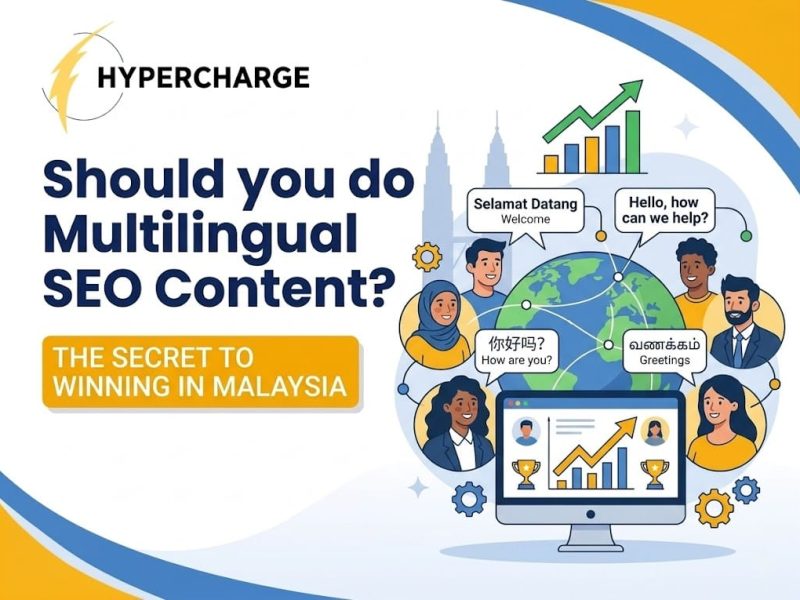
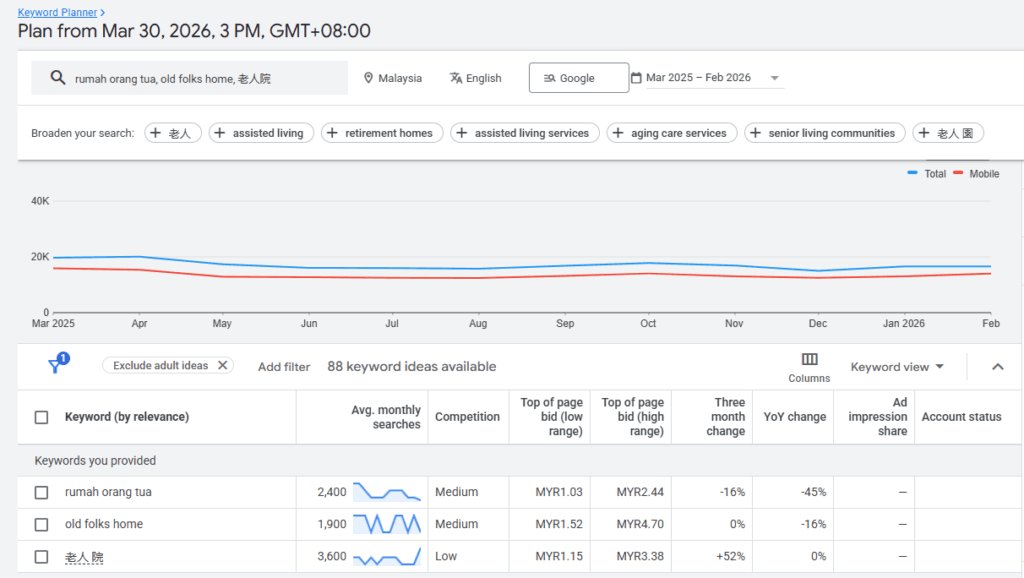
In Malaysia, we don’t just live in a multicultural society; we search in one. On any given day, a customer in Shah Alam might search for “rumah orang tua,” while a business owner in Bangsar looks for “old folks home,” and a shopkeeper in Johor Bahru searches for “老人院”.
This is not an unusual situation. It plays out across Malaysian businesses every day — clinics, dental practices, law firms, education centres, financial advisors — all serving genuinely multilingual communities while maintaining websites written entirely in English. The assumption is that English is sufficient because it’s the common language of business in Malaysia. The data suggests otherwise.
Multilingual SEO in Malaysia means optimising your website to rank in search results across more than one language — typically English, Bahasa Malaysia, and Mandarin. Because Malaysian consumers search in different languages depending on context and topic, a website targeting only English misses a significant portion of available search volume. The technical foundation is hreflang tags; the strategic foundation is language-specific keyword research and content.
📌 Key Takeaways
- Malaysia has three primary search languages — English, Bahasa Malaysia, and Mandarin — with meaningfully different search volumes by industry and demographic
- An English-only website is invisible for searches conducted in Malay or Chinese, regardless of how well-optimised it is in English
- Multilingual SEO requires three things: language-specific keyword research, genuine content in each language, and correctly implemented hreflang tags
- Hreflang tags tell Google which language version of a page to show to which searcher — without them, Google may show the wrong version or ignore your alternate language pages entirely
- Google uses Simplified Chinese (zh-Hans) for most Malaysian Mandarin searches — using Traditional Chinese (zh-Hant) for a Malaysian audience is a common and costly mistake
- Multilingual SEO is not right for every business — the three questions in this article will help you decide whether the investment makes sense for yours
Why Malaysia’s Search Market Is Unlike Any Other in Southeast Asia
Malaysia is one of the few countries in the world where three distinct languages each command significant search volume within the same national market. According to the Department of Statistics Malaysia, the Malaysian population is approximately 69% Bumiputera (predominantly Malay-speaking), 23% Chinese (predominantly Mandarin or Chinese dialect speaking), and 7% Indian (predominantly Tamil-speaking), with English functioning as a widely used second language across all communities.
This linguistic diversity doesn’t flatten into a single search language online. Malaysians code-switch — moving fluidly between languages depending on who they’re talking to, what they’re looking for, and what feels most natural for a given topic. A Chinese-Malaysian professional might search for investment advice in English, ask about hawker stall recommendations in Mandarin, and look up government grant applications in Bahasa Malaysia.
How Language Shapes Search Behaviour in Malaysia
Search language in Malaysia is not just about demographics — it’s about topic and intent. A few consistent patterns:
Government and official services are predominantly searched in Bahasa Malaysia. Queries related to SSM registration, LHDN tax filing, EPF contributions, and local council applications are conducted almost entirely in Malay. A professional services firm that wants to rank for these queries needs Bahasa Malaysia content — English pages simply won’t appear for Malay search queries.
Healthcare searches split by community. Chinese-Malaysian patients frequently search for doctors and clinics in Mandarin, particularly in communities with high Chinese-speaking populations — Cheras, Kepong, Puchong, Johor Bahru. A clinic in these areas with no Mandarin content is operating with a significant blind spot.
Commercial and B2B searches skew English. Corporate services, SaaS products, professional consultancy, and technology purchases are predominantly searched in English. For businesses serving the corporate sector, English-first SEO remains the priority.
Local and neighbourhood searches are often bilingual. A search for “kedai makan near me Subang Jaya” mixes English and Malay in a single query. Malaysian search behaviour includes significant code-mixing — particularly for local searches — which has implications for keyword research.
What an English-Only Website Is Actually Missing
The volume gap is not small. For many service categories in predominantly Chinese-Malaysian areas, Mandarin-language search volume for equivalent terms exceeds English-language volume. For government-adjacent services and many healthcare queries in predominantly Malay communities, Bahasa Malaysia search volume dominates.
An English-only clinic website in Cheras is not just missing some traffic. In some keyword categories, it’s invisible to the majority of its addressable market.
Do You Need Multilingual SEO? Three Questions to Ask First
Multilingual SEO is an investment — in content creation, in translation quality control, in technical implementation. Not every Malaysian business needs it. Answer these three questions honestly before deciding.
1. Do your customers actually search in more than one language? Look at your Google Search Console data. Under Search Results, filter by country (Malaysia) and check your search queries. If all your current search traffic comes from English queries, that may reflect your current content rather than your customers’ actual behaviour. Ask your front desk or customer service team: what language do most incoming enquiries arrive in? WhatsApp messages, phone calls, and walk-ins often reveal a different picture than your English-only analytics.
2. Is your service area in a predominantly multilingual community? A pest control company in Putrajaya — a predominantly Malay government administrative hub — benefits significantly from Bahasa Malaysia SEO. The same company in an area like Taman Desa or Kepong with a large Chinese-speaking residential population needs Mandarin consideration. Geography and community demographics should drive your language prioritisation.
3. Is your content translatable without losing quality or trust? Healthcare and legal content in particular requires translation by someone who understands the field — not just the language. A poorly translated medical FAQ that uses incorrect terminology, awkward phrasing, or culturally inappropriate framing can damage trust rather than build it. If you can’t produce genuinely good content in a second language, it’s better to launch it later when you can than to publish poor-quality content now. Google’s quality signals apply equally to Malay and Mandarin pages.
Building a Multilingual SEO Strategy for Malaysia
Step 1 — Identify Which Languages Your Customers Search In
Start with your existing data, then validate it. Google Search Console shows which queries are bringing traffic — but it only shows traffic you’re already capturing. To find traffic you’re missing, use keyword research tools (Ahrefs, SEMrush, or Google Keyword Planner) and search for your primary service terms in Bahasa Malaysia and Mandarin. Compare the search volumes.
For a dental clinic: compare search volume for “dental clinic near me” against “klinik gigi” and “牙科诊所”. The relative volumes by area will tell you where to invest first.
Step 2 — Conduct Language-Specific Keyword Research
This is not translation — it’s separate research. The Malay or Mandarin term your business would naturally use is not necessarily the term your customers search for. Keyword research for the Malaysian search market requires treating each language as its own search ecosystem with its own intent patterns, colloquialisms, and search volume distribution.
For Bahasa Malaysia: common abbreviations (klinik vs klinik pergigian), colloquial vs formal terms (ubat vs ubatan), and code-mixed queries (“klinik dengan good reviews Cheras”) all behave differently in search. A thorough keyword research process for the Malaysian context should include BM terms as a distinct keyword set, not as an afterthought to your English research.
For Mandarin: traditional business terms, informal colloquial terms, and code-mixed Chinese-English queries each have different search volumes. “牙科” (dentistry), “牙齿美白” (teeth whitening), and “洗牙” (dental scaling) are not interchangeable — each targets a different search intent and generates different volume.
Step 3 — Choose Your URL Structure
Google supports three technical approaches for serving multilingual content, each with trade-offs.
Subdirectories (recommended for most Malaysian SMEs) Example: hypercharge.my/ms/ for Malay, hypercharge.my/zh/ for Mandarin
- All language versions live under the same domain, sharing its authority
- Easier to manage than subdomains
- The most common and lowest-risk implementation for SMEs
Subdomains Example: ms.hypercharge.my, zh.hypercharge.my
- Treated by Google as separate entities, which can dilute domain authority across versions
- More complex to manage
- Generally not recommended unless you have a specific technical reason
Separate domains (ccTLDs) Example: hypercharge.com.my for English, hypercharge.my for Malay
- Strongest geographic signal but highest technical complexity and cost
- Requires building authority separately for each domain
- Only justified for large, resource-rich operations
For most Malaysian SMEs starting multilingual SEO, subdirectories — /ms/ for Bahasa Malaysia, /zh/ for Mandarin — provide the best balance of simplicity and SEO benefit.
According to Google’s guidance on managing multi-regional and multilingual sites, the key is consistency — choose one structure and implement it correctly, rather than mixing approaches across different language versions.
Step 4 — Create Genuine Language-Specific Content
The most important rule in multilingual SEO: translation is the floor, not the ceiling. A page that is a word-for-word translation of your English content will rank — but it won’t convert as well as content written with the cultural context and communication style of its language community in mind.
Malay-language content for a Malaysian audience should feel like it was written by someone who communicates naturally in Malaysian Malay — not translated from English with formal dictionary terms. The same applies to Mandarin content, where the register, character set, and phrasing expectations of a Malaysian Chinese audience differ from Mainland Chinese or Taiwanese content.
Where human translation by a qualified professional isn’t possible, machine translation reviewed and edited by a fluent speaker is the minimum viable standard. Machine translation published without human review produces content that native speakers immediately identify as artificial — with corresponding trust damage.
Hreflang Tags Explained — The Technical Signal That Ties It Together
Once you have language-specific content published on separate URLs, hreflang tags tell Google two things: that these pages are alternate-language versions of each other, and which version to show to which searcher.
Without hreflang, Google must guess. It may show your English page to a Malay-language searcher, or index only one language version while treating the others as duplicates. Hreflang resolves this ambiguity at the technical level.
What Hreflang Tags Actually Do
According to Google’s official hreflang documentation, hreflang attributes signal to Google which language and/or region a page targets. Google uses this signal to serve the most appropriate version of your content to each searcher based on their language settings and location.
Critically: hreflang tags do not boost your rankings. They ensure the right version of your page appears for the right searcher. A well-implemented hreflang structure prevents your Malay-language page from appearing in English-language search results (and vice versa) — which is both confusing for users and inefficient for your SEO.
The Correct Hreflang Format for Malaysian Websites
Hreflang tags use ISO 639-1 language codes and optionally ISO 3166-1 region codes. For a Malaysian website with three language versions, the hreflang implementation on each page looks like this:
<!– On the English page –>
<link rel=”alternate” hreflang=”en” href=”https://hypercharge.my/” />
<link rel=”alternate” hreflang=”ms” href=”https://hypercharge.my/ms/service/seo-malaysia/” />
<link rel=”alternate” hreflang=”zh-Hans” href=”https://hypercharge.my/zh/service/seo-malaysia/” />
<link rel=”alternate” hreflang=”x-default” href=”https://hypercharge.my/” />
<!– The same set appears on the Malay page –>
<link rel=”alternate” hreflang=”en” href=”https://hypercharge.my/” />
<link rel=”alternate” hreflang=”ms” href=”https://hypercharge.my/ms/service/seo-malaysia/” />
<link rel=”alternate” hreflang=”zh-Hans” href=”https://hypercharge.my/zh/service/seo-malaysia/” />
<link rel=”alternate” hreflang=”x-default” href=”https://hypercharge.my/” />
Four things to note:
Every page in the set must reference all other pages — including itself. A hreflang tag that only appears on the English page but not on the Malay and Mandarin pages is invalid.
x-default designates the fallback version — the page Google shows when no specific language match exists. For most Malaysian sites, this should be the English version.
zh-Hans is the correct language code for Simplified Chinese — the character set used by most Malaysian Chinese communities. Using zh alone or zh-Hant (Traditional Chinese) is a common and consequential mistake, covered below.
ms is the correct ISO 639-1 code for Bahasa Malaysia (Malay). Using ms-MY (language + region code) is also acceptable and slightly more specific — either works.
The same hreflang declaration set should also be submitted in your XML sitemap for reliability. WordPress plugins like Rank Math and Polylang handle this automatically once configured — covered in the context of technical SEO implementation for WordPress sites.
Common Hreflang Mistakes That Undermine the Whole System
Incomplete reciprocal linking. If page A references page B in its hreflang set, page B must reference page A. If even one page in the cluster is missing the reciprocal declaration, Google may ignore the entire set. This is the most common hreflang error on Malaysian websites — it’s easy to add the tags to new pages and forget to update the existing ones.
Using the wrong language code for Mandarin. Using zh alone is ambiguous — Google will typically infer the script, but it’s imprecise. Using zh-Hant (Traditional Chinese) for a Malaysian Chinese audience is an outright mismatch — Traditional Chinese is used in Taiwan and Hong Kong; Malaysian Chinese communities predominantly read Simplified Chinese (zh-Hans). Pages marked zh-Hant may be served to Taiwanese or Hong Kong searchers while being invisible to Malaysian ones.
Pointing hreflang to redirected URLs. All hreflang URLs must resolve to a 200 (live) status code. If you’ve redirected your Malay-language pages and haven’t updated the hreflang tags to point to the new URLs, the declaration is broken.
Applying hreflang to pages that aren’t truly translated. If your “Malay” page is just the English page with hreflang=”ms” added, you’re not serving Malay-language content — you’re creating a technical declaration that doesn’t match the actual content. Google will detect this mismatch.
Bahasa Malaysia SEO — What’s Different and What Matters
Search Volume in BM Is Larger Than Most Business Owners Assume
Many Malaysian business owners underestimate how much search activity happens in Bahasa Malaysia. Outside of the corporate and B2B segment, a large proportion of everyday consumer searches — for healthcare, home services, food, education, and government-related information — occur in Malay.
“Klinik berhampiran saya,” “doktor gigi murah,” “kontraktor renovasi rumah” — these are searches with real volume and real purchase intent that English-only pages cannot capture. For businesses in Malay-majority residential areas, or businesses serving mass-market consumer audiences, the BM search layer often represents more addressable traffic than the English layer.
Keyword Research in Bahasa Malaysia
BM keyword research has specific characteristics worth understanding:
Formal vs colloquial terms diverge significantly. The formal Malay term for a dental clinic is “klinik pergigian,” but many Malaysians search “klinik gigi” — an informal but widely understood variant. Both have search volume; which one to prioritise depends on your audience.
Code-mixed queries are common. “Klinik yang ada good reviews near me” mixes Malay, English, and a location signal in a single query. Standard keyword tools may not capture these mixed queries reliably — supplementing with Google’s autocomplete and “People Also Ask” in Bahasa Malaysia surfaces real search patterns that tools miss.
Location terms behave differently in Malay. “Klinik di Subang Jaya” performs differently from “Subang Jaya clinic” in English search. Understanding how city and location terms should be integrated into local SEO content applies to Malay-language pages with the additional layer of Malay grammatical structure (preposition “di” before location names is standard in BM).
Content Quality Standards for BM Pages
Google’s quality assessment applies equally to Bahasa Malaysia content. Thin, poorly constructed, or machine-translated Malay pages will not rank well — and they’ll damage trust with native Malay-speaking visitors who immediately recognise unnatural language.
BM content for professional services should be written in standard Malaysian Malay — not Indonesian Malay (which uses different vocabulary in some areas) and not overly formal classical Malay. The register should match how educated Malaysian Malay speakers communicate in professional contexts: clear, direct, and natural.
Mandarin SEO in Malaysia — A Separate Playbook
Simplified vs Traditional Chinese for Malaysian Audiences
This distinction matters enormously and is one of the most frequently mishandled aspects of Mandarin SEO for Malaysian websites.
Malaysian Chinese communities predominantly use Simplified Chinese (简体字) — the same character set used in Mainland China. Traditional Chinese (繁體字) is used in Taiwan and Hong Kong. A Malaysian Chinese reader can typically read Traditional Chinese, but it’s not their natural reading form — and Google’s search index treats Simplified and Traditional Chinese content as different entities.
If your Mandarin SEO content is written in Traditional Chinese, it is optimised for the wrong audience. You may capture some traffic from Malaysian Chinese users who read both, but you’re also competing for traffic from Taiwan and Hong Kong — while missing the core optimisation signal for Malaysian Mandarin searchers.
Always use Simplified Chinese (zh-Hans) for Malaysian Mandarin content.
Mandarin Keyword Research for Malaysian SMEs
Mandarin keyword research for a Malaysian audience diverges from both Mainland Chinese and Taiwanese keyword patterns in specific ways:
Malaysian Mandarin includes locally-specific terms. Malaysian Chinese communities use some vocabulary unique to the local Mandarin variant — terms borrowed from Malay, English loan words rendered in Chinese characters, and regional place names with specific Chinese transcriptions. “巴生” (Klang), “莎阿南” (Shah Alam), and “八打灵” (Petaling Jaya) are how these locations appear in Malaysian Mandarin text — not transliterations that Mainland Chinese users would recognise.
Search intent in Mandarin may differ from English for the same service. A Malaysian Chinese patient searching for an aesthetic clinic in Mandarin may use different framing than an English-language searcher — looking for “美容诊所” (beauty clinic) or “医美” (medical aesthetics) rather than a direct equivalent of “aesthetic clinic.” Understanding the Mandarin search vocabulary for your specific service category requires research, not just translation.
Entity signals matter in Mandarin content. For businesses building entity-based SEO authority in Malaysia, establishing clear entity identity in Mandarin content — the business name in Chinese characters, consistent location information, and structured markup — helps Google’s knowledge graph understand your business as a unified entity across language versions.
What Not to Do — Mistakes That Hurt More Than Help
Don’t use auto-translate plugins as a final output. Google Translate integration on your website does not produce indexable, SEO-friendly content — it generates dynamic translations that Google may not index correctly and that produce poor-quality reading experiences for native speakers.
Don’t create multilingual pages without unique content. A Malay-language page that is a direct translation of your English page may be treated as duplicate content by Google if it’s not sufficiently differentiated. Language alone does not make pages unique — the content must genuinely serve the search intent and context of the language community.
Don’t launch multilingual pages without hreflang. Pages in multiple languages without hreflang declarations will compete against each other in Google’s index rather than complementing each other. Your Malay-language page may suppress your English-language page — or vice versa — in search results.
Don’t prioritise all three languages simultaneously from the start. Trying to launch English, Malay, and Mandarin content at the same time — especially for a small team — usually means all three are done at insufficient quality. Prioritise the language that represents your largest missed opportunity, do it well, then expand.
Don’t translate page titles and meta descriptions as an afterthought. Your meta title and meta description for Malay and Mandarin pages should be researched and written in those languages — not translated from the English version. A translated meta title rarely aligns with how native speakers phrase search queries, which limits click-through rates from language-specific search results.For a full picture of how these multilingual layers fit into a comprehensive SEO strategy for Malaysian businesses, our SEO services include multilingual keyword research and implementation planning as part of the initial strategy phase.
3 Common Mistakes Malaysian SMEs Make
- The “One-Way” Link: If your English page points to the BM version, the BM version must point back to the English one. If the links aren’t reciprocal, Google will ignore them.
- Mixing Languages on One Page: Avoid “Manglish” on your main service pages. Keep your English page in English and your BM page in BM. Use
hreflangto connect them, don’t mash them together. - Using Only Google Translate: Automated translation often misses local context (like using “kereta” vs “kenderaan”). If your translation is poor,
hreflangwill just help people find a page that looks unprofessional. Always have a local human review your copy.