
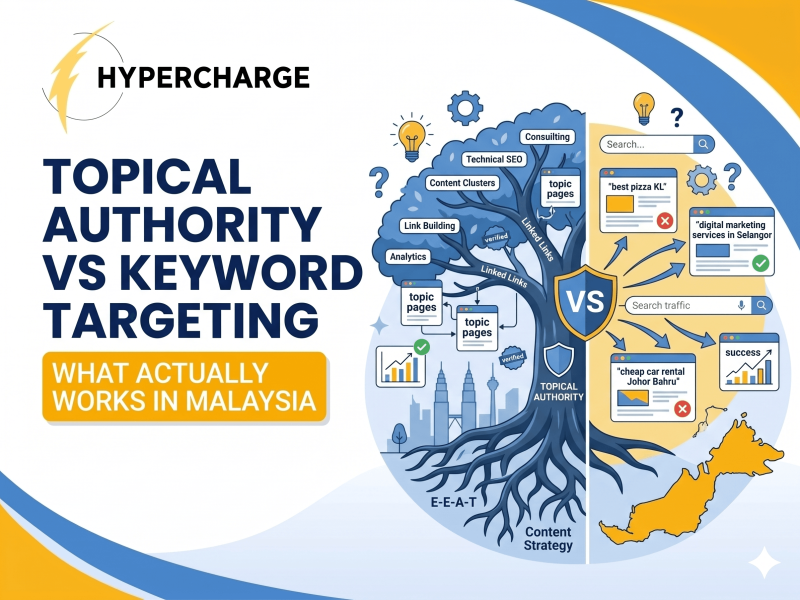
Keyword targeting helps individual pages rank for specific searches, but it limits long-term growth. Topical authority builds sustained visibility by covering an entire subject deeply. In Malaysia, where competition is lower and search behaviour is more varied, topical authority provides a stronger advantage. The most effective approach is using keywords to guide individual pages while building authority through structured content clusters.
Understanding Keyword Targeting in Modern SEO
Keyword targeting is the process of aligning a page with a specific search query. It remains essential because it connects your content directly to what users are actively searching for.
In practice, this means identifying keywords such as “dentist KL”, “Malaysia SEO services”, or “aircond service Shah Alam” and creating pages that match the intent behind those searches. However, modern keyword targeting is no longer about repeating exact phrases. Google now evaluates whether the page satisfies the user’s intent rather than simply matching words.
For example, someone searching “dentist KL” is likely ready to book a clinic, while “braces price Malaysia” reflects a research phase. These differences require completely different content structures, even though they belong to the same industry.
Many Malaysian businesses still create multiple pages targeting slight keyword variations. This often results in overlapping content that competes internally instead of strengthening overall visibility. As a result, rankings may stagnate despite having multiple optimised pages.
The Built-In Limitations of Keyword-First SEO
Keyword targeting works well for gaining initial visibility, but it has structural limitations. Each page is built around a single opportunity, which restricts how much organic reach can expand.
A page targeting “aircond service KL” may rank for that term and a few variations, but it is unlikely to rank for related queries such as “why aircond leaking water” or “aircond servicing frequency”. These represent different intents that require separate content.
This creates a ceiling for keyword-only strategies. Even when executed well, growth slows because the website lacks broader context. Google sees individual pages, but not a connected body of expertise.
What Topical Authority Really Means
Topical authority shifts SEO from individual keywords to complete subject coverage. Instead of publishing isolated pages, the website builds a network of related content that collectively demonstrates expertise.
For example, a business focusing on SEO should not rely only on a service page. It should also cover related topics such as keyword research, technical SEO, local ranking factors, and AI search behaviour. A central resource like the SEO guide for Malaysia acts as a hub, supported by detailed subtopics.
When these pages are internally linked, they form a structured ecosystem. This allows Google to understand not just what each page is about, but how the entire site contributes to a broader subject.
How Google Interprets Topical Depth
Google evaluates patterns across a website to determine authority. It looks for signals such as:
Coverage of related subtopics
Logical internal linking between pages
Content that answers follow-up questions
User engagement across multiple pages
When a site consistently covers a topic from multiple angles, Google begins to classify it as a reliable source. This is fundamentally different from ranking a single page based on keyword relevance.
For example, a website that covers SEO through articles like keyword research in a Malaysian context and technical SEO for WordPress reinforces its authority across the subject. Each page strengthens the others.
Why This Matters More in Malaysia
The Malaysian SEO landscape amplifies the importance of topical authority.
First, competition is still relatively underdeveloped. Many businesses rely heavily on service pages without building supporting content. This creates an opportunity for structured websites to outperform competitors without relying heavily on backlinks.
Second, search behaviour is highly varied. Users mix English and Bahasa Malaysia, use conversational queries, and include location-based modifiers inconsistently. A keyword-only strategy captures limited variations, while a topic-based approach captures broader intent patterns.
Third, local intent dominates. Searches often lead to Google Maps results, but organic rankings still influence visibility and trust. Websites with stronger topical authority tend to perform better across both.
How Topical Authority Supports Local SEO
Topical authority does not replace local SEO efforts such as Google Business Profile optimisation or citation building. Instead, it strengthens them.
A business investing in local SEO in Malaysia or Google Business Profile optimisation benefits from supporting content that addresses customer questions, pricing concerns, and service comparisons.
This creates a more complete relevance profile. Users are able to move from informational queries to service decisions, while search engines gain stronger signals about the business’s expertise.
Why AI Search Increases the Value of Topical Authority
AI-driven search is changing how visibility is earned. Instead of returning a list of links, search engines increasingly generate answers by referencing trusted sources.
Keyword-focused pages are limited because they address single queries with minimal context. In contrast, websites with strong topical authority provide multiple layers of related information, making them more reliable sources for AI-generated answers.
This is particularly relevant for businesses exploring AI search optimisation, where success depends on being recognised as a credible entity rather than just ranking individual pages.
How Keywords and Topics Work Together
Keyword targeting and topical authority are not opposing strategies. They operate at different levels.
Keywords provide direction. They identify what users are searching for and shape individual pages.
Topics provide scalability. They determine how much visibility a website can accumulate and how resilient it is to algorithm changes.
Without keywords, content lacks focus. Without topical authority, growth remains limited. The most effective strategy integrates both.
How Malaysian Businesses Should Build Topical Authority
The process begins with defining a core topic aligned with the business’s services. From there, the site expands into related subtopics based on real search behaviour.
Each piece of content should address a specific intent, whether it is informational, commercial, or comparative. These pages should then be connected through internal linking, forming a structured network.
Internal linking is critical because it signals relationships between pages. It helps search engines understand how content is organised and allows users to navigate deeper into the topic.
Over time, as more content is added, authority grows cumulatively. Each new page contributes to the overall strength of the topic rather than functioning independently.
Common Mistakes Malaysian Businesses Make
Many businesses create multiple pages targeting similar keywords, leading to content cannibalisation. Others neglect internal linking, resulting in disconnected content that fails to build authority.
Another common issue is over-reliance on the homepage for rankings. This limits the ability to create specialised pages that address specific intents.
Shallow content is also a major limitation. Without depth, pages fail to demonstrate expertise, regardless of how well they are optimised for keywords.
Final Verdict: What Works Best in Malaysia
Keyword targeting remains essential because every page needs a clear focus and intent alignment. However, on its own, it is a limited approach.
Topical authority enables a website to scale visibility, strengthen credibility, and remain competitive as search evolves. In Malaysia, where content depth is still developing across many industries, this presents a significant opportunity.
The most effective strategy is not choosing between keywords and topics, but using keywords to build pages and topics to build authority.
Frequently Asked Questions
Keyword targeting focuses on ranking individual pages for specific search terms, while topical authority focuses on building expertise across an entire subject through interconnected content.
Yes, especially for service pages and early-stage SEO. However, it should be combined with broader content strategies for long-term growth.
Many Malaysian websites still rely on limited content. Businesses that build structured, in-depth content gain a competitive advantage more easily than in more mature markets.
AI systems prioritise sources that demonstrate depth and reliability. Websites with strong topical coverage are more likely to be referenced in AI-generated answers.
Both are necessary. Keywords guide individual pages, while topical authority builds long-term visibility and trust.