
Every few years, someone declares SEO dead. In 2011, it was Google’s Panda update. In 2019, it was zero-click searches. In 2023, it was ChatGPT. In 2026, the concern is more specific — and more legitimate — than it has ever been: Google’s AI Overviews are answering questions directly on the search results page, Perplexity is replacing search for a growing slice of the population, and voice assistants are getting good enough to be genuinely useful for local queries.
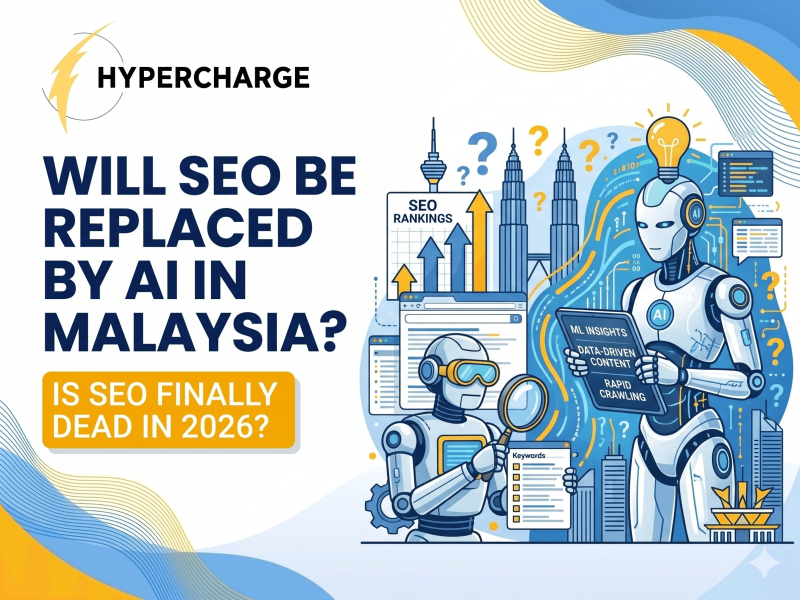
So here is the honest answer to the question Malaysian business owners are actually asking before they commit to an SEO investment: no, SEO is not being replaced by AI. But what it means to do SEO well in 2026 is fundamentally different from what it meant in 2022. And the businesses that understand this difference are going to accumulate a significant advantage over those that do not.
SEO is not being replaced by AI in 2026 — it is being extended by it. Traditional Google search rankings remain the dominant source of organic leads for Malaysian businesses. But AI-generated search results (Google AI Overviews, Perplexity, ChatGPT Browse) are a new and growing visibility surface that sits on top of traditional rankings. Businesses that optimise for both will outperform those that focus on only one.
What Has Actually Changed in Malaysian Search in 2026
The shift is real — it is just not the one most people are describing.
Google has not replaced search results with AI. What it has done is add an AI-generated answer above the traditional results for a growing proportion of queries — particularly informational questions, comparison searches, and “best of” style queries. That answer block is called an AI Overview, and it pulls from existing web content to generate a summary, with citations to the sources it draws from.
For Malaysian businesses, this creates two distinct visibility opportunities where previously there was one. The first is the traditional organic ranking — your website appearing in the blue links below the AI answer. The second is being cited in the AI answer itself. Businesses that appear in both positions dominate the search results page for their target queries. Businesses that appear in neither are invisible.
What has also changed: Perplexity, ChatGPT Browse, and voice assistants like Google Assistant and Siri are now answering a meaningful share of searches — particularly from younger, more tech-literate users — without those searches ever reaching Google’s results page. For Malaysian professionals aged 25 to 40 in KL, Penang, and Johor, this is not a future behaviour. It is a current one.
Why “SEO Is Dead” Is the Wrong Conclusion
The businesses killing their SEO budgets in response to AI are making a category error. They are confusing a channel evolving with a channel disappearing.
Google processes approximately 8.5 billion searches per day globally. Malaysian consumers still turn to Google first for the searches that matter most to local service businesses — “dentist near me”, “renovation contractor Subang Jaya”, “conveyancing lawyer Georgetown”. Those searches still resolve to a results page with traditional rankings. Google Maps searches, which drive the majority of calls and walk-in enquiries for Malaysian SMEs in healthcare, home services, and professional services, are not being replaced by AI Overviews. They are a separate system with separate ranking factors.
The data bears this out. According to research on search behaviour post-AI Overview rollout, the impact on click-through rates varies significantly by query type. Informational queries — “what is SEO” or “how does a conveyancing process work” — see reduced clicks because the AI answer satisfies the question without a click. Commercial queries — “best aesthetic clinic KL” or “seo agency malaysia” — see minimal impact because the user intent is to find and contact a business, not to read a summary.
For most Malaysian SMEs, the queries that drive revenue are commercial and local. That is precisely the segment where traditional SEO continues to matter most.
What GEO and AEO Mean — and Why They Matter Now
Two terms are entering the Malaysian digital marketing conversation that every business owner investing in organic visibility should understand.
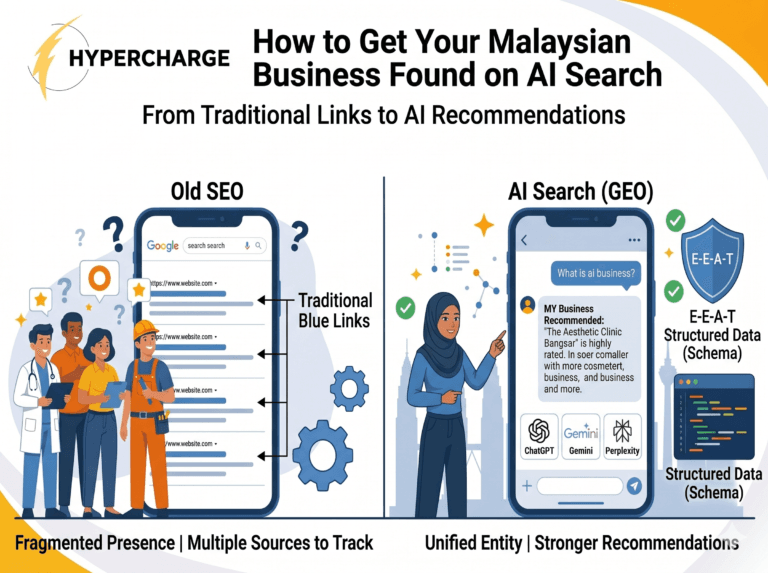
GEO — Generative Engine Optimisation is the practice of optimising your brand and content to be cited and recommended by AI-generated search responses. When someone asks Perplexity “which SEO agency in Malaysia has the best results for healthcare businesses?”, GEO determines whether Hypercharge appears in that answer — or whether a competitor does. The ranking factors for GEO are different from traditional Google rankings: they weight entity authority, topical depth, citation frequency across the web, and the quality of structured data on your site.
AEO — Answer Engine Optimisation is the practice of structuring your content to appear in featured snippets, People Also Ask boxes, and voice search responses — the “zero-click” positions that appear before users even reach the traditional search results. For Malaysian businesses, AEO is most relevant for FAQ-style content: “how much does a dental implant cost in KL?”, “what documents do I need for a conveyancing transfer in Malaysia?”, “how long does it take to rank on Google in Malaysia?”. A business whose website directly and clearly answers these questions — in the right format, with the right schema markup — can capture significant visibility without the user needing to click through.
The businesses best positioned for both GEO and AEO are the ones that have already built strong traditional SEO foundations — because topical authority, content depth, and domain trust feed all three systems simultaneously. GEO and AEO are additions to a working SEO strategy, not replacements for one.
Hypercharge’s AI search optimisation service covers the full GEO and AEO workflow — from entity signal building to structured content formatting and schema implementation.
The Malaysian Context: What This Means for SMEs Here
Malaysia’s search market has characteristics that make the AI transition both slower and more nuanced than what is happening in the US or UK.
Bahasa Malaysia and Mandarin searches — which constitute a significant proportion of total Malaysian search volume — are less affected by AI Overviews at present. Google’s AI answer quality in Malay and Mandarin lags its English performance, which means the traditional blue-link results remain the dominant format for a large slice of Malaysian searches. For businesses serving non-English-dominant markets — home services in Selangor, F&B in Georgetown, retail in Johor Bahru — the urgency of GEO optimisation is lower than for businesses serving English-dominant professional markets in central KL.
Local searches — anything with a suburb name, “near me”, or Google Maps intent — are almost entirely unaffected by AI Overviews at the query level. Google Maps results are a separate display format with separate ranking signals. For the majority of Malaysian service businesses, where “dentist SS2” or “plumber kota damansara” drives more business than “what is the best dental procedure for sensitivity”, the Maps pack and local organic results remain the primary battleground.
Where Malaysian businesses are starting to see meaningful AI search impact is in the research phase of the buying journey — the stage before a customer has decided which business to contact. Someone researching “is laser hair removal safe” or “what should I look for in a conveyancing lawyer” may now get that answer from an AI response rather than clicking through to a clinic or law firm’s blog. The implication: the businesses that appear in those AI responses — by being cited as sources — are building brand familiarity before the purchase decision is made.
What the Smartest Malaysian Businesses Are Doing Right Now
The businesses that will dominate Malaysian search over the next three to five years are not choosing between traditional SEO and AI optimisation. They are building both, on the same content foundation.
They are making sure their traditional SEO foundations are solid first. Technical health, strong internal linking, suburb-specific location pages, and optimised Google Business Profiles are the infrastructure that feeds everything else. An AI Overview cites credible, well-structured web pages — the same pages that rank well in traditional search. Weak traditional SEO means weak AI visibility.
They are structuring content for direct answers. Blog posts and FAQ sections written with clear, concise answers to specific questions — in a format Google can extract as featured snippets — are the same content that gets cited in AI Overviews and read by voice assistants. One piece of content, built correctly, serves all three surfaces simultaneously.
They are building topical authority, not just targeting individual keywords. An AI system that is asked “which renovation contractor in KL is most trustworthy?” is more likely to cite a business that has extensive, consistent coverage of renovation-related topics across its website than one that has a single well-optimised service page. Topical depth is an AI ranking signal as much as it is a traditional SEO ranking signal.
They are treating their Google Business Profile as a content channel. Regular Google Posts, fully populated service lists, Q&A sections with seeded answers, and consistent review responses all contribute to the local entity signals that AI systems use to identify and cite local businesses.
What This Means If You Are Evaluating SEO Right Now
If you are a Malaysian business owner who has been holding off on SEO investment because of uncertainty about AI — the uncertainty is understandable but the delay is costly.
The businesses that invested in SEO in 2023 and 2024 are now sitting on the topical authority and domain trust that makes GEO and AEO optimisation faster and more effective. Starting from scratch in 2026 means competing against those businesses for the same AI citation slots — with less authority built up to draw on.
The decision is not “SEO or AI optimisation.” A proper SEO engagement in Malaysia in 2026 should include both traditional search optimisation and the structured content, schema markup, and entity-building work that drives AI visibility. They are the same investment, not two different ones.
What has changed is the agency you choose to work with. An agency that is still running 2020-era keyword strategies — content volume, basic on-page optimisation, generic link building — without accounting for AI search surfaces is not equipped to build the compounding visibility advantage that is available right now. The agencies that understand GEO, AEO, and how entity authority signals work across traditional and AI search are building a meaningfully different product.
The Bottom Line for Malaysian Businesses
SEO is not being replaced by AI. It is being expanded by it — into new surfaces, with new ranking signals, serving users at different stages of the search journey simultaneously.
For Malaysian service businesses — clinics, law firms, contractors, professional services — the core of what drives enquiries from Google has not changed: local search visibility, Google Maps rankings, and website content that matches what your customers are searching for. That foundation remains as valuable as it has ever been.
What has changed is the ceiling. Businesses that build that foundation correctly, and extend it into AI search visibility, now have access to a share of voice in search results that was not available three years ago — including AI Overview citations, People Also Ask boxes, and voice search responses that appear before any traditional result.
The businesses that understand this are investing accordingly. The ones waiting for clarity are watching their competitors occupy the positions that are increasingly hard to displace.
For a full breakdown of what this looks like in practice for KL and Klang Valley businesses, see how we approach SEO for Kuala Lumpur businesses.
FAQs
No — SEO is evolving alongside AI, not being replaced by it. Google Search remains the dominant platform for local and commercial queries in Malaysia, including the suburb-level and service-specific searches that drive enquiries for clinics, law firms, home service businesses, and professional services. AI Overviews add a new visibility layer on top of traditional rankings — the businesses that appear in both positions are better positioned, not the ones that abandoned SEO in favour of waiting for AI to settle.
No. Local SEO — the process of appearing in Google Maps and location-based searches — is largely unaffected by AI Overviews at present. Google Maps results operate as a separate display system with separate ranking signals. For Malaysian service businesses where “dentist near me” or “renovation contractor Subang Jaya” drives the majority of enquiries, local search visibility, Google Maps rankings remains the highest-return digital marketing investment available.
GEO (Generative Engine Optimisation) is the practice of optimising your brand and content to be cited by AI-generated search responses — from Google AI Overviews, Perplexity, ChatGPT Browse, and voice assistants. Traditional SEO targets rankings in Google’s blue-link results. GEO targets the AI-generated answers that appear above those results. The two share many of the same foundations — content quality, topical authority, structured data — but GEO specifically requires entity-level brand signals and direct-answer content formatting.
AEO (Answer Engine Optimisation) focuses on capturing featured snippets, People Also Ask boxes, and voice search responses — the positions that appear before users reach traditional search results. For Malaysian businesses, AEO is most valuable if your customers research before buying — healthcare, legal, home services, and professional services are all categories where prospective clients search for answers to specific questions before contacting a business. Appearing in those answers builds familiarity and trust before the first call.
Both — and they are not separate investments. A properly structured SEO engagement in 2026 should include traditional search optimisation and the schema markup, direct-answer content, and entity-building work that drives AI visibility simultaneously. The businesses best positioned for AI search are the ones with strong traditional SEO foundations — because topical authority, content depth, and domain trust feed all three systems: traditional rankings, AI Overviews, and voice search.