
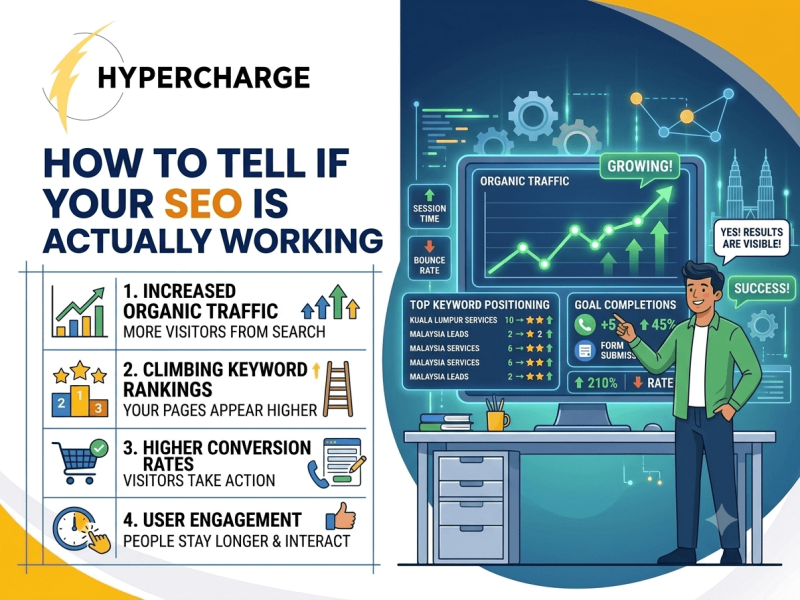
TLDR: The clearest signs that SEO is working are: organic clicks and impressions trending upward in Google Search Console, non-branded keywords improving in position over consecutive months, new pages being indexed and appearing in search results, and — ultimately — enquiries or leads that can be attributed to organic search. Rankings alone are not enough. Traffic and leads are what confirm the work is translating into business outcomes.
Three months into an SEO engagement, a clinic owner in Puchong opened her monthly report. Domain Authority: up from 12 to 17. Impressions: 14,000 for the month. Five keywords now ranking on page two. The agency called it “strong progress.”
She called us to ask why her phone still wasn’t ringing from organic search.
The report wasn’t fabricated. The numbers were real. But they were the wrong numbers — metrics that move early and look like progress while the signals that actually matter (organic clicks, non-branded keyword positions, and leads from search) remained flat.
This is the most common source of confusion Malaysian business owners experience in SEO engagements: not that the agency is lying, but that the numbers being reported don’t correspond to the outcomes the business was promised. Learning to read the right signals — and to ask for them explicitly — is how you evaluate whether your SEO investment is genuinely working.
📌 Key Takeaways
- The most reliable SEO progress signal is organic clicks trending upward in Google Search Console — not domain authority, not impressions alone
- Non-branded keyword position movement is the clearest evidence that SEO is working for new customer acquisition — if only branded terms are ranking, new customers aren’t finding you
- Good SEO progress follows a predictable sequence: technical foundation (month 1–2), early impressions (month 3–4), ranking movement (month 5–6), consistent leads (month 7–12)
- A flat impressions chart at month 4 is a warning sign — it suggests either new content isn’t being indexed or keyword targeting is off
- Domain Authority, total impressions alone, and branded keyword rankings are the vanity metrics most likely to appear in reports that obscure a lack of real progress
- If your report doesn’t show Search Console clicks, non-branded keyword movement, and index coverage data — ask for them
The Core Problem: Most SEO Reports Show the Wrong Numbers
A well-designed SEO report can make any engagement look productive. Domain Authority is going up — that sounds like authority is building. Impressions are in the tens of thousands — that sounds like lots of people are seeing your site. Keywords on page two — that sounds like you’re almost there.
None of these numbers are lies. But on their own, none of them confirm that SEO is generating business value.
Domain Authority is a third-party score that doesn’t directly map to Google rankings. Impressions mean your page appeared in a search result — not that anyone clicked. A page-two keyword position means nothing if the keyword nobody searches for. The numbers that confirm SEO is working are specific, directional, and tied to the path that leads a stranger to becoming your customer.
The question is not “are these numbers moving?” The question is “are the right numbers moving?”
The Metrics That Actually Tell You SEO Is Working
Metric 1 — Organic Clicks (The Most Direct Signal)
An organic click is a real person choosing your result from Google’s search results page and visiting your website. It is the most direct evidence that your SEO is producing visible, attractive search presence.
Organic clicks are available in Google Search Console’s Performance report. The number you want to see is total organic clicks trending upward month over month — not a single month’s spike, but a consistent directional increase over three or more months.
The benchmark to track against: where were your organic clicks three months ago versus today? If you had 80 organic clicks in month one and 85 in month four, that’s negligible movement. If you had 80 in month one and 320 in month four, that is genuine progress — a fourfold increase over three months of active SEO work.
Clicks without context are incomplete. A single large keyword appearing in your report could account for almost all clicks while dozens of target keywords contribute nothing. Always look at the query breakdown alongside total click numbers.
Metric 2 — Organic Impressions
Impressions tell you how many times your pages appeared in Google search results, regardless of whether anyone clicked. An impression is not a visitor. But impressions are a leading indicator — they typically rise before clicks do, because pages appear in search results before they’ve accumulated enough click-through history to rank prominently.
According to Google’s explanation of how impressions, clicks, and position work in Search Console, impressions count each time a URL appears in search results — including results a user didn’t scroll to see.
Impressions matter in context: if impressions are rising but clicks are not, it means your pages are appearing but not attracting enough clicks. That’s either a ranking position problem (you’re appearing at position 12 where click rates are very low) or a meta title and description problem (your listing isn’t compelling enough to click). Either is diagnostic information that should prompt action.
If impressions are flat or declining after three months of SEO work, that’s a more serious signal — it suggests new content isn’t being indexed or keyword targeting isn’t aligned with actual search demand.
Metric 3 — Non-Branded Keyword Position Movement
This is the metric that most clearly separates genuine new customer acquisition from the appearance of it.
Branded keywords are searches that include your business name — “Hypercharge Digital review,” “Klinik Bangsar appointment,” “Ah Seng Plumbing contact.” These searches come from people who already know you exist. Ranking for them confirms your website is indexed; it does not confirm SEO is reaching new customers.
Non-branded keywords are searches that don’t include your name — “SEO agency KL,” “aesthetic clinic Bangsar,” “plumber Shah Alam.” These are potential customers who don’t yet know your business exists. Ranking for these is what SEO is for.
Ask your agency to show you a keyword position tracking report filtered to non-branded terms. The questions to ask: which non-branded terms have moved from positions 20+ to positions 11–20 (the movement that signals progress)? Which have moved from 11–20 to 1–10? Which have reached the top 5?
Progress in non-branded keyword positions is the most direct evidence that SEO is building your visibility with people who have never heard of you.
Metric 4 — Index Coverage
Understanding how Google discovers and indexes your website is the foundation for understanding why Index Coverage matters as a progress metric.
The Index Coverage report in Google Search Console shows you how many of your pages Google has indexed (added to its searchable database) and how many it has excluded — and why. Pages that aren’t indexed cannot rank for anything.
What you want to see: the number of indexed pages growing as new content is published, and the number of excluded or errored pages decreasing as technical issues are fixed. If you’ve published 12 new blog articles over three months but only 6 are indexed, that’s a conversation to have with your agency. Half your content investment isn’t yet eligible to rank.
Metric 5 — Organic Leads and Enquiries
This is the metric that matters most to your business — and the hardest to measure precisely, because attributing a lead to organic search requires either tracking setup or direct questioning.
Basic attribution: when a new enquiry arrives by WhatsApp or phone, ask where they found you. If they say “Google search” or “I Googled [service name],” that’s an organic lead. Track this in a simple spreadsheet: date, channel (organic search, Google Maps, referral, social, paid ad, other), enquiry type.
More precise attribution: use Google Analytics 4 to set up conversion events for form submissions, WhatsApp link clicks, and phone number clicks — then filter by organic search as the traffic source. This shows you exactly how many website actions came from organic visitors.
Over time, the number of organic leads should trend upward as rankings improve. By month 9 to 12 of a well-executed SEO engagement, organic should contribute a measurable and growing share of total monthly leads — not all of them, but enough to notice and calculate cost per acquisition.
How to Read Google Search Console in 10 Minutes
Google Search Console is free, and every Malaysian business website should have it configured. If your agency hasn’t set it up or hasn’t given you access, that is itself a warning sign — these are your accounts and your data.
The Performance Report
Navigate to Search Console → Search Results (under Performance). Set the date range to the last three months. This shows you total clicks, total impressions, average click-through rate, and average position for all the queries your site appeared for during that period.
Click on the “Queries” tab to see which specific search terms are generating impressions and clicks. Sort by clicks to see your highest-performing queries. Sort by impressions to see the full range of queries you’re appearing for. Look for your most important non-branded target keywords — are they in this list? What position are they at?
Compare this to the previous three months by adding a comparison period. A side-by-side view of before and after shows you whether clicks and impressions are genuinely growing or holding flat.
The Index Coverage Report
Navigate to Search Console → Indexing → Pages. This shows the total count of indexed pages and the breakdown of pages excluded from the index with reasons.
If you’ve published 20 pages and Search Console shows 12 indexed, click into the excluded pages to understand why. Common exclusions: “Submitted URL has crawl issue” (a technical problem), “Duplicate without user-selected canonical” (content overlap), “Crawled — currently not indexed” (Google visited but didn’t find the content worth indexing). Each one points to a specific fix.
The URL Inspection Tool
Type any specific URL into the search bar at the top of Search Console. This gives you the exact indexing status of that page — is it indexed, when was it last crawled, are there any issues. Use this to check your most important pages: homepage, service pages, and recently published blog articles.
What Good SEO Progress Looks Like Month by Month
The clearest source of misaligned expectations in Malaysian SEO engagements is not deception — it’s a mismatch between what clients expect to see and when. SEO in Malaysia follows a predictable progression that looks different at each stage.
Months 1–2: Foundation Stage
What’s happening: technical audit completed and fixes implemented, keyword research delivered and agreed, Google Business Profile optimised, initial content published, Search Console configured.
What you should see in the data: search console impressions may be flat or very slightly increasing. Indexed pages growing as new content goes live. No significant ranking movement yet — this is normal and expected. The work in this phase sets the foundation for everything that follows.
Red flag at this stage: No audit delivered, no keyword research shown to you, no access to Search Console. If two months in you haven’t received these foundational deliverables, the engagement is behind.
Months 3–4: Early Signals
What’s happening: content published in months 1–2 beginning to be evaluated by Google. Some target keywords starting to appear in Search Console impressions, typically at positions 15 to 40.
What you should see in the data: impressions growing noticeably — often doubling or tripling from the month-1 baseline. Clicks beginning to appear for some queries, even if small in number. A handful of non-branded target keywords appearing in position tracking reports, even if not yet on page one.
Red flag at this stage: Impressions completely flat at month 4, no new keywords appearing in Search Console at all. This suggests either new content isn’t being indexed or it’s targeting queries with no search volume.
Months 5–6: Ranking Movement
What’s happening: keywords that entered the index at positions 20–40 in months 3–4 beginning to move upward as content accumulates authority. Some moving into positions 8–15 — the zone where click-through rates start to matter.
What you should see in the data: clear upward trend in organic clicks. Non-branded keywords showing consistent position improvement over consecutive months. GBP visibility metrics (views, direction requests, calls) improving if local SEO is part of the engagement. First attributable organic leads appearing.
Red flag at this stage: Keyword positions fluctuating randomly rather than trending upward. Large spikes followed by drops. This may indicate technical issues like keyword cannibalization or inconsistent content quality.
Months 7–12: Compounding Growth
What’s happening: according to how Google measures organic search quality over time, pages that have accumulated months of indexing history, click-through data, and relevance signals rank more stably and prominently. Content published in month one is now more authoritative than it was at launch.
What you should see in the data: multiple non-branded keywords on page one for target terms. Organic clicks delivering a consistent, growing volume of website visitors. Organic leads contributing a measurable share of monthly enquiries. Month-on-month improvement visible in Search Console comparisons.
Warning Signs That Your SEO Is Not Working
These signals, if present at the appropriate stage of an engagement, warrant a direct conversation with your agency.
Impressions flat at month 4 or beyond. New content should be generating impressions within 6 to 10 weeks of publication. If it isn’t, either the content isn’t being indexed (technical problem) or it’s targeting keywords with no search volume (strategy problem).
Only branded keywords showing in Search Console. If every query driving clicks includes your business name, SEO isn’t reaching new customers. The whole purpose of SEO is to appear for searches from people who don’t yet know you exist.
Rankings improving for keywords nobody searches. Some agencies optimise for low-competition keywords with negligible search volume because they’re easy to rank for. Your position tracking report should include the search volume of each tracked keyword — if the keywords you’re ranking for have fewer than 50 monthly searches, the rankings aren’t generating meaningful traffic regardless of position.
No index growth despite regular content publication. If your agency is publishing articles but your indexed page count in Search Console isn’t growing, something is blocking indexing — a technical issue that needs immediate investigation.
Technical issues left unfixed for multiple months. Core Web Vitals failures, slow page load times, and mobile usability problems act as a ceiling on ranking progress. If technical issues were identified in the audit and are still present three months later, the foundation work isn’t complete.
The Vanity Metrics That Sound Good but Mean Little
Domain Authority (DA) increase. DA is a third-party Moz metric that doesn’t directly influence Google rankings. An increase from 12 to 20 may reflect some new links being built — but it doesn’t confirm those links are producing ranking improvements for your target keywords.
Total impressions without click context. 50,000 impressions sounds impressive. If 48,000 of those impressions are at positions 15 to 50 where click rates are below 1%, you’re getting roughly 480 clicks from 50,000 impressions. Total impressions without position and click-through context is a number without meaning.
Branded keyword rankings. Ranking number one for your own business name confirms your website is indexed. It does not confirm your SEO is working for new customer acquisition.
Number of keywords ranking. “You now rank for 340 keywords!” means nothing without context on which keywords, at what positions, with what search volume. 340 keywords averaging position 28 with 20 monthly searches each is not meaningful progress.
Social media metrics in an SEO report. Followers, likes, and post reach belong in a social media report. Their presence in an SEO report is either confusion about what SEO is or an attempt to pad the report with movement that the agency can actually control.
How to Have a Direct Conversation With Your Agency
If your reports are full of the metrics above while the signals that matter remain flat, this is the conversation to have — directly and without antagonism.
Start with a specific question rather than a general complaint: “Can you show me our organic click trend in Search Console over the last four months, filtered to non-branded queries?” If the trend is flat, ask what the agency attributes it to and what they’re doing to address it.
Request a keyword position tracking report filtered to your top 10 target non-branded keywords. Ask what positions they’re at, where they were two months ago, and what the projected timeline to page one is for each.
Ask to see the Index Coverage report and discuss any pages excluded from indexing. How many are excluded? Why? What’s being done to fix it?
If the conversation is productive and the agency provides clear answers with a credible plan, that’s an agency worth continuing with. If the answers are vague, deflecting, or focused on defending the metrics they’ve been reporting rather than engaging with the metrics you’re asking about, that tells you what you need to know about the relationship.
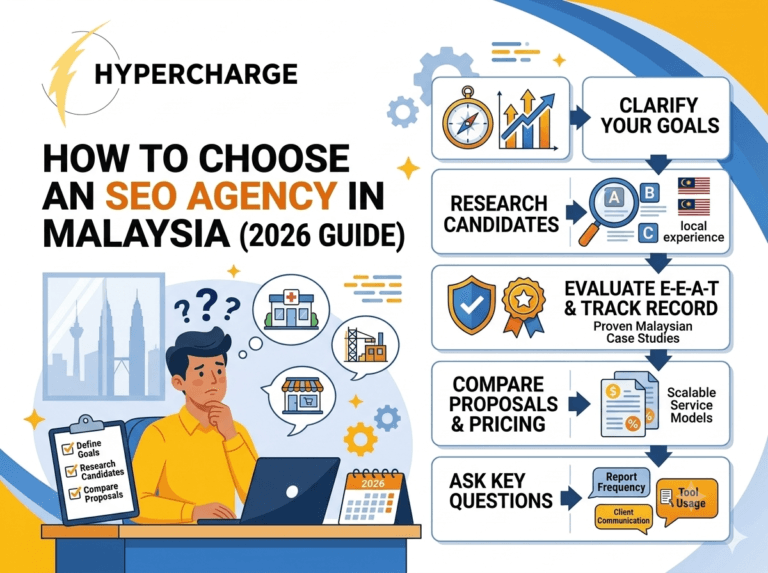
Understanding what to look for when choosing or re-evaluating an SEO agency is the context that makes this conversation easier — you’re not just expressing frustration, you’re applying a specific framework.
If after this conversation you want an independent assessment of whether your current SEO engagement is on track, Hypercharge’s SEO audit reviews your Search Console data, current rankings, and technical health to give you an objective second opinion.
Frequently Asked Questions
Month 1 and 2 are foundation months — no meaningful ranking data is expected yet. By month 4, you should see clear impressions growth and the beginning of keyword movement, even if clicks are still modest. By month 6, organic clicks should be clearly trending upward and some non-branded keywords should be on page two or better. If none of this has happened by month 6, the engagement deserves a structured review.
Partially. SEO does take time — 6 to 12 months for consistent results is realistic for most Malaysian SMEs. But “take time” describes the journey from good execution to strong results, not an excuse for no visible progress at all. By month 4, you should see clear signals in Search Console — growing impressions, keyword movement, index growth — even if page-one rankings and lead attribution are still developing. Patience is warranted for results. It is not warranted for evidence that work is being done.
It depends entirely on your industry, target keyword search volumes, and how many pages are ranking. A local dental clinic targeting neighbourhood-level keywords might reach 200 to 400 organic clicks per month within 9 months and consider that strong progress if those clicks are converting. A national-targeting business might reach 2,000+ clicks in the same period. Don’t benchmark against arbitrary numbers — benchmark against your own trend and against the search volumes of your specific target keywords.
Some fluctuation is normal — Google updates its rankings constantly as it processes new content, new backlinks, and shifting user behaviour. What you’re looking for is a trend direction over months, not stability week to week. Rankings that fluctuate within a band (e.g., between position 6 and 12) while gradually trending toward the lower number over three months are healthy. Rankings that spike suddenly to position 2 then crash to position 25 suggest either a manipulative tactic that briefly worked or a technical issue causing instability.
It depends on the positions generating those impressions. A page at position 15 getting 500 impressions might generate 5 to 10 clicks — a 1 to 2% click rate that is normal for that position. The same page at position 3 should generate 80 to 120 clicks from 500 impressions — a 16 to 24% click rate. High impressions with very low clicks usually means your pages are appearing but not ranking high enough to attract clicks. The fix is improving ranking positions, not increasing impressions — and that’s the conversation to have with your agency when reviewing this data.
Read This Next
You can now evaluate whether your SEO is working. The next most common question from Malaysian business owners at this stage: is SEO even worth it for a small business in the first place — or is there a faster, more reliable path to customers?
👉 Is SEO Effective for Small Businesses in Malaysia? An Honest Answer The genuine case for and against SEO at different stages of business growth — with real Malaysian examples of when it worked, when it didn’t, and what made the difference.